 Seller OS
Fiverr proofreading SEO for editors and proofreaders
Proofreading buyers arrive confused about what they are buying. A student asks for proofreading and describes a line edit, an author asks for copy editing and means formatting, and both expect the deep version at the shallow price. The words they type are the words your title has to answer, so the first task in this category is naming the edit level precisely.
This guide maps the ladder buyers mix up, shows the deliverables and sample-edit proof this category responds to, and builds a per-word package structure with a stated counting rule. Every phrase in the table is an example to check against live search, never platform data.
Free plan available. Local-first data. Human review on every change.
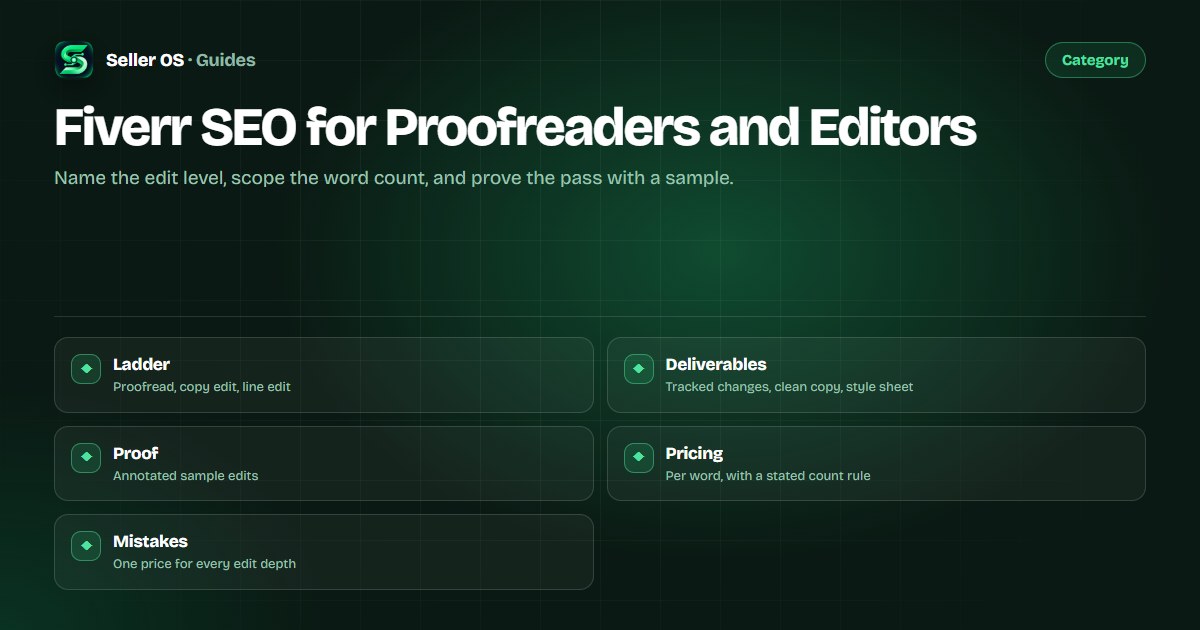
The proofreading, copy editing, line editing ladder
Proofreading, copy editing, and line editing are three different services, and buyers routinely order one while describing another. Proofreading catches errors in a text that is otherwise finished. Copy editing fixes grammar, usage, and consistency against a style guide. Line editing reworks sentences for clarity and rhythm, which is closer to rewriting than checking.
Mix the levels and the buyer judges the delivery against the level they expected, while one flat price cannot cover the deepest one. Fiverr's public Proofreading and Editing category page, checked October 1, 2026, separates the work into six subcategories: Proofreading, Formatting, Copy Editing, Review and Rewrite, AI Content Editing, and Citation.
| Level | What changes | How buyers ask for it |
|---|---|---|
| Proofreading | Spelling, grammar, and punctuation in a finished text | Proofread my thesis before submission |
| Copy editing | Usage, consistency, and style-guide rules | Copyedit my manuscript for publication |
| Line editing | Sentence flow, structure, and phrasing | Edit my writing line by line |
| Formatting | Headings, spacing, and citation layout | Format my book for print and ebook |
Keyword examples to validate locally
Start from phrases that describe work you have finished at least once, then test each one on Fiverr: type it into search, read the autocomplete suggestions, open the gigs that rank for it, and note what they promise. You are reading how buyers in this category phrase the job, not guessing at demand.
The set below fits one editor who works on academic papers and book manuscripts. Validate each row from your own account before you build the listing around it. Fiverr's Advanced Analytics article explains the reading order: title text first, then the positive keywords field, then the description, and it asks sellers to give new or updated keywords at least 30 days before reviewing their impact.
| Slot | Example phrase | Why a buyer types it |
|---|---|---|
| Primary | fiverr proofreading | The category phrase in a buyer's own words |
| Secondary | copy editing fiverr | Edit level named before the platform |
| Secondary | editing services fiverr | Shopper comparing services, not people |
| Long-tail | thesis proofreading and editing | Document type with a submission date |
| Long-tail | book proofreading and formatting | Author preparing a print release |
Title, tags, and description mechanics
Fiverr's gig creation article says the title arrives with I will already in place, asks sellers to keep it short, clear, and to the point, and to avoid special characters such as ampersands, slashes, quotation marks, and plus signs. Editing the title later does not change the gig URL, and the category cannot be changed after publication.
The keyword field takes up to five words or short phrases, the tag field takes five, and Fiverr's guidance is to use all five tags. The description runs up to 1,200 characters, with up to ten FAQ entries below it. Put the edit level and the document type in the title, close variants in the tags, and your process and limits in the description.
- Title — edit level first, then the document or audience
- Five tags — close variants of the title phrase, none repeated
- Description — process, limits, and turnaround within 1,200 characters
- FAQ — how you count words, what you do not fix, revision terms
Deliverables and the proof buyers check
Buyers cannot judge your eye from a gig card, so they judge what arrives. Name three deliverables in the description: a tracked-changes file with every edit visible, a clean copy with the changes accepted, and a style sheet recording the choices you made, such as spellings kept, serial commas, and capitalization of recurring terms. State whether the edit runs as one pass or two.
Sample edits are the strongest proof this category allows. Offer to mark up a short passage the buyer supplies, or show an excerpt you own with your comments intact, and name the style guide you followed, whether Chicago, APA, MLA, or the client's own sheet. Fiverr's portfolio article allows one to twenty projects, each holding one to five files with a description of 120 to 1,400 characters.
Pick a sample you may publish
self-written, public-domain, or client-approved
Mark it up fully
tracked changes plus comments that explain each call
Annotate the hard part
one line on the term, tone, or consistency issue
Name the style guide
Chicago, APA, MLA, or the client's own sheet
Per-word pricing with a stated count rule
Per word is the convention here because the input is measurable, but the unit only works with a written rule. Say whether you count the source text or the final text, how a document between bands is priced, and what happens above the top band. Fiverr's gig creation article states that you can offer three packages, each with its own delivery time, revision count, and price, that at least one revision option is required per package, and that the minimum starting price is $5, with higher minimums in some categories.
As an illustrative example: a buyer sends a 12,500-word manuscript and your top band stops at 12,000. Without a stated rule you either absorb the extra 500 words or open a negotiation after the order has started. With one, the quote takes a single message. The bands below are an illustrative structure only, so set the counts from your own delivery history and sanity-check the numbers with the fee calculator.
| Tier | Word band example | Delivery example |
|---|---|---|
| Basic | Up to 2,000 words, proofreading pass only | 2 days |
| Standard | Up to 6,000 words with a short style sheet | 4 days |
| Premium | Up to 12,000 words, two-pass edit plus style sheet | 7 days |
Proofreading SEO mistakes that stall orders
The first mistake is one price for every edit depth. A proofreading price attached to a description that also promises line edits wins the click and loses the order at delivery, because the buyer judges you against the deepest promise they read. Split the depths across packages or across gigs instead.
The second is promising plagiarism-free rewriting. Rewriting sits with the copywriters side of this market, and a guarantee about plagiarism is a claim about an outcome you do not control. Promise what you actually check: grammar, consistency, and the style guide you followed.
The third is no word-count scoping, which turns every quote into a negotiation. The fourth is quieter: carrying the AI Content Editing label while the pass is mostly automated. The content writers guide marks where writing ends and editing begins.
Where Seller OS helps
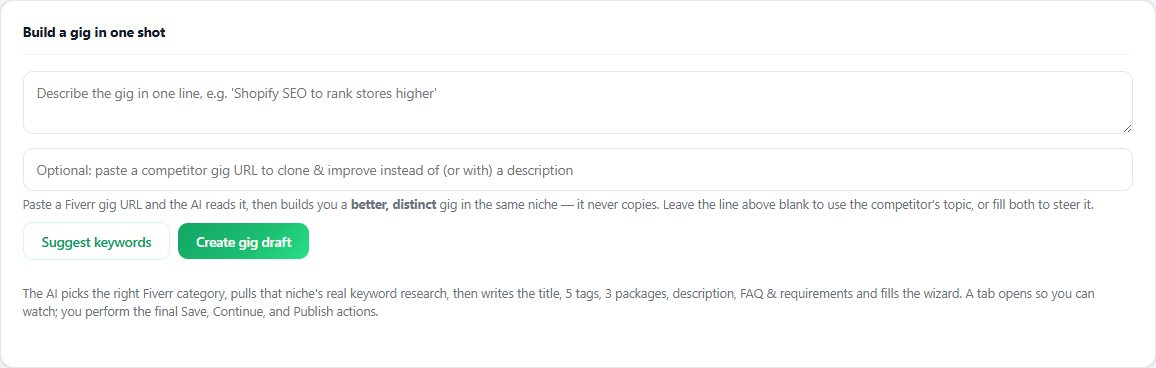
Seller OS drafts the parts of a listing that sellers stall on. The Gig Builder turns a one-line idea, such as thesis proofreading with tracked changes, into a structured gig with title, five tags, description, and three packages, and fills the Fiverr wizard while you review each field. The Gig Performance Optimizer then reviews a live gig's copy and gallery against that gig's own performance data and proposes changes.
Tracked keywords keep local position history for your edit-level phrases, and client records hold each buyer's word bands, style guide, and delivery notes so a second manuscript starts informed. It drafts and fills; a person performs every final Save, Continue, or Publish action, and it never edits your client's text.
Fiverr SEO for Proofreaders and Editors questions
How should I name my proofreading gig on Fiverr?
Put the edit level and the document type in the title, phrased the way a buyer types it, such as proofread and copyedit your thesis. Fiverr's gig creation article asks for short, clear titles without special characters, and your category choice is locked once the gig is published, so match the level to the subcategory you pick.
Should I charge per word or per project for editing?
Per word matches how buyers in this category think, as long as you publish the counting rule: which text you count, how partial bands are priced, and what happens above your top band. Projects work for short documents with fixed scope. Either way, state the word band inside each package before the order starts.
How do I show editing samples without client work?
Use text you own or public-domain passages, mark them up with tracked changes and comments, and annotate the decision that mattered. Fiverr's portfolio article allows up to twenty projects with one to five files each, so you can publish a proofreading excerpt, a copy-edited excerpt, and a short style sheet as separate pieces.
What do proofreading buyers ask before ordering?
Usually three things: which level of edit you will perform, how you count words, and when the file comes back. Answer all three in the package descriptions and again in your FAQ, because buyers read those before they message. A clear answer in the listing reduces the pre-order conversation that delays the order.
Name the level, then price the words
Pick one edit level, publish a sample edit, and set word bands a buyer can quote against in a single message.