How to rank a Fiverr gig in 2026
The six-step loop: pick the keywords, build the fields in order, earn the early signals, then track and iterate. Includes the moves that quietly hurt a gig.
Read the guide → Seller OS
Three hundred seventy-five field guides for the work that decides whether your Fiverr business grows: ranking and keywords, pricing, difficult clients, account problems, and using AI without handing over your edge. Written for sellers, dated, and free to read.
Free plan available. Local-first data. Human review on every change.
If you only read three pages here, read these. They cover the loop that everything else feeds into: getting found, fixing a gig that stopped performing, and pricing the work so the orders are worth taking.
The six-step loop: pick the keywords, build the fields in order, earn the early signals, then track and iterate. Includes the moves that quietly hurt a gig.
Read the guide →Read the funnel in order — impressions, clicks, conversion, performance — and fix the first broken stage instead of rewriting everything.
Read the guide →Price from delivery hours and your target rate, build three tiers with real deltas, and raise prices without stalling the gig.
Read the guide →Keywords, titles, tags, impressions, and rank tracking. The technical half of getting found by the right buyer.
The full loop from keyword shortlist to rank history, with the mistakes that waste weeks.
Read the guide →A metric-by-metric diagnosis: zero impressions, impressions without clicks, clicks without orders.
Read the guide →What to check first when the views stop, in the order that finds the cause fastest.
Read the guide →Tell an algorithm shift apart from a gig problem, then recover with one measured change.
Read the guide →What the score summarizes, how to read it as a trend, and the habits that keep it from sliding.
Read the guide →Where the words actually come from, how to score them, and how to track the shortlist.
Read the guide →The 80-character budget, the order that works, and how to test a title safely.
Read the guide →Five slots, 20 characters each: how to support the title instead of repeating it.
Read the guide →The short list that survives scrutiny, plus the myths that keep costing sellers money.
Read the guide →Finding work worth doing, pricing it properly, and handling the moments that decide whether a buyer comes back.
Score ten candidate services on demand, fit, and delivery time before you build anything.
Read the guide →A capture sheet for titles, tags, tiers, and promises, so you find the gap instead of copying the gig.
Read the guide →Price packages from cost and target rate, build three tiers, and raise prices without losing momentum.
Read the guide →Batch the inbox, protect delivery blocks, and keep one short list that actually ends the day.
Read the guide →Seven checks in order, two-week measurement windows, and the panic moves to avoid.
Read the guide →The first 24 hours, a public reply that builds trust, and how to recover the average over time.
Read the guide →How cancellations and late delivery erode the rate, and how to protect an order before it becomes a dispute.
Read the guide →What the rate tracks, the reading-without-replying trap, and the inbox routine that protects it.
Read the guide →Buyer and support cancellations, what they touch, and the conversation that prevents the next one.
Read the guide →How to document it, report it through the right channel, and protect future orders.
Read the guide →Read the notice, appeal once with facts, and keep your records intact while access is limited.
Read the guide →Turn an adjacent skill into a sellable gig without over-investing before demand shows up.
Read the guide →What AI changes about selling on Fiverr, which tools are worth the money, and how the alternatives compare.
What AI commoditizes, what buyers still pay for, and how to position the difference.
Read the guide →The four categories worth paying for, how to choose, and the client-data rules that keep you safe.
Read the guide →What shuts down on October 1, 2026, what it means for your response rate, and the routine that replaces it.
Read the guide →What Fiverr's own program covers, what Seller OS adds, and where each one earns its place.
Read the comparison →Web rank tools versus local rank history: what changes when the data stays in your browser.
Read the comparison →Inbox-first AI versus the whole seller workflow: drafts, gigs, ranks, pricing, and monitors.
Read the comparison →Whether AI killed the work, what buyers still pay for, and how to position the next year of your freelance business.
What Fiverr's own 2026 numbers show about low-value pressure and higher-value work.
Read the guide →The low end got cheap; accountability, context, and judgment kept their price.
Read the guide →What to automate, what to keep human, and how to price the decision, not the file.
Read the guide →What buyer-side AI matching changes about gig visibility, briefs, and positioning.
Read the guide →The fee math, the signals it still works, and five questions before you double down.
Read the guide →Access versus independence: fees, buyer flow, control, and cost side by side.
Read the guide →Commodity reads went cheap; direction, usage rights, and a human on the hook still get hired.
Read the guide →One-off images got cheap; brand systems, production files, and accountability did not.
Read the guide →Screens generate fast; research, flow decisions, and handoff still need a person.
Read the guide →Tool-by-tool and field-by-field pages for getting found: rank tracking, keyword research, titles, tags, audits, and the questions sellers ask when a gig is quiet.
What to track, how often to check, and how to read position movement without chasing noise.
Read the guide →How to run one clean position check, why sessions disagree, and what a single result really proves.
Read the guide →What a keyword tool must handle on Fiverr, how matching works, and how to choose usable terms.
Read the guide →Mine the exact phrases buyers use, score candidates honestly, and map the winners to your gig fields.
Read the guide →Judge a result set honestly, spot genuinely easier phrases, and test one without breaking the gig that works.
Read the guide →Read demand from autocomplete and result pages, then decide how much competition a popular phrase is worth.
Read the guide →Grade one keyword with five checks and an honest verdict on whether your gig can compete for it.
Read the guide →Build specific three-to-five-word buyer phrases from real order language, then place each one in the right field.
Read the guide →A research method for the five tag slots: where candidates come from and how to test each one.
Read the guide →A field-by-field pass over a live gig title, with the checks that catch weak phrasing before buyers skip it.
Read the guide →An audit pass for a live description: limits, first lines, scan structure, keyword placement, and scope clarity.
Read the guide →A field-by-field pass or fail checklist to run before you publish a Fiverr gig, with the limits Fiverr publishes.
Read the guide →The diagnostic loop for one gig: evidence, layer-by-layer scoring, one deliberate change, and a measurement window.
Read the guide →No fixed timeline exists: what the first weeks look like, and how to tell not yet from stuck.
Read the guide →A day-by-day triage for the first 14 days of a quiet new gig, from eligibility to one deliberate change.
Read the guide →A working update cadence for Fiverr gigs: evidence first, one edit per window, and two weeks before you judge it.
Read the guide →What an edit can disturb, which changes carry risk, and how to test one change at a time.
Read the guide →What the results page shows, what sellers can observe, and which parts Fiverr documents rather than leaves to guesswork.
Read the guide →The published ranking signals, the stages from query to order, the lever at each stage, and the myths that fail a sourcing check.
Read the guide →Published counts for every gig, profile, gallery, and offer field, plus the fields Fiverr publishes no number for.
Read the guide →Impressions, clicks, conversion, thumbnails, descriptions, packages, and pricing — the pages a gig needs between attention and an order.
The click-to-order path layer by layer, with one fix each and a measurement habit that keeps your own trend honest.
Read the guide →The gap between click and order, five suspects behind it, and the evidence that tests each one.
Read the guide →Why the card loses the first decision, how to read your own click ratio, and a two-week test.
Read the guide →The five-part structure buyers scan, a weak-versus-strong rewrite to copy from, and where keywords belong in 1,200 characters.
Read the guide →How to design the first image for search-result size, what to avoid, and how to test a swap.
Read the guide →The published gallery limits, pixel range, and export workflow, plus where Fiverr's own pages disagree.
Read the guide →The differentiation levers that matter, in order: narrower promise, proof, package design, and delivery experience.
Read the guide →Turn the pre-order questions buyers repeat into a short FAQ field that removes hesitation.
Read the guide →What changes between the three tiers, what must stay fixed, and how to make the middle package the default choice.
Read the guide →Speed, scope, format, rights: honest add-ons that raise order value without changing your entry price.
Read the guide →Enough to cover the buyer problems you serve, few enough that every gig earns your attention.
Read the guide →A decision framework for launching a new listing or fixing the one you already have.
Read the guide →Price changes move two numbers at once: who clicks and who buys. Model it before you edit.
Read the guide →Rank and conversion measure different things. Together they tell you which problem to fix.
Read the guide →Annotated example descriptions for four categories, weak openings side by side, and a fill-in skeleton to adapt.
Read the guide →How Fiverr’s seller system works as published: levels and the Success Score, Briefs, custom offers, subscriptions, Request to Order, Promotions, coupons, and ads.
The published requirements for every level, what each one unlocks, and the numbers Fiverr keeps unpublished.
Read the guide →The published Level 1 bar, a low-volume plan to clear it, and the shortcuts that backfire.
Read the guide →Bigger numbers, same six metrics: a consistency plan for the step from Level 1 to Level 2.
Read the guide →What Top Rated actually is, what Fiverr publishes, and the honest bar behind the badge.
Read the guide →A calm triage for a Success Score drop: timeline it, read the areas, map the orders, fix one input.
Read the guide →Six metrics, automatic advancement, a 30-day grace period, and one formula Fiverr has never published.
Read the guide →What Briefs were, how matching worked, what replaced them, and where new opportunities arrive now.
Read the guide →Improve the match surface: service clarity, profile specificity, response behavior, and honest limits.
Read the guide →A four-part response structure with a fill-in example, plus what to leave out of a brief reply.
Read the guide →An empty briefs page is expected now. Work this check order before assuming a penalty.
Read the guide →Published offer mechanics plus an offer anatomy: scope, price logic, timeline, and what to leave out.
Read the guide →A decision guide: how each path looks to the buyer, what carries over, and when to choose which.
Read the guide →Recurring orders, the published eligibility and billing rules, and a fit test for services that renew.
Read the guide →A retention system: map recurring needs, hand off delivery, follow up on a rhythm, and keep records.
Read the guide →What the Request to Order setting changes, who can turn it on, and when approval protects your delivery schedule.
Read the guide →How first-time client promotions work, the published caps, and how to tell whether the discount paid for itself.
Read the guide →Repeat-client and custom offer coupons, the stacking rules, and the margin math to run before you send one.
Read the guide →Auction bidding, cost-per-click billing, placement, and the honest economics of paying for attention on Fiverr.
Read the guide →A budget loop for Fiverr Ads: read the whole funnel, cut weak gigs, scale winners, and re-check.
Read the guide →Paid vs earned placement: what each buys, when ads are worth running, and when fixing organic search wins first.
Read the guide →What Neo did, why matching now runs through Mira, and the gig data sellers can actually influence.
Read the guide →How Fiverr Go's creation models work, what the reported price actually buys, and where human gigs still win.
Read the guide →What the AI Video Hub sells to brands, what it means for editing gigs, and how to repackage your deliverables.
Read the guide →Eligibility, setup, pricing posture, and call hygiene for Fiverr's paid video consultation orders.
Read the guide →How milestone stages are funded and released, who qualifies, and the scope habits that keep big orders healthy.
Read the guide →What the agencies program is, the invitation-based application path, and how team order flow changes.
Read the guide →The published Pro application path, what reviewers examine, and the real gap between Pro and Top Rated.
Read the guide →What the Fiverr and LinkedIn connection displays, who qualifies, and how to turn profile presence into leads.
Read the guide →How hourly contracts are logged, billed, and disputed, plus when the model fits your kind of work.
Read the guide →Who can start a call, how long it runs, and where the off-platform line sits during a Fiverr Zoom conversation.
Read the guide →Auto-reply limits, quick-response setup, and human-sounding templates that protect your 24-hour response rate.
Read the guide →The combined inbox explained: order messages, labels, unread discipline, and archived-order habits that keep replies fast.
Read the guide →A task-by-task mobile guide: inbox and orders work on the phone, gig edits and full analytics belong on desktop.
Read the guide →Screening questions were a Briefs-era feature. Learn the legacy mechanic, the Mira present, and strong answer craft.
Read the guide →Professions is gone from browsing. What it was, what survived, and the category and tag rebuild that replaces it.
Read the guide →The January 2026 Terms date explained honestly, where to read the text, and a practical compliance checklist.
Read the guide →Username versus display name: the permanent handle, the editable name, and the link checklist after edits.
Read the guide →A reason-by-reason reactivation map: paused, denied, and removed gigs with the right recovery for each state.
Read the guide →Feedback boosting is prohibited: the banned behaviors, why they trigger warnings, and honest ways to earn reviews.
Read the guide →Buyer Requests is long retired and Briefs followed. What each system was and where sellers find work now.
Read the guide →What the numbers mean, how to read them per gig, and the tracking habits that turn dashboard data into decisions.
A view-by-view map of Fiverr analytics: what each tab answers and what the dashboard cannot tell you.
Read the guide →Read each per-gig statistic in order, spot which step broke, and change one thing at a time.
Read the guide →Fiverr's definitions of each metric, the funnel between them, and hypothetical math that shows what movement means.
Read the guide →What CTR measures, what moves it, and a one-change test plan you can read in a full window.
Read the guide →The three conversion definitions Fiverr publishes, which one answers your question, and how to read a trend at low volume.
Read the guide →Which keyword data Fiverr actually provides, who can see it, and how to read a keyword row without overreacting.
Read the guide →Find the terms already working for your gig, shortlist five to eight of them, and prove one per window.
Read the guide →One gig, one period, five questions, one decision: the recurring analysis routine that keeps edits honest.
Read the guide →The business view of your sales: earnings, order value, repeat share, and a monthly sheet that ends in one decision.
Read the guide →One line per gig per period, with a change note: the lightweight tracking habit behind every good diagnosis.
Read the guide →A stuck score is a triage problem: identify the dragging component, isolate it with recent orders, then test one fix at a time.
Read the guide →Public reviews build your visible reputation; private feedback feeds the Success Score. Here is who sees what and what you can influence.
Read the guide →Why there is no category-wide Fiverr benchmark, how to read the score labels, and how to set a personal baseline instead.
Read the guide →Why the communication label can look weak when you reply fast, and the on-platform habits that move it.
Read the guide →A calm triage order for a sudden impression drop, with one concrete check at each step before you edit anything.
Read the guide →How to tell a 2026 demand shift from a gig problem, then run a recovery sequence that fits larger-budget buyers.
Read the guide →What each Fiverr search sort optimizes, where a newer gig can win, and how buyers use the toggle differently.
Read the guide →What a copycat takes, what you can protect, the report path on Fiverr, and when a similar gig is simply competition.
Read the guide →What Reddit and LinkedIn each allow, why profile-first beats link-drops, and how to route attention back to your gig.
Read the guide →Where a brand-new gig loses people on the way from impressions to orders, and what to fix at each stage in the first 90 days.
Read the guide →What to lean on while you have zero reviews, and how to ask for the first ones politely once orders start landing.
Read the guide →The platform's move toward larger projects, described generally, and the packaging, minimums, and trust changes a small seller can make.
Read the guide →First orders, more orders, repeat buyers, faster replies, proposals, follow-ups, and price objections.
Proof, a narrow offer, and rule-respecting outreach — the honest path to order number one and the review that follows.
Read the guide →How to replace missing reviews with proof buyers can verify: portfolio evidence, honest guarantees, a shown process, and fast replies.
Read the guide →Channels beyond search: people who know your work, referrals, content, and communities, plus the platform rules that constrain them.
Read the guide →Six levers in priority order, what each one fixes, and the work that comes before spending on ads.
Read the guide →The order-level mechanics of repeat business: subscriptions, packages built to recur, coupon timing, and what order history compounds.
Read the guide →A moment-by-moment playbook across one order, with a worked message example and a follow-up cadence you can copy.
Read the guide →What the response rate counts, a batching routine, reply patterns by message type, and a review gate on AI drafts.
Read the guide →The message that carries the offer, line by line, with a full example you can adapt to your own scope.
Read the guide →A five-beat proposal structure, a generic-to-specific rewrite, and the one question that opens a conversation.
Read the guide →A copy bank for the six messages sellers send most, with notes on making each one yours.
Read the guide →Four moments, the timing that works for each, and the rules for stopping.
Read the guide →Two kinds of silence, the clocks attached to each, and the moment to stop.
Read the guide →A reply that adds options instead of discounts, and the floor below which you decline.
Read the guide →Three offer moments, relevance before revenue, and one question instead of a pitch.
Read the guide →A demand-led ranking of Fiverr skills for 2026, with the signal behind each pick and a rough time to first order.
Read the guide →A six-week n8n roadmap from first workflow to paid Fiverr gig, with buyer language, deliverables, and pricing.
Read the guide →A practical roadmap from first cut to paid reels work: tools, formats, spec pieces, retention basics, and pricing.
Read the guide →Learn the combined AI UGC stack: hooks, avatars, voice, and editing, plus disclosure rules and a pricing ladder.
Read the guide →Turn Canva competence into Fiverr income with three sellable deliverables, honest proof, and prices that leave room to grow.
Read the guide →Pick a Shopify lane, build the skill behind it, prove it with demo stores, and scope and price each deliverable.
Read the guide →Thirty days from blank page to a copywriting offer: fundamentals, five spec pieces, a niche, prices, and outreach.
Read the guide →The four cleaning request types, a four-week skill plan, anonymized proof samples, and per-task pricing.
Read the guide →Account, profile, ID verification, first gig, pricing, and the real path a first order takes to reach you.
Read the guide →Three annotated proposal examples for the situations sellers actually write in, plus the openings that get ignored.
Read the guide →The seller surfaces buyers check after the gig: profile, bio, professional title, portfolio, and standing out without discounting.
The order buyers read your profile in, and the fields that deserve the first fixes.
Read the guide →A four-part bio structure and a full weak-to-strong rewrite you can pattern-match.
Read the guide →What each surface holds, which one search shows, and how profile and gig support each other.
Read the guide →What to show, in what order, with what caption, and how to prove skill before your first order.
Read the guide →The two item types, the fields each project needs, file limits, and fixes for common upload errors.
Read the guide →What the profile tagline should name, five worked examples, and how it differs from your gig titles.
Read the guide →Why low profile views are usually a gig traffic problem, and the checks to run before you edit anything.
Read the guide →Positioning levers that never touch your price: offer shape, process, proof, communication, and when to narrow a niche.
Read the guide →Three annotated bios for different seller situations, the rules Fiverr states for the About section, and the lines to remove.
Read the guide →The difference between a profile intro video and a gig video, a beat plan, and three scripts you can adapt.
Read the guide →Paused, denied, under review, removed, disabled, verification, and going away — what each state means and what to do.
You paused it, a setting did, or the listing is in another state — and what to do per case.
Read the guide →Read the reason, fix what is fixable, resubmit once, and know when an appeal is the right path instead.
Read the guide →What the review state means, why Fiverr publishes no timeline, and the calm way to wait it out.
Read the guide →The account-level states, what access changes, and how to respond while limited without making it worse.
Read the guide →Read the notice, protect your records and funds path, and work the one official appeal without false hope.
Read the guide →What removal means, the warning risk it carries, and how to appeal and rebuild without reposting the same listing.
Read the guide →When Fiverr asks for ID, what documents it accepts, and how to get through the check without failing it.
Read the guide →What Fiverr's availability setting changes for orders, messages, search visibility, and your response rate.
Read the guide →What a longer break does to your gigs and ranking, plus a leave and return checklist.
Read the guide →Stuck in buyer mode? The published activation path, the states that block it, and browser fixes that help.
Read the guide →An ordered fix path for silent Fiverr alerts, from OS permissions and battery rules to in-app settings and the web fallback.
Read the guide →An ordered triage for vague Fiverr errors during gig saves, uploads, checkout, and messaging without losing your work.
Read the guide →A calm outage triage that separates platform problems from local ones and protects your deadlines while pages fail.
Read the guide →Late delivery, extensions, revisions, unresponsive buyers, scope creep, disputes, and the Resolution Center.
What a missed deadline costs, what your buyer can do, and how to rescue the order.
Read the guide →Who can request time, how the new date is calculated, and how to ask so clients say yes.
Read the guide →Set revision counts per package, define what a round includes, and stop loops before they start.
Read the guide →What the platform allows after a completed order, how to decide, and three replies for three cases.
Read the guide →Stage-by-stage clocks, what to deliver when nobody answers, and the documented path to closure.
Read the guide →Classify the ask, reply with one of three scripts, and say no without losing the client.
Read the guide →Spot the pattern early, send the checkpoint message, and convert each addition into paid work.
Read the guide →Try resolution first, keep an evidence file ready, and know how a bank chargeback differs from a dispute.
Read the guide →Who can open what, cancel versus partial refund, and the 48-hour clock behind every request.
Read the guide →Pre-order red flags in briefs and messages, plus a short screening habit to run before you accept any order.
Read the guide →Seven scope signals hiding in thin briefs, each paired with the clarifying question that turns fog into terms.
Read the guide →Pre-order decline wording versus post-order cancellation, with the metric cost of each path spelled out.
Read the guide →Stay calm, keep the thread on-platform, document the demand, offer one fair fix, and escalate the right way.
Read the guide →Which unfair Fiverr reviews can be removed, how to report feedback abuse, and what to do when the review stays.
Read the guide →When a cancelled Fiverr order can still be reviewed, when it cannot, and how the cancellation route shapes the outcome.
Read the guide →How mutual and support cancellations differ on Fiverr, which metrics each touches, and which route to prefer in each case.
Read the guide →Prevent endless Fiverr revision loops with clear scope and requirements, and respond, charge, or escalate when abuse starts.
Read the guide →Build a three-tier scope ladder where the first package carries the offer and extras finish the job.
Read the guide →Set a visible Fiverr delivery time from your real turnaround minus review time, so the promise you make is one you can keep.
Read the guide →Plan a realistic number of orders in flight, batch similar work, and use a simple status board to keep the queue honest.
Read the guide →Build an intake question set that fixes scope at the start and ties every answer to a package or an extra.
Read the guide →Compare the availability controls, what each does to search and orders, and which fits travel versus overload.
Read the guide →What a longer break changes, what returns by itself, and the signals to send in your first weeks back.
Read the guide →Batching windows, a template library, and escalation rules that keep first replies fast under load.
Read the guide →When to send each follow-up, three timing templates, and the stop rules that keep nudges professional.
Read the guide →The script that anchors a custom offer price to scope and holds it when a buyer pushes back.
Read the guide →A generic brief response, a specific rewrite, and a line-by-line map of exactly what changed and why.
Read the guide →How to prove your skill with no paid clients: four legitimate proof types, the honest label each needs, and what each one shows a buyer.
Read the guide →Which title field is for who, where each one appears, the length question, and how to write both without a keyword list.
Read the guide →The auto-complete windows Fiverr publishes, what pauses the timer, and why treating it as a delivery strategy backfires.
Read the guide →Post-order correction playbook: message first, compare scope, then pick the path that protects your score and gets paid.
Read the guide →Why extras disappear from the order page — gig-edit lag, buyer-side package choice, mobile view, order state — and the safe custom-offer recovery.
Read the guide →Every failure point on the custom-offer path — eligibility, chat state, bounds, drafts, glitches — with an ordered fix list and fallbacks.
Read the guide →AI-generated revision requests are a 2025–26 pattern. Learn to spot them, respond with a clarifying script, and protect your scope without escalating unnecessarily.
Read the guide →The repeat business badge is earned, not applied for. Score ≥ 95 and subcategory leadership trigger it. Delivery quality, follow-up, and re-engagement are the real levers.
Read the guide →Fiverr Ads eligibility is performance-gated. When a campaign pauses for quality, fix the underlying gig signals (rating, OCR, delivery, response) before re-enabling.
Read the guide →Home, Orders, Gig Analytics, Earnings, Inbox — where everything lives now, why sellers lost their bearings, and a one-week routine to rebuild muscle memory.
Read the guide →What to automate, what to keep human, and prompt-by-prompt workflows for SEO, replies, briefs, and optimization.
Choose AI tools by gig SEO job: keyword expansion, title variants, description drafts, and the review gate.
Read the guide →Audit first, prompt second: read your gig's own numbers, generate candidates, edit one field, and measure the window.
Read the guide →Where AI helps with Fiverr keywords, where it invents demand, and the verification loop that keeps honest phrases.
Read the guide →Feed constraints, not just a topic: prompts that produce usable description drafts, and the edit pass that removes generic filler.
Read the guide →Context to include, tone controls, what never to paste, and three worked reply drafts with the edit each needs.
Read the guide →Feed the model, set output rules, review a worked draft, and answer inside the window without sounding generic.
Read the guide →What AI can draft, the Fiverr field limits that apply, and the human checkpoints between a draft and Publish.
Read the guide →The allowed uses, the risky ones, what Fiverr publishes about original work, and the review pass that keeps delivery clean.
Read the guide →A prompt bank for buyer replies, offer drafts, scope questions, review responses, and weekly planning, each with review rules.
Read the guide →Prompt recipes for keyword clustering, titles, tags, descriptions, and a listing audit, with field limits and verification steps.
Read the guide →Tool roundups, alternatives, and honest comparisons — vendor claims attributed, no invented numbers.
Compare Fiverr SEO tools by the job they do, with published vendor facts and criteria for choosing between them.
Read the guide →Compare Fiverr rank trackers by what they measure, check cadence, and where your position data is stored.
Read the guide →What free and paid keyword sources cover, how to judge suggestions, and which tool fits each job.
Read the guide →What Fiverr Mate publishes, which alternative category fits each job, and how to switch without losing data.
Read the guide →What each view answers, where their data comes from, and how to read them together without mixing them up.
Read the guide →What manual SEO costs in hours, what tools change, and the judgment neither one replaces.
Read the guide →A calculator that estimates Success Score factors from your dashboard data, explains the unpublished weighting, and shows how to read the directional output.
Read the guide →A title generator that builds gig titles from keyword, outcome, and qualifier patterns, enforces Fiverr field rules, and shows worked examples across categories.
Read the guide →A description generator that builds copy from service, audience, proof, and package bridge inputs, enforces the 1,200-char structure, and includes a worked before/after example.
Read the guide →A tag generator that expands a seed keyword into five compliant tags, enforces Fiverr's field rules, and shows a worked expansion with reasoning.
Read the guide →A CTR calculator that uses your gig's impressions and clicks, explains the formula, shows how to compare periods correctly, and includes a worked calculation with example numbers.
Read the guide →What the 200,000-user Quick View extension shows, which permissions to question, and safer ways to read gig data.
Read the guide →What Fivlytics covered, how to verify a rank tool, and replacements with dated store facts.
Read the guide →What the Seller Assistant rank tool covers, its limits, and the replacement checklist with dated facts.
Read the guide →A permission-first roundup of Fiverr seller extensions with dated facts and honest trade-offs.
Read the guide →Category-specific keyword language, proof conventions, and mistakes for 21 freelance specialties.
Deliverable-first keywords, kit-based packages, and the portfolio proof that helps graphic design gigs get found.
Read the guide →Qualifier-first keywords, proof built on grids and mockups, and package logic for logo and brand kit work.
Read the guide →Web design gigs live on platform and page-count phrases, and their proof lives on live links and before-and-after shots.
Read the guide →Fix, repair, speed, and build phrases, builder qualifiers like Elementor, and package logic that separates fixes from full builds.
Read the guide →Theme setup, migration, speed, and app-integration phrases, plus proof rules that protect client store data.
Read the guide →How video-editing buyers search, what reel-style proof wins orders, and how format, title, and package fields fit together.
Read the guide →Creator search language, long-form versus Shorts proof, and how retainers and subscriptions turn one edit into monthly work.
Read the guide →Platform-qualified phrasing, honest growth proof, and retainer tiers for social media managers on Fiverr.
Read the guide →Deliverable keywords, voice qualifiers, marked-up proof, and AI-era positioning for copywriters on Fiverr.
Read the guide →Topic qualifiers, ghostwriting proof, and word-count package tiers for content writers on Fiverr.
Read the guide →Cluster-based keywords, proof without client links, and packages priced around scope for Fiverr SEO sellers.
Read the guide →Why the umbrella phrase buries you, how to specialize by channel, and how to split campaign planning from execution.
Read the guide →Tool-qualified phrasing, outcome framing, and workflow-diagram proof for automation sellers who want the right buyers.
Read the guide →Accent and tone qualifiers, use-case phrases, demo-reel proof, and package tiers that state usage rights plainly.
Read the guide →Task-phrased keywords, niche stacks, and process proof that help virtual assistant gigs get found by the right buyers.
Read the guide →Language-pair keywords, deliverable-specific proof, and per-word packages that match how translation buyers search on Fiverr.
Read the guide →Tool-qualified keyword phrases, clear dashboard offers, and anonymized sample proof for data analyst gigs on Fiverr.
Read the guide →Use-case phrases, software qualifiers, and render-driven proof for 3D modeling, printing, and product render gigs.
Read the guide →Style-first keywords, usage-rights package tiers, and process proof for illustration gigs that buyers can verify.
Read the guide →Stage and platform phrases, scoping packages that cap expectations, and store-link proof for mobile app development gigs.
Read the guide →Audit, on-page, speed, and local SEO clusters, report-based proof, and scope language for sellers whose product is optimization.
Read the guide →A repeatable method for finding low-competition Fiverr gigs: read search signals, score demand, and shortlist ideas worth testing.
Read the guide →Five pass-or-fail gates that validate a Fiverr niche idea: demand, competition, language, price ceiling, and delivery.
Read the guide →Low-competition Fiverr gig ideas for 2026 by category, each with its competition read and a sensible opening price.
Read the guide →Estimate monthly orders per seller from public review counts, then judge whether the niche has room for you.
Read the guide →Turn competitor low-star reviews into gig gaps: sample fairly, cluster complaints, and fix your offer first.
Read the guide →Find Fiverr keywords free with autocomplete, top gigs, category pages, and buyer questions, then verify each.
Read the guide →Meet Fiverr video specs, open with proof in seconds, and follow a 30-second script buyers finish.
Read the guide →Design a Fiverr gallery that earns clicks: one clear main image, legible thumbnails, and proof buyers trust.
Read the guide →Filing, phrases, a first portfolio, and order mechanics for creators selling user-generated content on Fiverr.
Read the guide →Logo Maker access status, logo gig filing and pricing, example phrases to test, and the Live Portfolio rule.
Read the guide →Buyer phrases, deliverable bundles, privacy-safe proof, and package tiers for resume and CV gigs that get found.
Read the guide →One data type, buyer-shaped phrases, a documented QA pass, and per-record pricing for data entry gigs on Fiverr.
Read the guide →Software-first phrases, cleanup and retainer packaging, confidentiality proof, and the scope questions to settle before a bookkeeping order.
Read the guide →Subcategory phrases, the document stack buyers request, honest proof, and interview-based pricing for business plan gigs.
Read the guide →Buyer phrasing, deliverable types, portfolio proof, package tiers, and the mistakes that cost interior designers visibility and profit on Fiverr.
Read the guide →Buyer phrasing, per-episode and retainer packages, audio proof conventions, deliverable bundles, and the pricing mistakes that trap podcast editors.
Read the guide →Four producer sub-services, usage-rights packaging, stem delivery, licensing clarity, and the mistakes that blur offers and erode margins.
Read the guide →Five animation styles buyers search, style-specific reels, package structures with script and voice-over, aspect-ratio options, and the mistakes that make animation gigs invisible.
Read the guide →Remote vs local split, corporate and event deliverables, gear proof, travel scoping, raw-footage rights, and the mistakes that hide location limits and blur filming vs editing.
Read the guide →Edit-level naming, sample-edit proof, and per-word packages that match how proofreading buyers search on Fiverr.
Read the guide →Verbatim versus clean read versus captions, timestamp conventions, and per-minute packages for transcription sellers on Fiverr.
Read the guide →Platform-specific titles, flow and campaign deliverables, honest proof, and retainer packaging for email marketing sellers on Fiverr.
Read the guide →Service splits, list specifications, compliant samples, and volume pricing for lead generation sellers on Fiverr.
Read the guide →Scope splits, platform deliverables like A+ content and Etsy tags, anonymized proof, and honest access rules for ecommerce sellers.
Read the guide →Split game gigs by asset, system, prototype, and fix, then prove each with builds buyers can try.
Read the guide →Turn grant writing into defined deliverables with honest proof and deadline-safe ordering for nonprofits.
Read the guide →Name dielines, mockups, and print files clearly, then prove range with mockups plus specs.
Read the guide →Package shop setup, listings, affiliates, and live support with proof buyers can verify.
Read the guide →Price decks by slides and revisions, prove transformations, and keep founder content duties clear.
Read the guide →Realistic income math, fees, payouts, taxes, promotion ROI, and whether paid programs are worth it — every platform figure attributed, every scenario labeled illustrative.
Fee-adjusted income ranges for starter, part-time, and full-time sellers, with the math shown and no single-number promise.
Read the guide →A 30/60/90-day timeline for new-seller earnings: what realistically moves each month and what does not yet.
Read the guide →A step-by-step first-$100 plan with real fee math, from one narrow offer to the review that unlocks the next hundred.
Read the guide →Exactly how many orders $2,000 net takes at four price points, plus the weekly pace and the price-versus-volume choice.
Read the guide →A careful raise playbook: timing signals, package sequencing, testing the increase, and scripts for repeat buyers.
Read the guide →The full fee map for sellers and buyers, with worked nets on small and large orders and pointers to current rates.
Read the guide →Clearing, speed, fees, and availability for each payout route, plus which sellers each one suits best.
Read the guide →Records, forms, deductions, and a set-aside habit for US sellers, framed as general information rather than tax advice.
Read the guide →The early payout fee, who qualifies, and a small worked example to judge when waiting is the better call.
Read the guide →What the advance is, how repayment works, and a decision checklist for judging it against waiting or raising prices.
Read the guide →A break-even formula for Fiverr Promoted Gigs, with a worked example that marks the exact point paid clicks lose money.
Read the guide →Seller Plus features weighed against the monthly fee at your order volume, with a clear answer on who should skip it for now.
Read the guide →Stage-by-stage fixes for a failed Fiverr withdrawal, ordered so you rule out the cheap causes before you open a ticket.
Read the guide →Who converts your Fiverr earnings, where the spread appears, and what a payout in local currency actually delivers.
Read the guide →The published tip flow, the fee treatment, the separate 14-day clearance, and one worked example sellers can check.
Read the guide →The money states Fiverr uses, what moves funds between them, and the dashboard signals that tell you where your earnings stand right now.
Read the guide →Why the Early Payout button disappears, the eligibility rules Fiverr publishes, and the ordered checks to run before you assume it is broken.
Read the guide →What Fiverr does with a disabled account balance, how the 90-day hold works, and the appeal to file first.
Read the guide →Where the buyer's money sits from checkout to clearance, plus milestones, subscriptions, and custom offers.
Read the guide →What Fiverr gives sellers instead of invoices: statements, activity exports, purchase receipts, and a clean buyer invoice.
Read the guide →Commission plans, the 30-day cookie, the $100 threshold, and the two monthly payout cycles, from Fiverr's own pages.
Read the guide →Refer a freelancer to your client in the inbox, earn 2.5% in credits, and learn how expiry and badges work.
Read the guide →Spotting bad actors, off-platform lures, phishing, malware attachments, and account-security hygiene — platform rules attributed to Fiverr, generic risk guidance labeled as best practice.
The early tells of fake Fiverr buyers, a short screening habit to run before any order, and how to report safely.
Read the guide →Why buyers push payment to Telegram or crypto, what protection you lose by agreeing, and polite scripts that keep the order on Fiverr.
Read the guide →Verification fees, deposits, and training charges aimed at sellers, the one rule that exposes every version, and how to report it.
Read the guide →Lookalike links, fake login pages, QR codes, and urgent credential requests aimed at sellers, plus how to check and report each one.
Read the guide →Which small proofs are worth doing, which free-work requests are traps, and the exact lines that decline without losing real buyers.
Read the guide →An order stalled before requirements arrives, the reminder sequence that restarts it, and the extension and escalation path before time runs out.
Read the guide →What a chargeback is, which delivery and message records support your case, and the on-platform path for raising a payment dispute.
Read the guide →What Fiverr allows on contact sharing, why sellers get flagged for it, and safe ways to handle calls and scheduling on-platform.
Read the guide →Why buyer files are a malware vector, the red flags to spot first, and a scan-before-you-open routine for every attachment.
Read the guide →A safe-handling standard for client files: macros off, preview first, isolation for unknowns, and separation of personal and work data.
Read the guide →The ordered response after opening a suspicious file: contain, scan, reset passwords from a clean device, and report to Fiverr.
Read the guide →Recognize common inbox spam patterns, report and block them correctly, and keep your response rate safe while ignoring junk.
Read the guide →Reported risks of free VPNs, why location jumps can flag a seller account, and safer ways to work from new networks.
Read the guide →Read extension permissions before install, keep buyer and account data local, review access often, and remove tools you no longer use.
Read the guide →A hardening checklist for the account that holds your earnings: two-factor, passwords, sessions, and connected apps.
Read the guide →What a new-location login can trigger, how to prepare the account beforehand, and the calm steps to take if it is flagged.
Read the guide →The ordered 2FA recovery path: saved codes, verified devices, then a support request with identity evidence.
Read the guide →A minute-by-minute hacked-account plan: regain access, revoke sessions, inspect payouts, and contact support with proof.
Read the guide →The full scam taxonomy for sellers: seven types, their warning signs, the safe response, and where to report.
Read the guide →What blocking does and misses, why blocked buyers reappear, and the calm escalation ladder that ends it.
Read the guide →Fiverr's company identity, buyer and seller protections as published, and the honest limits every user should understand.
Read the guide →Contacting support, verification and DSA steps, and the warning, restriction, and appeal paths — every process attributed to the Fiverr Help Center.
The published contact routes in order, which channel fits each kind of problem, and the fallback for a locked-out account.
Read the guide →When email is the right fallback, why the sending address matters, and how to structure a message that gets matched to your account.
Read the guide →Self-checks, the right channel, and the one follow-up that helps when a Fiverr support reply is slow to arrive.
Read the guide →The fields a reviewer needs, the ones that slow a ticket down, and how to write one request instead of five.
Read the guide →The published flow from gathering a physical document to the selfie capture and the review that follows.
Read the guide →Separate the failures worth a clean re-shoot from those that need a different action, then retry once with a fix.
Read the guide →Why the code goes missing, which numbers qualify, and a recovery sequence that fixes most cases.
Read the guide →What the EU trader rule requires, the information it collects, and how sellers complete it without guesswork.
Read the guide →How notices stack, how long they stand in your history, and the response that fits each stage of the ladder.
Read the guide →The seven terms traps new sellers fall into by habit, each paired with the safe swap that keeps the same outcome.
Read the guide →Why Fiverr allows one account per person, how duplicates get linked, and the safe way to expand or share a household.
Read the guide →The fair-process appeal: evidence first, one factual account, a single submission from the registered email, then patience.
Read the guide →What restriction blocks, how it differs from a warning or suspension, and the practical steps that resolve it honestly.
Read the guide →Read the denial reason, check the common triggers, fix the one thing it names, then resubmit once with your evidence saved.
Read the guide →Two things hide a gig: your own pause and a Fiverr-set hold. Tell them apart, then take the one recovery action each allows.
Read the guide →Why duplicate tickets and daily follow-ups slow resolution, how to fold your evidence into one thread, and when a single follow-up is right.
Read the guide →Why fresh accounts get flagged so fast, what each enforcement state means, and the one appeal worth filing.
Read the guide →Deactivation pauses for up to a year; deletion is forever. Clear funds, finish orders, and save records first.
Read the guide →What Fiverr publishes about language and skill tests today, plus an honest preparation plan that never touches answer sheets.
Read the guide →An honest read on Fiverr skill tests versus portfolio proof, with clear rules for when a test is worth your hours.
Read the guide →Fiverr measured against Upwork, Freelancer.com, Contra, Toptal, and running your own site — fee math and trade-offs with attributed platform facts.
Listings versus proposals, fee shape, and time to first pay: which platform a beginner should start on in 2026.
Read the guide →Commission math on $100 and $500 jobs, proposal costs, and which platform keeps more of your earnings.
Read the guide →Rate ceilings, fee shapes, and volume decide the winner, with illustrative monthly scenarios that show where your own break point sits.
Read the guide →A practical split playbook: what each platform rewards, how to position offers apart, and a weekly cadence that fits both.
Read the guide →Listings versus bidding in one short comparison: fees, buyer signals, and which seller each platform suits.
Read the guide →Zero commission against discovery and infrastructure: worked take-home math across order volumes, with each trade-off stated plainly.
Read the guide →Open marketplace against screened network: how vetting works, the gaps that fail beginners, and a realistic path to becoming ready.
Read the guide →What Fiverr supplies, what a site demands in marketing and ops, and a hybrid setup that keeps income steady.
Read the guide →Fee math, buyer mix, screening friction, and payouts across Upwork, Freelancer, Contra, Toptal, and your own site.
Read the guide →Payout paths, currency mechanics, and market context for the countries where sellers earn with Fiverr — informational, dated, and rechecked at drafting time.
Published payout routes, conversion mechanics, the 30-day tax data rule, and the paperwork Indian sellers keep for filing.
Read the guide →Published payout routes, why PayPal is not a given, PSEB and tax questions, and the records Pakistani sellers keep.
Read the guide →Published withdrawal routes, USD and wallet paths, conversion timing, identity checks, and the payout scams Nigerian sellers meet.
Read the guide →Published payout routes, the documents bank and wallet setups ask for, conversion mechanics, and competing on reliability.
Read the guide →Published withdrawal routes, the Payoneer to wallet path, conversion timing, and the records Philippine sellers keep.
Read the guide →Indonesia is a top-5 Fiverr market. Learn the published payout methods, IDR conversion details, and practical steps to avoid failed withdrawals.
Read the guide →Egypt is a major MENA seller market with payout-path restrictions. Learn the published methods, how sellers route through available rails, and what skills are in demand.
Read the guide →Fiverr's seller base spans 160+ countries. This hub links every country guide with sourced figures and explains how geography affects competition, buyer demand, and payout options.
Read the guide →Link-magnet reference with sourced figures only: Q2 2026 revenue, buyers, spend, take rate, seller geography. Platform disclosures separated from third-party estimates.
Read the guide →The buyer-side on-ramp: defining the task, posting a brief, vetting sellers on evidence rather than badges, and using the platform's protections correctly.
The buyer on-ramp every Fiverr page assumes: define the task, browse or brief, write clear requirements, compare sellers fairly, communicate during the order, and use the platform's resolution tools.
Read the guide →A buyer's vetting checklist: levels and badges decoded, portfolio proof vs. task fit, recent review relevance, three scope questions to ask, and red flags that precede disputes.
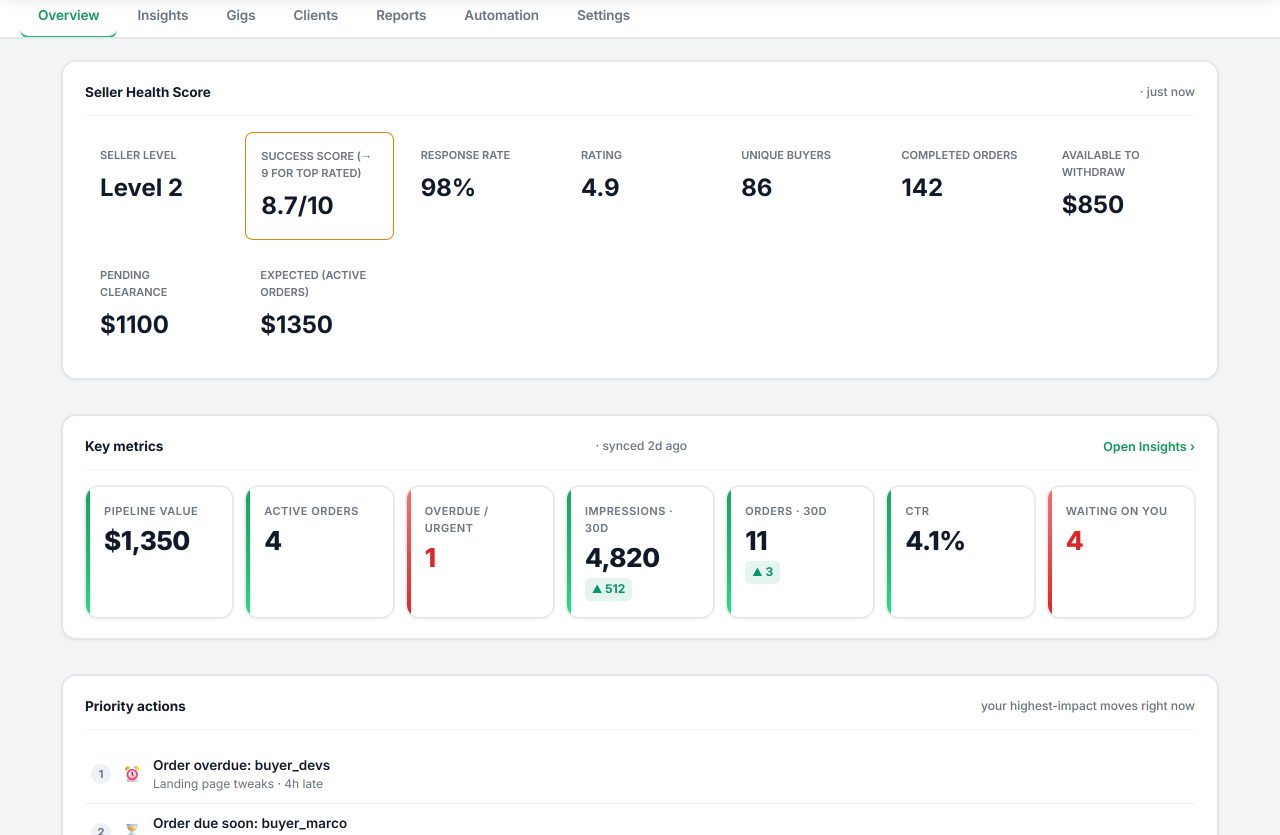
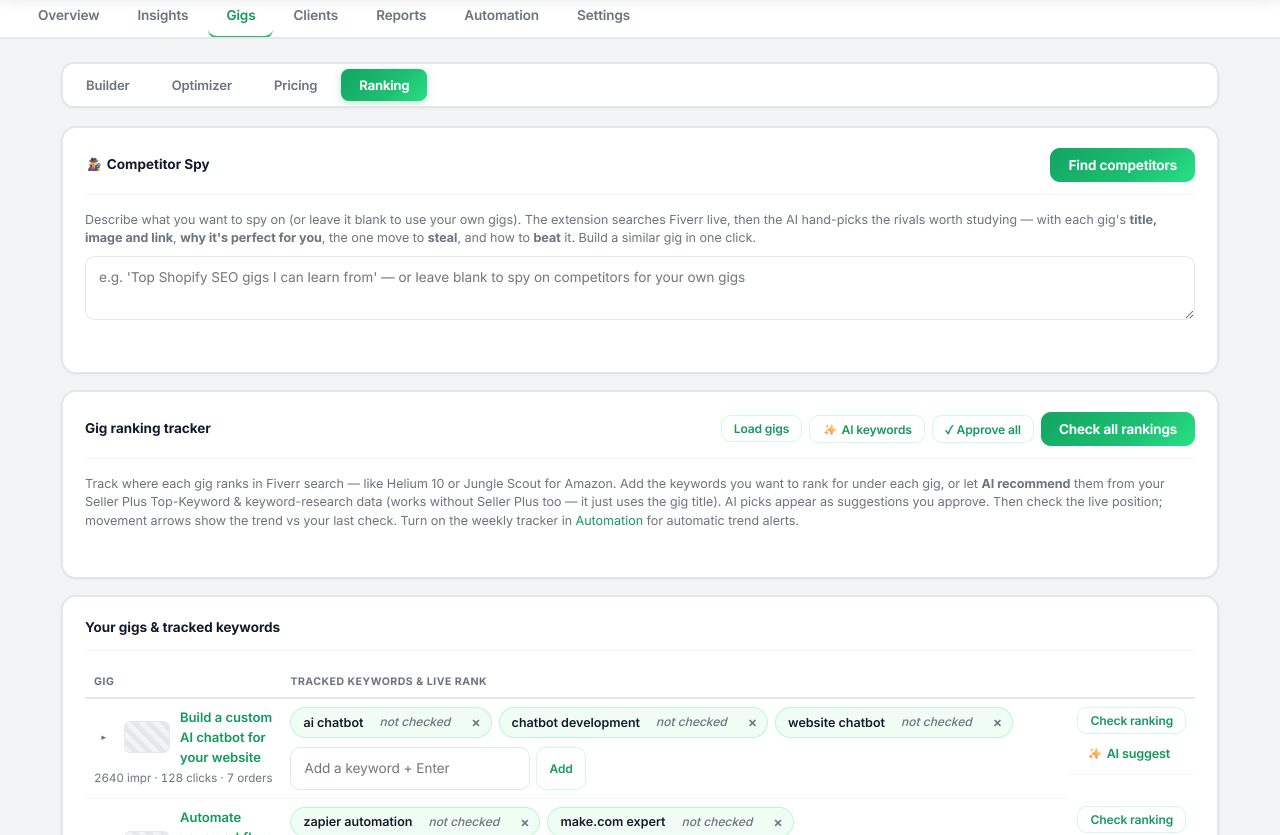
Read the guide →Seller OS is a local-first Chrome extension for Fiverr sellers: keyword and rank tracking, a one-shot Gig Builder, a Gig Performance Optimizer, inbox and brief drafts you review, client records, pricing guardrails, and Pro monitors. It never sends, saves, continues, or publishes without you.
Start with the Fiverr seller tools guide for the category map, or the Fiverr SEO tool guide for the ranking workflow.
Yes. Every guide on this page is free to read, with no account required. They are written for Fiverr sellers and updated as the marketplace changes.
No. Each guide stands on its own. Where a step is repetitive, the guide notes how the Seller OS Chrome extension automates or drafts it, but the method works without the extension.
Guides are dated and reviewed as Fiverr changes its systems, field limits, and seller tools. When a guide changes materially, its dateModified is updated.
Free to start, with human review on every action.