 Seller OS
Fiverr withdrawals: PayPal, Payoneer, and bank compared
Fiverr holds your earnings through a clearing period after each order completes, and only cleared funds can move to your account. The route you pick for that move, PayPal, Payoneer, or bank transfer, decides how fast the money arrives, what it costs, and whether it is available in your country.
This guide compares the three routes sellers use most on those exact points, then matches each one to the seller it suits. It covers payouts only; the commission taken before funds clear is mapped in the fees guide.
Free plan available. Local-first data. Human review on every change.
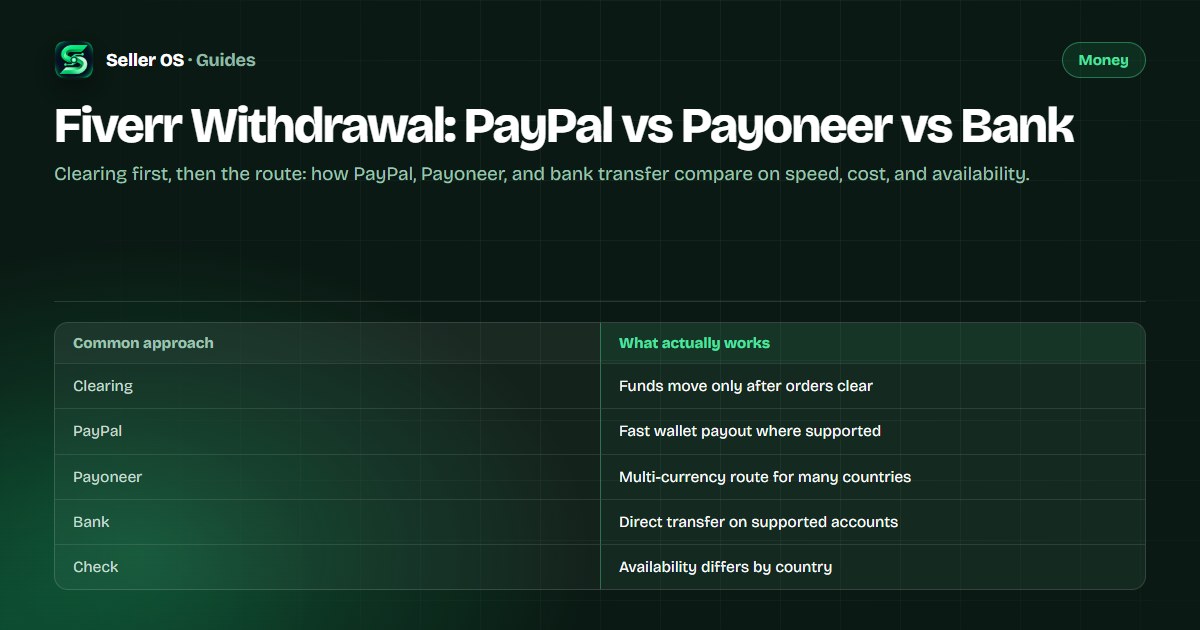
Clearing comes before any withdrawal
When an order completes, the earnings enter a clearing period described in the Fiverr Help Center. Until that period ends, the balance shows as pending and no payout route can move it. Plan cash flow around cleared funds, not around delivery dates.
New sellers sometimes request a payout the day an order completes and assume the route is broken when nothing arrives. The route is rarely the problem; the funds simply have not cleared. Check the pending-versus-available split on your earnings page before you compare speeds.
PayPal: the fast wallet option
PayPal suits sellers who want cleared funds in a familiar wallet quickly and who already use PayPal for other income. Transfers from Fiverr to PayPal are among the faster options where supported, and from there you can spend, hold, or move money to a bank on PayPal's own terms.
Two limits matter. PayPal is not supported in every country, and PayPal applies its own currency and withdrawal terms after Fiverr hands the funds over. If your buyers pay in one currency and you spend in another, read both sides of the conversion before you choose.
Payoneer: the multi-currency route
Payoneer suits sellers outside PayPal coverage and anyone paid across currencies. It provides receiving accounts in several major currencies, so the path from Fiverr earnings to local spending can involve fewer conversions. Many sellers in supported countries treat it as the default.
The trade is complexity. Payoneer has its own fee schedule and verification steps, separate from anything Fiverr charges or checks. Open the account early, complete verification before you need the money, and confirm that your country and currency are supported.
Bank transfer: direct but slower
Bank transfer moves cleared funds straight to your account without a wallet in the middle, which suits sellers who cash out to spend locally. Setup usually means registering the account once, then requesting payouts against it.
Expect slower arrival than wallet routes and stricter availability: not every bank or country is supported, and intermediary handling can add time on cross-border transfers. For regular earners the simplicity is worth the wait; for urgent bills it is the wrong route.
- One registered destination keeps reconciliation simple.
- Cross-border transfers can add handling time.
- Confirm support for your bank before you rely on it.
Which route suits you
Choose by constraint, not by popularity. If PayPal is supported in your country and you value speed to a wallet, start there. If you earn across currencies or PayPal does not serve you, Payoneer's receiving accounts usually fit better. If you cash out to one local account and never hurry, bank transfer keeps the chain short.
Revisit the choice once a year or when your volume changes. Fees, coverage, and your own currency mix all move, and the payout page plus each provider's published schedule show current terms. The early payout guide covers the separate question of getting funds faster.
| Route | Speed | Cost note | Best when |
|---|---|---|---|
| PayPal | Fast to wallet | Provider terms apply after transfer | You want wallet speed |
| Payoneer | Varies by currency | Own fee schedule; check first | You earn across currencies |
| Bank transfer | Slowest of the three | Bank handling may apply | You cash out locally |
Where Seller OS helps
Seller OS tracks the side of earnings it can see: orders, delivery dates, and the cleared-versus-pending rhythm in your local records. That history helps you predict when funds become available without opening the earnings page every day.
It never touches payouts. Withdrawal requests stay manual in your Fiverr account, and every figure the extension shows comes from data already on your device. Client records and order history remain in Chrome local storage.
Fiverr Withdrawal questions
How long does a Fiverr withdrawal take?
Clearing comes first: earnings stay pending through the clearing period Fiverr describes in its Help Center, and only then can a payout start. After that, wallet routes such as PayPal or Payoneer usually arrive faster than bank transfer, though exact times depend on the provider and country. Measure from the clearing date, not the delivery date.
Is PayPal or Payoneer better for Fiverr?
Neither wins outright. PayPal suits sellers who want fast wallet access where it is supported and already use it elsewhere. Payoneer suits sellers outside PayPal coverage or earning across currencies, with receiving accounts that cut conversions. Compare each provider's published fees for your country, then pick the one whose constraint set matches yours.
Can I withdraw Fiverr earnings straight to my bank?
In supported countries and banks, yes. Bank transfer sends cleared funds directly to your account without a wallet step, which keeps reconciliation simple. Availability is narrower than wallet routes and arrival is usually slower, so confirm your bank is supported before you depend on it, and keep a second route configured as backup.
Why is my Fiverr balance pending?
A pending balance almost always means uncleared earnings: orders completed recently are still inside the clearing period. Open your earnings page and compare pending against available before troubleshooting the payout route. If cleared funds will not move, recheck the registered payout account, then contact support through the published channels.
Match the route to your constraint.
Speed, currency, or simplicity: pick the payout route that fits, then recheck it yearly.