 Seller OS
How much you can make on Fiverr
There is no single figure for Fiverr income, because two sellers with the same skills can earn very different amounts. What you make is your average order value multiplied by your order volume, minus the platform fee, and each of those inputs is within your influence over time.
This guide replaces the single number with three fee-adjusted profiles, shows the arithmetic behind each one, and names the variables that move the result. Every scenario is labeled illustrative, because your category, prices, and pace decide your outcome.
Free plan available. Local-first data. Human review on every change.
Why there is no single number
Published averages mislead because the spread is enormous. A seller doing occasional five-dollar tasks and a seller delivering four-figure brand packages both count as Fiverr sellers, and any average across them describes nobody. Your income comes from your own price point and your own order count, not from a platform-wide mean.
The honest question is narrower: given a price and a realistic order volume, what lands in your account. Fiverr states that sellers earn 80 percent of each completed order amount, as described in the Fiverr Help Center, so every scenario below applies that payout to a gross figure. Work with net numbers from the start and the planning gets much calmer.
| Profile | Order value | Orders per month | Role |
|---|---|---|---|
| Starter | Around $25 | 2 to 5 | Side income beside a job |
| Part-time | Around $50 | 10 to 15 | Regular weekly orders |
| Full-time | Around $75 and up | 30 or more | Primary income with systems |
Three illustrative profiles, with the math
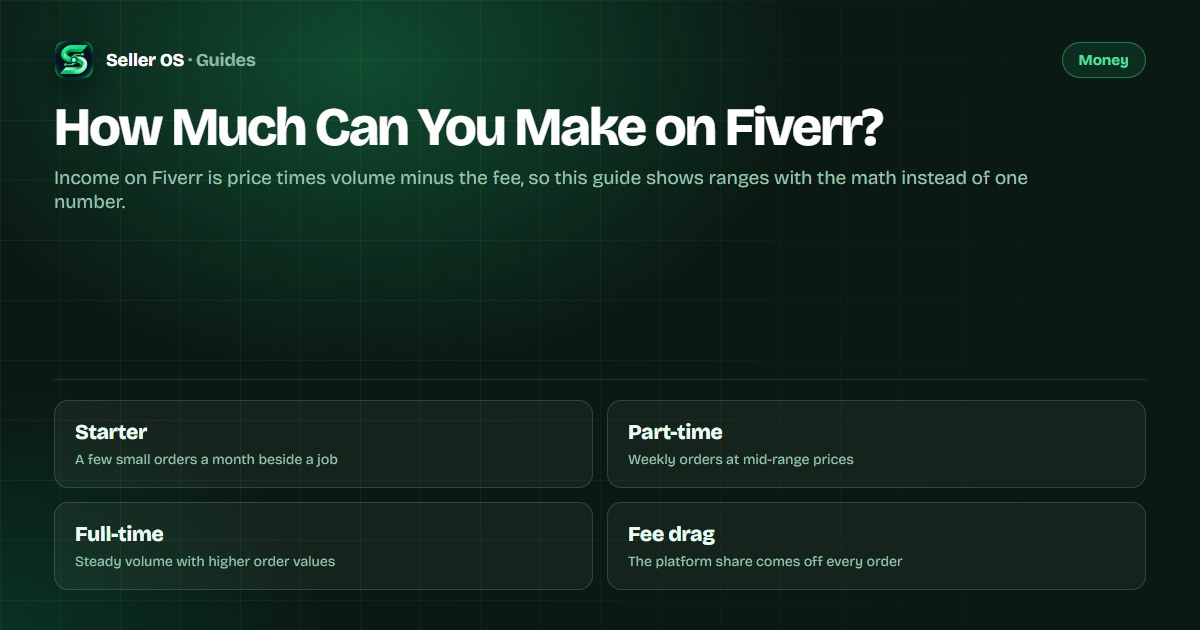
Take each profile as a worked example, not a forecast. The starter sells four orders at $25, which is $100 gross and $80 net at the 80 percent payout. The part-time seller completes twelve orders at $50, which is $600 gross and $480 net. The full-time seller delivers forty orders at $75, which is $3,000 gross and $2,400 net. Same arithmetic each time: orders times price times 0.8.
Notice which input does the heavy lifting. Doubling your order value doubles your income at the same workload, while doubling your volume doubles your hours. Most sellers who grow past the part-time band do it by raising prices and order values first, then adding volume. The orders math guide extends this arithmetic to a specific monthly target.
| Profile | Gross | Payout | You keep |
|---|---|---|---|
| Starter: 4 orders at $25 | $100 | 80 percent | $80 |
| Part-time: 12 orders at $50 | $600 | 80 percent | $480 |
| Full-time: 40 orders at $75 | $3,000 | 80 percent | $2,400 |
What moves the number most
Five variables explain most of the gap between profiles. Average order value matters more than anything, because packages, extras, and custom offers raise what each order is worth without adding delivery days. Conversion rate decides how many visits become orders, and repeat buyers compress the whole funnel because they skip search entirely.
Category choice sets the ceiling your prices can reach, and delivery capacity sets how many orders you can carry without late deliveries hurting your standing. A seller in a $20 category with full weeks earns less than a seller in a $200 category with half the orders, which is why price positioning beats raw hustle once the basics work.
- Average order value: packages and extras raise what each order is worth.
- Conversion rate: more visits turning into orders at the same traffic.
- Repeat buyers: past clients who reorder without a new search.
- Category ceiling: what buyers in your niche already pay.
- Delivery capacity: orders you can finish on time, every time.
Fees and your real take-home
Plan in net terms from day one. At the 80 percent payout, a $25 order puts $20 in your account, a $50 order puts $40, and a $150 order puts $120. Withdrawal routes can add their own small charges on top, which is why the fee calculator exists for live numbers rather than memory.
Taxes sit outside the platform entirely. Fiverr does not withhold for you in most cases, so set aside a share of each payout as it lands and keep records from the first order. Treat the payout figure as revenue, not profit, until you have subtracted your costs and your tax reserve.
Raising the ceiling without more hours
If the math shows your current price cannot reach your target at a sane volume, the answer is rarely more orders. It is higher order values: a stronger middle package, an extra buyers actually add, or custom offers that scope bigger projects. The raise playbook walks through that sequence, and the pricing guide covers the foundations.
New sellers should read this in the other direction. Your first months are for proof, not for maximum rates, and the first-3-months timeline sets honest expectations for that stretch. Earn the reviews at sustainable prices, then move the price while the proof compounds.
Where Seller OS helps
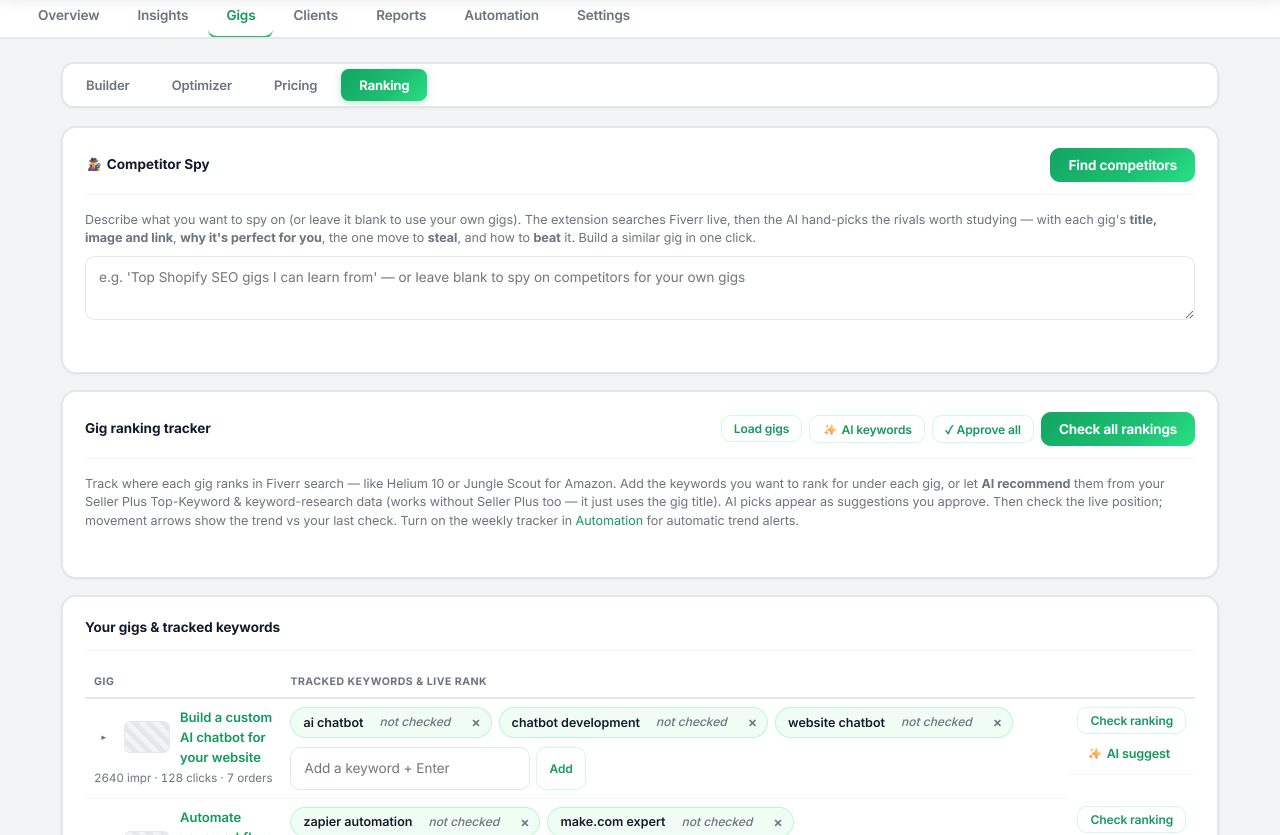
Seller OS keeps the income math visible while you work. Its analytics views track how impressions turn into clicks and orders per gig, so you can see which input is actually dragging instead of guessing, and the pricing review checks your tiers against assumptions you set.
Everything stays local and draft-first. The extension reads your gig data in Chrome local storage, never publishes or prices anything on its own, and a person completes every change on Fiverr.
How Much Can You Make on Fiverr? questions
How much can a beginner make on Fiverr per month?
A beginner with a few small orders often nets under $100 a month after the 80 percent payout, which is normal while proof is thin. Four orders at $25 leave you $80, for example. Income grows as reviews accumulate and order values rise, not on a fixed schedule, so treat early months as foundation work rather than a verdict on the platform.
Can you make a full-time living on Fiverr?
Some sellers do, usually by combining steady volume with order values well above entry prices. Forty orders at $75 gross $3,000 and net $2,400 at the 80 percent payout, which shows the shape required. It takes established reviews, repeat buyers, and capacity systems, and results vary widely by category and effort.
What percentage does Fiverr take from sellers?
Fiverr states that sellers earn 80 percent of each completed order amount, so the platform share is 20 percent of the order value. Plan every price and monthly target in net terms by multiplying by 0.8 first. Withdrawal routes may add their own small charges, which the fee calculator on this site can model.
Why do Fiverr income figures online disagree so much?
Because they average across sellers with nothing in common, from occasional five-dollar tasks to four-figure custom projects. A single mean across that spread describes nobody. Ignore platform-wide averages and work from your own price point and realistic order volume, run through the 80 percent payout, to get a figure that means something.
Do your own math before you set targets.
Pick a price, pick a volume, multiply by 0.8, and see which input must move.