 Seller OS
How to raise Fiverr prices without losing orders
Every growing Fiverr seller reaches the moment when prices lag behind proof. Reviews accumulate, delivery gets faster, and the old rate starts costing money on every order. Raising prices is how the account catches up with the work.
This guide is a raise playbook: when the timing is right, how much to move, whether to touch packages or base price first, how to test the increase, and what to tell repeat buyers. It covers the mechanics of raising, distinct from answering objections or pricing from scratch.
Free plan available. Local-first data. Human review on every change.
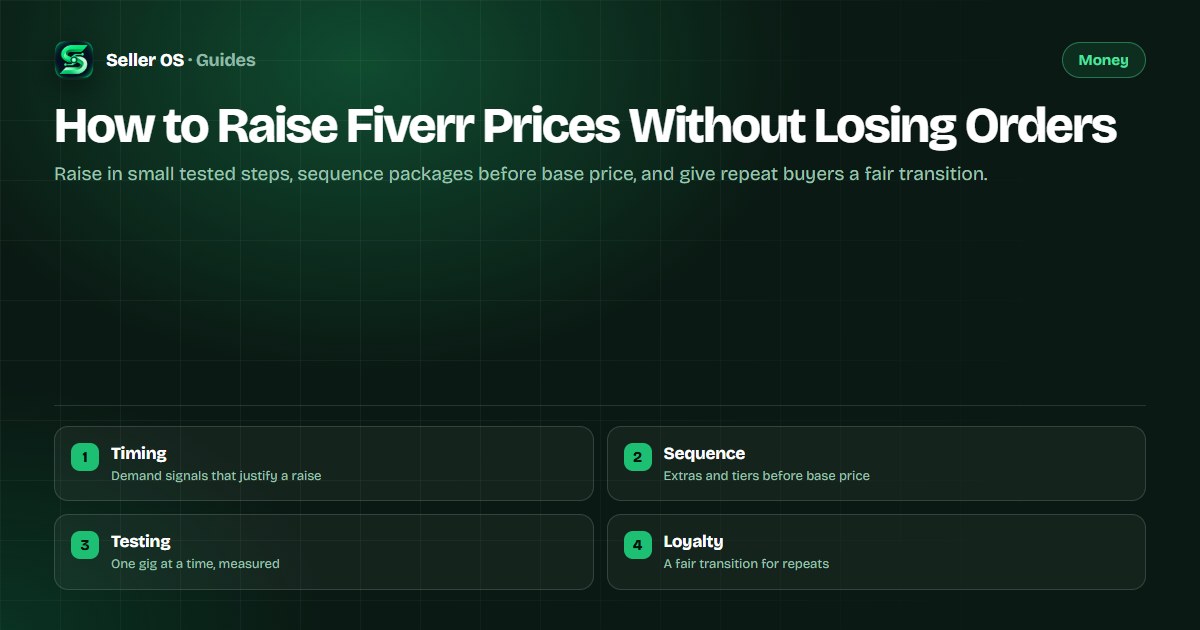
When the timing is right
Raise on evidence, not on feeling. The reliable signals are a full queue at current prices, conversion that stays strong while competitors charge more, and buyers who accept quotes without negotiation. Each one says demand exceeds your price, which is exactly the gap a raise closes.
Two moments deserve caution. Do not raise during a demand dip, when fewer orders may reflect the market rather than your price, and do not raise the week you publish a new gig with no history. The raise belongs to proven gigs with steady flow, where the data can confirm the decision afterward.
- A queue that stays full without discounting or pleading.
- Strong conversion while comparable sellers charge more.
- Repeat buyers who reorder without questioning the quote.
- Delivery so practiced that each order costs you less time.
How much to move, and in what order
Move in steps of roughly ten to twenty percent, then let the data settle before the next step. A $50 package becomes $55 or $60, not $80 overnight. Small steps are measurable: if conversion holds, the raise worked, and if it slips, you know exactly which change to revisit.
Sequence matters as much as size. Raise extras and upper tiers first, because they affect fewer buyers and carry the highest margin. Then strengthen the middle package, which most buyers choose. Touch the base price last, since it anchors every comparison. Fiverr describes custom offers as a tool for tailored solutions, and bigger scoped offers are a quiet way to lift average value without touching gig prices at all.
Test the raise on one gig first
Treat the raise as an experiment with a control. Change one gig, leave the others, and watch clicks-to-orders over the next two to four weeks rather than the first few days. Short windows mislead because traffic varies; a fortnight of data tells you whether buyers still convert at the new number.
Read three signals together. Conversion rate is the verdict, inquiry quality tells you whether bargain hunters filtered themselves out, and revenue per order confirms the arithmetic. If conversion holds within its normal range while revenue per order climbs, commit the change and consider the next step. The pricing and conversion guide models these trade-offs in depth.
What to tell repeat buyers
Repeat buyers deserve notice before they meet the new price at checkout. A short message works: thank them for the steady work, name the new rate and its start date, and honor the old rate for one final order or a short window. The transition costs you little and protects the relationships that took months to build.
Example message, labeled hypothetical: Thanks for the steady projects this year. From next month my project rate moves from 150 to 175 to reflect the current scope. I will honor 150 for one more order placed before then, and I would be glad to keep working together. Notice the structure: gratitude, number, date, and a bridge, with no apology for the value.
If orders dip after the raise
A small dip is part of the bargain, not proof of failure. Fewer orders at higher value can still net more with fewer hours, so compare revenue and hourly return before comparing order counts. Panic-reverting on week one abandons the experiment before the data exists.
Revert only on a clear signal: conversion down substantially for a full month with traffic steady, or a silent inbox where inquiries used to arrive. Roll back one step, not to the starting price, and let that settle. If the numbers hold, the raise was simply the market telling you what the work is worth, and the objection guide handles the buyers who still hesitate.
Where Seller OS helps
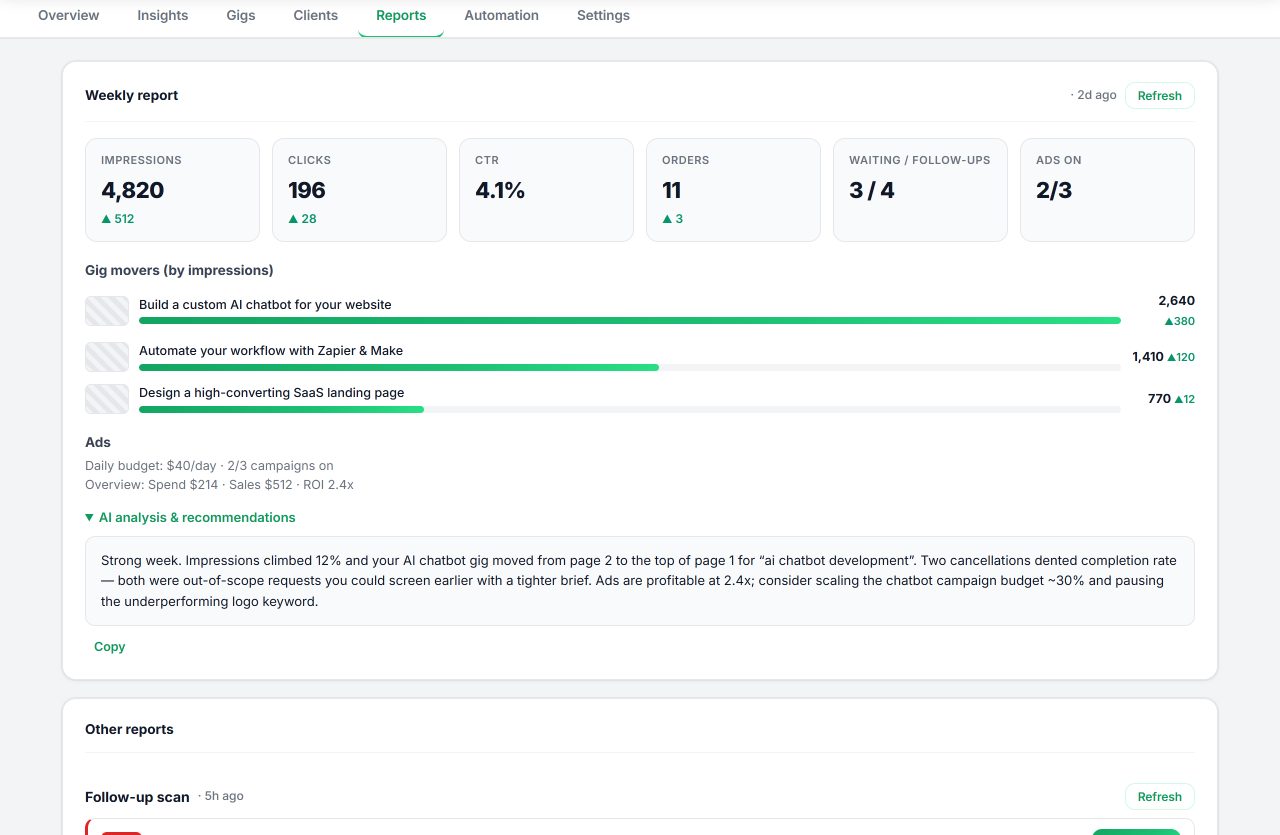
Seller OS makes raises measurable instead of anxious. Its analytics views track clicks-to-orders per gig, so a test raise shows its effect in the same place you decided it, and the pricing review remembers recently applied prices so stepwise increases stay deliberate.
As always, the extension only informs. It drafts, tracks, and compares locally in Chrome storage, while every price change on Fiverr is made by you.
How to Raise Fiverr Prices Without Losing Orders questions
When should I raise my Fiverr prices?
Raise when demand exceeds price: a consistently full queue, strong conversion while competitors charge more, and buyers who accept quotes without haggling. Avoid raising during demand dips or on brand-new gigs without history. The raise belongs to proven gigs with steady flow, where several weeks of data can confirm the decision.
How much should I raise Fiverr prices at once?
Move in steps of roughly ten to twenty percent, then let conversion data settle for two to four weeks before the next step. Raise extras and upper tiers before the middle package, and the base price last. Small tested steps tell you exactly which change worked, while a sudden doubling leaves you guessing if orders slip.
Will raising prices lose my repeat buyers?
Not if you give them notice and a bridge. Tell repeat buyers the new rate and its start date before they meet it at checkout, and honor the old rate for one final order or a short window. Most established clients accept an explained increase, because they are paying for proven reliability rather than shopping on price.
What if orders drop after I raise prices?
Compare revenue and hourly return first, since fewer orders at higher value often net more with fewer hours. Revert only on a clear signal: conversion down substantially for a full month with steady traffic. Roll back one step rather than to the starting price, and let that settle before judging again.
Raise on evidence, one step at a time.
Move ten to twenty percent, measure conversion, then decide the next step.