 Seller OS
Fiverr gig pricing vs conversion: how price affects orders
Price does two jobs at once on Fiverr: it decides who clicks, and it decides what each order earns you. Move it up and you may lose clicks; move it down and you need more orders to keep the same income. Neither direction is automatically right.
This guide shows the arithmetic behind that trade with a worked model clearly labeled as an example, explains how the three package tiers frame each other, and gives you a clean way to test one price change without wrecking your history.
Free plan available. Local-first data. Human review on every change.
The two numbers a price change moves
Fiverr gives you two lenses on conversion, and they are not the same calculation. The per-gig dashboard defines conversion rate as total orders divided by total impressions for that gig. Seller Plus keyword and performance views describe conversion as orders after clicks, and the mobile dashboard counts orders resulting from clicks after views.
That distinction matters when you test price. If you track the dashboard number, a price change that reduces impressions also changes the denominator. If you track orders per click, you isolate whether buyers who saw the page still wanted it. Decide which number you are reading before the test starts.
- Dashboard conversion: orders divided by impressions, per gig.
- Seller Plus views: orders after a click.
- Your own metric: one formula, written down, never changed mid-test.
Modeling the demand band before you edit
Every price sits inside a band. At the top, buyers question the value and clicks fall away. At the bottom, orders arrive but each one earns too little. The band is specific to your service, your proof, and the prices shown around you, and Fiverr publishes no benchmarks, so model your own trade with your own numbers.
The table below is arithmetic, not prophecy. A 20% cut asks for 25% more orders from the same traffic just to stand still; a 20% increase allows roughly one fewer order to match the same earnings. Whether either trade is available depends on your clicks and your page, which is what the test measures.
| Package price | You earn per order | Orders needed to match $512 |
|---|---|---|
| $80 | $64.00 | 8 orders (the baseline) |
| $64 | $51.20 | 10 orders, 25% more volume |
| $96 | $76.80 | 7 orders, fewer but higher value |
Anchor tiers and the middle default
Fiverr lets you offer up to three packages: Basic, Standard, and Premium. The middle package is usually the one buyers compare against, so its price and scope do the framing work. If the middle tier is a thin version of the top one, buyers drift down; if it is a clear step up from Basic, it becomes the natural choice.
A hypothetical resume gig: Basic single-page edit at $35, Standard rewrite plus cover letter at $85, Premium rewrite, LinkedIn summary, and 24-hour delivery at $165. Each tier adds a named deliverable and a speed or format difference rather than a vague promise of more.
Fiverr's Help Center documents the package mechanics in Creating and managing Gig packages: the three-tier structure, the $5 starting price, and the categories where a higher minimum applies. Read it before you promise a price you cannot list.
Signals that say raise, hold, or restructure
Price decisions should follow evidence you already have: the questions in your inbox, the orders that arrive, and the patterns in your gig analytics. The signals below are practical reads from your own data, not published thresholds.
| Signal | Where you see it | Likely move |
|---|---|---|
| Custom offer requests above your top tier | Inbox messages | Add a higher tier or extra, not a new gig |
| Clicks steady, orders flat | Per-gig analytics | Check the page and promise before price |
| Buyers negotiate scope down, not price | Inbox messages | Restructure so entry scope is honest |
| Repeat buyers ask for more work | Repeat business analytics | Hold price and add a tier for the bigger brief |
| Questions about what is included | Description and FAQ copy | Rewrite scope before discounting |
How to test a price change cleanly
A price test is only useful if the result can be attributed to the price. That means one change, one gig, one measurement window, and everything else held still. Fiverr's per-gig statistics default to the last 30 days, which makes a month the natural unit for the test.
If the result is inconclusive after one window, extend the test rather than stacking another change. Two simultaneous edits produce a number nobody can explain, and you will end up reverting both. Patience here is cheaper than an unexplained price war.
Change one package
leave the other two tiers exactly as they were.
Freeze everything else
no title, thumbnail, or description edits during the test.
Run a full window
Fiverr's per-gig statistics default to the past 30 days.
Compare like with like
the trend arrows compare the selected period to the previous one.
Judge on earnings and completed orders
conversion rate alone moves with traffic mix.
The margin math behind every tier
Fiverr states that for every order you complete, you earn 80% of the purchase amount, including gig extras and tips. So a $95 order puts $76 in your column before your own costs, and a 20% discount on that order takes $15.20 out of your earnings rather than out of Fiverr's fee.
Set package prices so the cheapest tier still covers your time, then use extras to raise order value without raising the entry price. Fiverr lists three extra types: fast delivery, revisions, and additional extras, with source files available in specific categories only. Extras are the honest way to sell speed or scope.
This is also why the packages guide and the pricing question belong together: a tier structure with clear deltas converts better than three versions of the same thin offer.
What a price change cannot fix
A price cut cannot manufacture demand. If the gig earns no impressions, the problem is upstream: relevance, category, or a service nobody is searching for. If it earns impressions but no clicks, the thumbnail and title promise are doing the damage. Fix those first.
Nor can price fix scope confusion. When buyers ask what exactly they get, the description and FAQ need work, not a cheaper tier. Fiverr's description field allows up to 1,200 characters and the FAQ field up to 10 questions, which is room to answer the objections that are costing you orders.
Where Seller OS helps
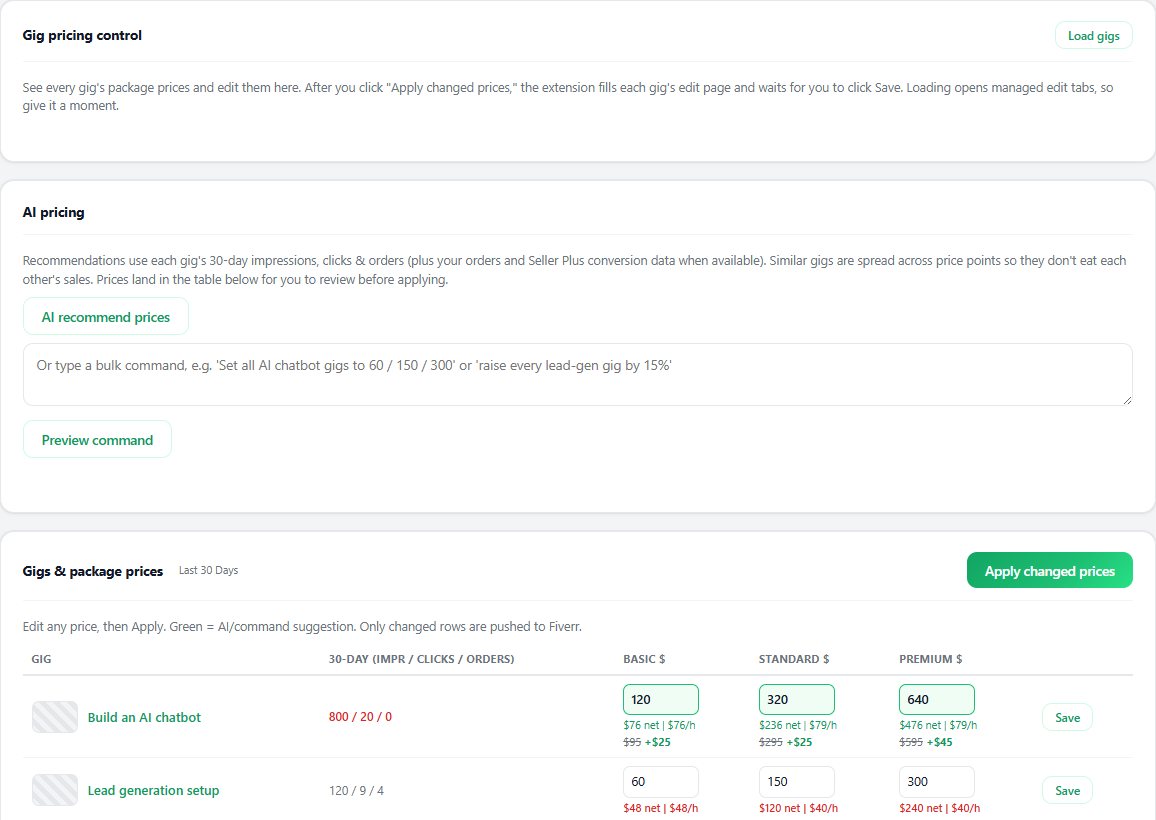
Seller OS keeps the arithmetic honest. The pricing review checks a gig's package structure against profit assumptions you set, flags tiers whose deltas do not justify their prices, and remembers the prices you recently applied so a test does not quietly overwrite itself.
It also connects the price question to the rest of the loop: gig audits propose page changes that can fix a conversion gap before you discount for it, and the Keyword Rank tracker shows whether a price move coincided with a position change. Nothing is published or sent without your review.
Fiverr Gig Pricing vs Conversion questions
Will lowering my price get more orders on Fiverr?
It can, but the math has a floor. A 20% cut means you need roughly 25% more orders to earn the same amount at the 80% payout, and Fiverr publishes no benchmark for how buyers respond. Test on one package, keep everything else fixed, and judge on earnings, not order count alone.
How do I know if my gig is priced too high?
Look for indirect signals: clicks that arrive but rarely convert, messages asking about cheaper scope, or custom offer requests that sit below your entry package. None is proof on its own. Check the page and promise first, then test one price change across a full 30-day window.
Should my three Fiverr packages be priced far apart?
Far enough apart that each tier buys something named: scope, speed, format, or rights. The middle package usually frames the choice, so it should read as a clear step up from Basic rather than a slightly bigger version of it. Fiverr allows up to three packages with no published rule on the gap.
Do Fiverr extras affect conversion?
Extras give buyers a way to raise order value without changing your entry price, and Fiverr lists fast delivery, revisions, and additional extras as the three extra types. Whether yours help is something to read in your own analytics and inbox, not something Fiverr publishes a benchmark for.
Model the trade before you move a price.
Run your own numbers, change one package, and let a full stats window give the verdict.