 Seller OS
Fiverr client says your price is too high
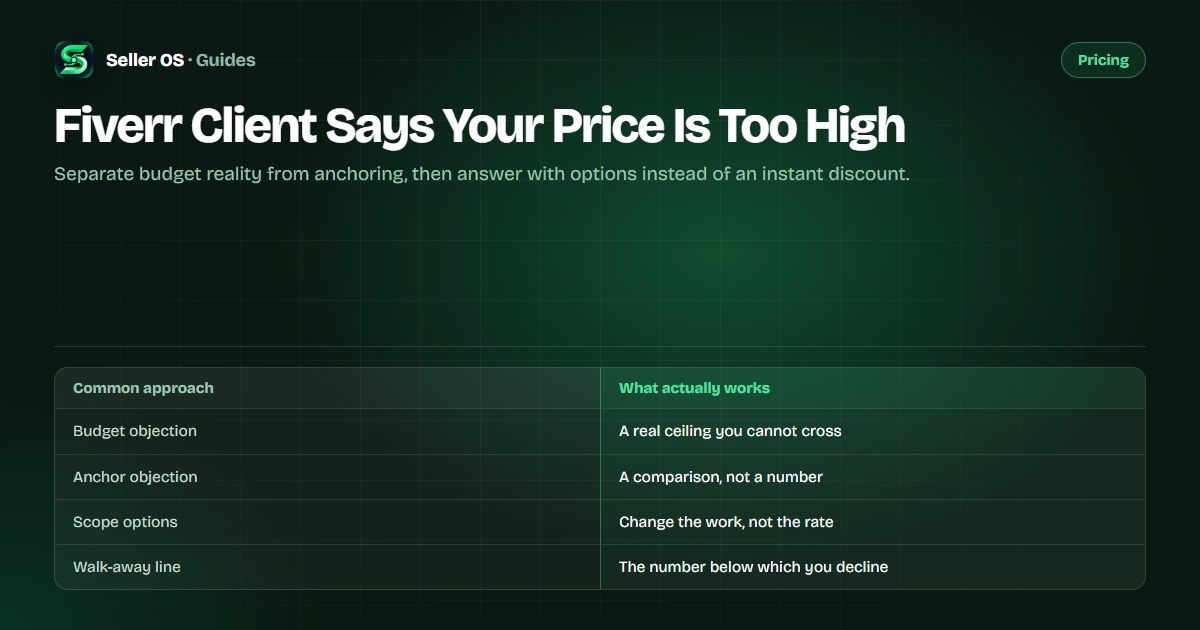
The price objection arrives in two flavors, and they need different answers. One buyer has a real budget that cannot reach your rate. The other has no fixed number in mind, only an anchor from somewhere else. Guessing wrong costs you either the order or your margin.
This guide separates the two, gives a reply that gathers the missing information, shows three scope options that keep the rate, and helps you set the line where you politely decline.
Free plan available. Local-first data. Human review on every change.
Budget or anchor? Read the message twice
A budget objection names a constraint: the project has a fixed amount, a grant, or a manager with a limit. An anchor objection names a comparison: a cheaper seller, a past project, or a marketplace average. Budgets need scope changes; anchors need information.
The first reply decides which one you are dealing with. The common mistake is discounting before you know, which negotiates against yourself and teaches the buyer that the first number was fiction. Ask one question and the message usually reveals itself.
Tone matters too. The objection is about money, not about your worth, and the reply should sound like a colleague solving a constraint rather than a seller defending a number. Warmth costs nothing and keeps the conversation open even when the answer turns out to be no.
- I only have 200 for this. A budget with a number attached.
- That is more than I paid last time. An anchor, and last time may have been a smaller job.
- Other sellers quoted less. A comparison, unless you know the scope matched.
The first reply: one question, no discount
Example reply, labeled hypothetical: Thanks for telling me straight. Help me understand what I am working with: is 200 the ceiling for the whole project, or is that what you had in mind before seeing what is included? If it is the ceiling, I can show you what fits inside it. If it is a starting point, I can show you the version that gets the full result.
This message does three things. It thanks them for the honesty, it separates budget from anchor with a question they can actually answer, and it promises two different paths. Neither path is a discount on the same work, which is the trap this reply avoids. Notice what the message does not do: it never defends the price and never apologizes for it.
Do the math before you move a number
Fiverr states that for every completed order you earn 80 percent of the purchase amount, so a discount comes out of your side of the table. A 20 percent cut on a 500 dollar project removes 100 dollars from the order price, which is 80 dollars out of your earnings at the 80 percent payout, not from the platform's fee. Run the arithmetic before you answer.
A worked, hypothetical example: your rate is 500 and you would still profit at 400. The buyer says 200. Instead of countering at 450, you keep 500 as the reference and show a 200 version with named limits: one deliverable instead of three, standard turnaround instead of priority, and no source files. Same rate, smaller scope.
| Quote | Discount | You receive | Difference |
|---|---|---|---|
| $500 | 0% | $400 | Baseline |
| $500 | 10% | $360 | -$40 |
| $500 | 20% | $320 | -$80 |
| $500 | 30% | $280 | -$120 |
- Would I take this order at that number on a quiet week?
- Does the lower number still cover my costs and my time?
- If I say yes, what does every future quote from me become?
Three scope options that keep the rate
When the budget is real, change the work rather than the rate. The three moves that preserve your pricing logic: reduce the deliverables, move the deadline to a slower lane, or split the project into phases.
Phasing is the strongest of the three. A milestone custom offer can hold up to five steps, and you get paid as each step is completed, so the buyer starts smaller without feeling like they bought a lesser service. A hypothetical example: the full brand kit is 600, the first milestone is the logo and type system at 250, and the rest is a second milestone later. Fiverr describes custom offers as a tool for tailored solutions, and scope is exactly what tailoring means.
Answer an anchor with evidence, not emotion
When the objection is a comparison, do not defend your rate; describe the difference. Their last project may have been half the scope, a template instead of custom work, or a seller building a portfolio. State what your price includes that the comparison cannot match, and let the buyer judge.
Example anchor reply, labeled hypothetical: That makes sense if the last project was a single thumbnail. For the full set, the price covers custom illustration, two revision rounds, and the source files in three formats. If the scope was actually identical, I would rather part as colleagues than match a price I cannot sustain.
“Custom offers are a tool for freelancers to provide tailored solutions that may not be covered by standard Gigs.”
— Fiverr Help Center, Creating and managing custom offers, September 2026
Set your walk-away line, then use it
Your walk-away line is arithmetic, not attitude: the lowest number at which the order still pays your hourly target after the 80 percent payout and your own costs. Write it down before the negotiation starts, because it is much harder to invent under pressure.
When the buyer's ceiling sits below the line, decline cleanly and leave the door open: name what their budget can buy from you, or point them to the scope that fits, then move on. A polite no protects the pricing that every previous buyer has already accepted. The pricing and conversion guide models the trade in more detail.
A polite no, labeled hypothetical: I cannot deliver the full set at 200 without cutting the quality I would have to put my name on, so I will pass this time. If you want the smaller version at that budget, I am glad to do it, and the door stays open either way.
Where Seller OS helps
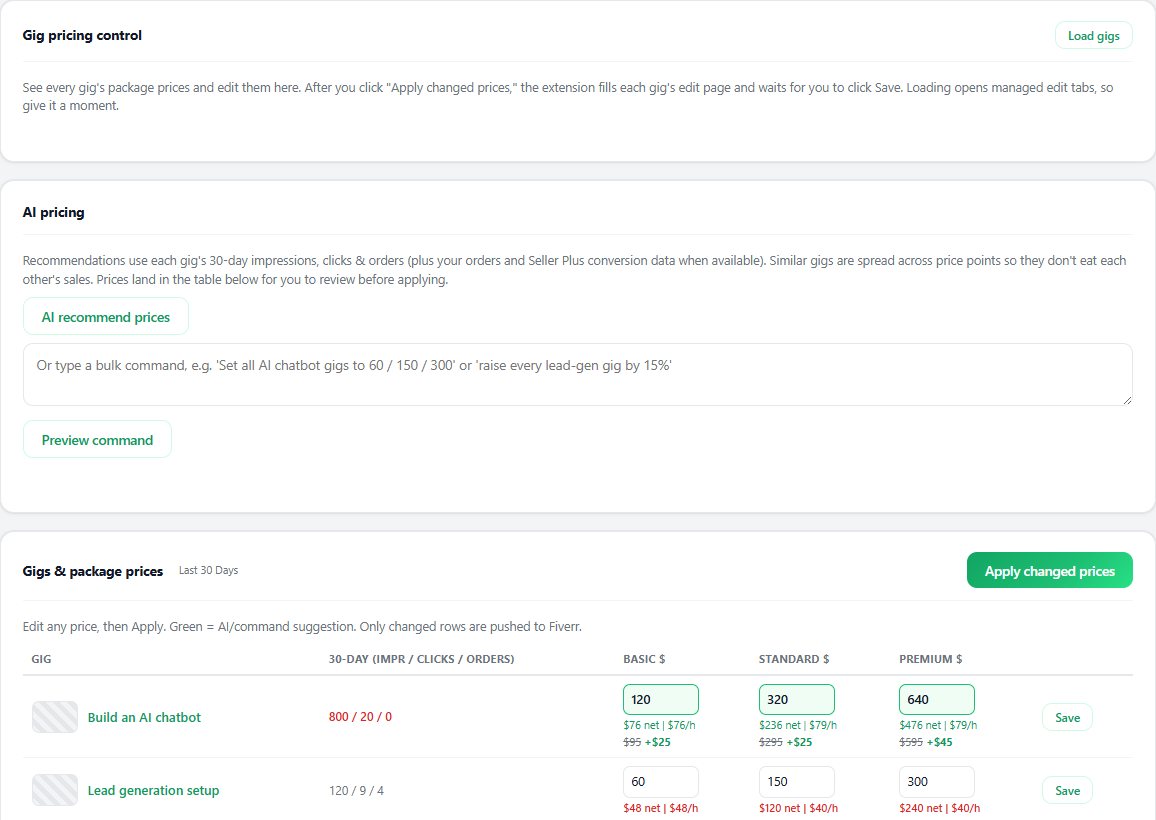
Seller OS keeps the floor in front of you. The package pricing review checks a gig's tiers against profit assumptions you set and remembers the prices you recently applied, so an ad hoc discount does not silently become your new price.
For the reply itself, the inbox assistant can draft an objection response from the conversation context, and you edit before sending. The extension does not discount, accept, or send offers on its own.
Fiverr Client Says Your Price Is Too High questions
How do I respond when a Fiverr client says my price is too high?
Thank them, then ask whether the number is a ceiling or a comparison. Their answer tells you whether to offer a smaller scope or to explain what the price includes. Do not discount in the first reply; a discount before you understand the objection gives away margin and teaches the buyer that your first number moves.
Should I lower my price to win a Fiverr client?
Only when the arithmetic works. You keep 80 percent of the purchase amount, so a 20 percent discount on a 500 dollar project costs you 80 dollars. If the budget is real, cut the scope rather than the rate: fewer deliverables, a slower lane, or a first milestone. Keep your rate intact and let the version change.
What do I say to decline a Fiverr project politely?
Decline the work, not the person. Name the version their budget can buy, or say plainly that you cannot do the full scope at that number, and wish them well. Keep it to two or three sentences, avoid explaining your costs, and leave the thread open in case the scope changes later.
Can a Fiverr client negotiate a custom offer?
Yes. A client can accept, decline, or ask for changes, and you can withdraw an offer before it is accepted or expires. Use that loop to adjust scope rather than just the number: a redesigned offer with fewer deliverables and a clear timeline gives the buyer a real choice, while a bare price cut only resets the anchor.
Answer the objection with a choice.
Offer three ways forward, keep your floor in writing, and let scope move before price.