 Seller OS
Fiverr gig packages: how to create Basic, Standard and Premium
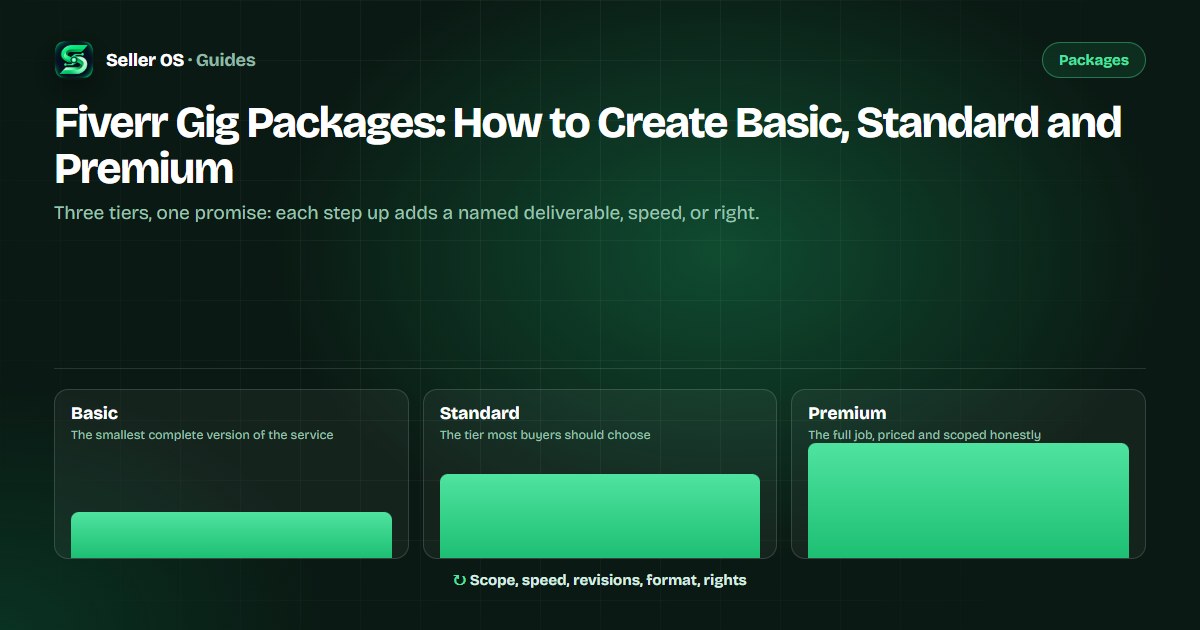
Fiverr lets you offer up to three packages on a gig: Basic, Standard, and Premium. The names are standard, but the design decisions are yours, and that is where sellers get stuck. A package ladder should make the choice easier, not present three versions of the same thin offer.
This guide covers the deltas that make tiers feel real, what should never change between them, why the middle tier usually becomes the default, and a worked example. It links the pricing guide for rate math instead of repeating it.
Free plan available. Local-first data. Human review on every change.
What the three packages actually decide
Packages are the comparison unit on a gig page. Fiverr allows up to three: Basic, Standard, and Premium, and each one carries its own delivery time in days, revision count, and price in USD. Buyers rarely read three descriptions start to finish; they compare columns, so the design has to survive a table.
Fiverr's Creating and managing Gig packages article documents the structure, including the requirement to offer at least one revision option per package and the 5 dollar starting minimum, which is higher in some categories. Read it once so your ladder fits the rules your category enforces.
Packages also set the floor of your order value and the shape of every conversation after checkout. If the entry package is unclear, you will spend the order explaining what it excludes. If the top package is thin, custom work keeps arriving without a price attached.
Give each tier one visible, named delta
A tier earns its price by adding something a buyer can name: more scope, a faster lane, extra revisions, or a new format. Pick one primary delta per step and state it in the package name or its first line. If you cannot describe what changed in a single sentence, the buyer cannot see a reason to step up.
The lazy delta is the word more. More of what, exactly? Contrast a weak step, revision count doubled, with a strong one, adds the vertical cutdown and the subtitle file. The second version is checkable, and it prices work you actually perform.
The fastest test for a delta is to read the package table aloud. If two tiers sound like the same sentence with a different number attached, the step is not real yet.
| Weak delta | Named replacement |
|---|---|
| More revisions | Two full revision rounds on the same concept |
| Faster delivery | Three-day delivery instead of five |
| Better quality | Source files plus a second aspect ratio |
| More content | Two extra scenes up to 20 seconds |
Build the ladder: a worked example
Here is a worked example for a podcast editing gig, labeled hypothetical. The numbers are placeholders that show the mechanics; your own costs and your market decide the real ones. What matters is the pattern: every step adds a deliverable a buyer can picture.
Each tier changes only what it needs to. Basic stays a complete edit. Standard adds the thing most podcast buyers want between episodes, a clip they can post. Premium expands the volume of the same work instead of inventing a different service.
The table below is a hypothetical three-tier podcast editing gig. Read it as a buyer would: the step from Basic to Standard adds time, a revision, and a clip; the step to Premium roughly doubles the deliverable. Both moves are legible without opening a single package description.
Note the arithmetic in the example: the middle step is roughly double the entry price, and the top step is roughly double the middle. That progression is a placeholder, not a rule; it simply keeps each step big enough to notice and small enough to consider.
| Tier | Deliverable | Delivery | Revisions | Price |
|---|---|---|---|---|
| Basic | One episode to 30 minutes: cleanup and mastering | 3 days | 1 | $45 |
| Standard | One episode to 60 minutes plus an audiogram clip | 4 days | 2 | $95 |
| Premium | Two episodes plus audiograms and show notes | 5 days | 3 | $185 |
Why the middle tier is the default choice
Most buyers land on the middle tier when the ladder is built honestly, because it usually removes the single limitation they noticed in Basic. That makes Standard your real product: design it first, price it first, and write its description first. The other two tiers are built relative to it.
Basic still has to be a complete small result, not a warning. If the entry tier cannot satisfy anyone, buyers do not upgrade; they leave for a gig whose floor is usable. Premium should read as a genuine project, not as Basic with a multiplier attached to the same scope.
The tier table carries this balance better than any paragraph. A buyer should be able to default to the middle without regret, while the outer tiers serve the person who wants clearly less or clearly more than the standard case.
If your analytics later show most orders landing on Basic, the middle tier is not doing its job. Check whether the deliverable it adds is one the common buyer actually wants, before you touch a price.
What should stay identical across tiers
The quality standard, the communication rhythm, and the delivery process should not change with price. A Premium order earns more attention only through scope, not through care. When buyers sense that cheaper tiers receive worse treatment, the whole ladder loses trust, and trust is what makes the comparison easy.
Put the differences where buyers can see them. Each package description states what is included and what is not, and the FAQ answers the boundary questions the tiers raise. The FAQ guide shows how to turn the most common package question into a short public answer.
One more constant is the revision policy language. If Basic and Premium describe revisions in different vocabularies, buyers assume the rules differ in ways you did not intend, and they will ask you to clarify before they order.
A useful test: cover the prices and read the three descriptions on their own. If the steps are not obvious without the numbers, the copy is carrying the ladder instead of the design.
Price the ladder without repeating the math
Fiverr pays 80 percent of the purchase amount on completed orders, and that figure is the floor every tier has to clear after your own costs. The arithmetic of raising, cutting, and matching earnings is covered in the pricing guide and the pricing vs conversion guide; this page only sets the rule.
The rule: no tier exists below your margin, and no tier is priced so low that a busy week turns it into a loss. Set the middle price from your time and costs, then step the other two so every move buys something named.
If the math says the entry tier cannot be both competitive and profitable, that is a signal about the service, not the price. Narrow the scope until the floor holds.
Package mistakes that flatten conversion
The most common mistake is three tiers that differ only in price. Buyers see the duplication, assume the cheapest is fine, and the ladder stops laddering. The second is burying the real difference inside a package description nobody expands. If the delta is not visible in the table, it does not exist for the buyer.
The third is letting the entry tier set a trap: revisions too few to finish a normal job, or a turnaround that almost guarantees a late delivery. Fiverr requires at least one revision per package, and a tier that cannot complete its own scope costs you the difference in messages and goodwill.
Review the ladder after every ten orders or so. Package problems show up as repeated pre-order questions, so the tiers and the description copy improve together, one change per window.
Finally, resist hiding a fourth shape inside a description with a line like message me for a bigger option. That is what tiers are for, and it keeps every comparison on the same table.
Where Seller OS helps
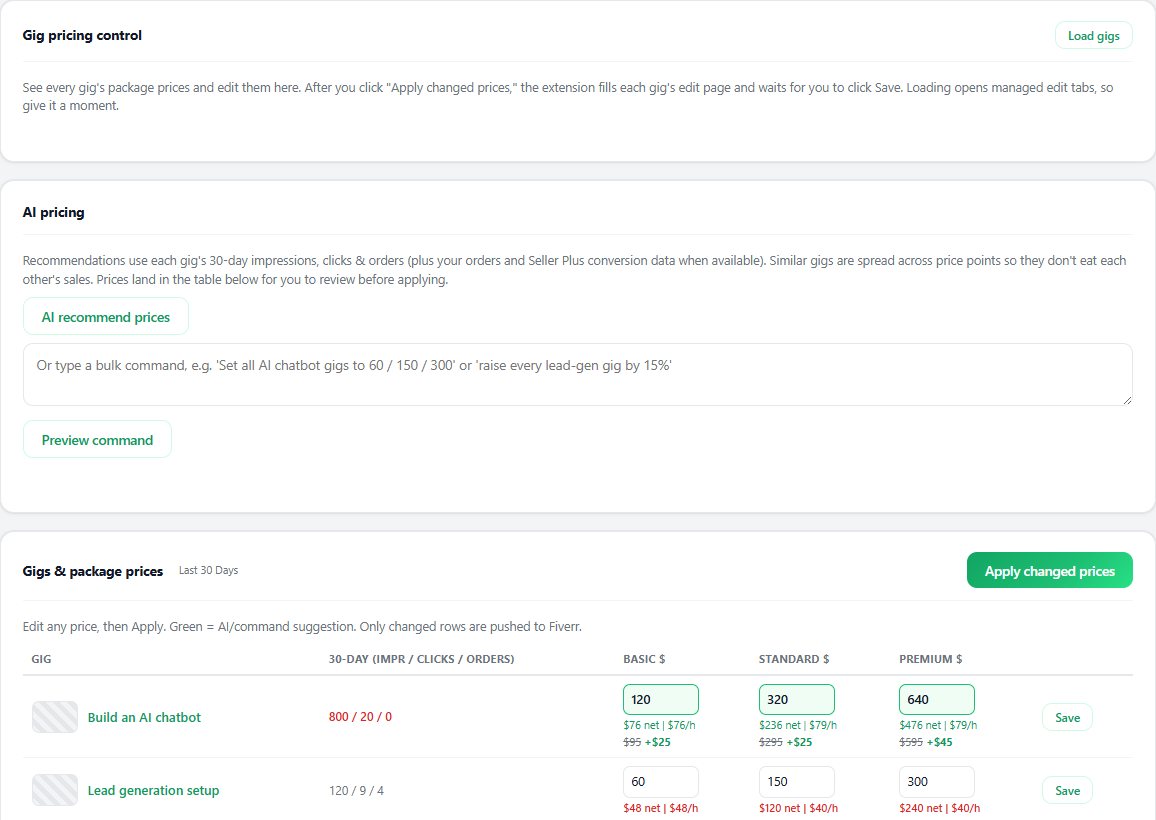
Seller OS can run the ladder past the numbers before you publish it. The package pricing review checks each tier against profit assumptions you set and remembers the prices you recently applied, so a test does not silently overwrite itself.
The Gig Builder turns a one-line idea into a structured gig with packages and fills the Fiverr wizard when you are ready; you complete every Save and Continue step. The gig audit then reviews the live tiers against the gig's own performance and proposes one change at a time.
Fiverr Gig Packages questions
How many packages can I offer on a Fiverr gig?
Fiverr allows up to three packages per gig: Basic, Standard, and Premium, each with its own price, delivery time, and revision count. You can sell with fewer, and some sellers run a single offer. A three-tier ladder is still the standard shape because it gives buyers something to compare rather than a yes or no.
What should change between Basic, Standard, and Premium?
Scope, speed, revisions, format, or rights: each step up should add at least one thing a buyer can name. A stronger tier that only says more of the same reads as an upsell, not an upgrade. Keep the middle tier as the one that solves the common case best.
Which package should I design first?
Design the middle tier first. It is the one most buyers choose when the ladder is clear, so it should carry your core deliverable at a price that clears your costs. Build Basic down from it as a smaller complete result, then push Premium up with a bigger scope, not a bigger promise.
Should the cheapest package be deliberately limited?
It should be small, but it must still be a complete result someone can use. Limits that punish the buyer, such as no usable revisions or a turnaround you cannot hit, invite cancellations and unhappy messages. Sell a smaller outcome, not a worse version of the same one.
Build a ladder buyers can climb.
Design the middle tier first, give every step a named delta, and let the package table do the comparing.