 Seller OS
How to write a Fiverr gig description that converts
A converting Fiverr gig description answers the buyer's questions in the order they are asked. Buyers scan the top of the page, check what is included, look for proof, and then decide whether to order now. Most descriptions fail not because the writing is bad but because the order is wrong.
This guide gives you a five-part structure — opening promise, scope, process, proof, next step — a paragraph rewrite you can adapt, and the field facts: up to 1,200 characters, keywords handled naturally, and the FAQ field carrying the details that do not fit.
Free plan available. Local-first data. Human review on every change.
Why structure beats clever writing
The description is scanned, not read. A buyer who arrived from search is comparing several tabs and deciding which seller looks safest to pay. Your first visible lines do more work than everything below them, and the middle of the page decides whether the price feels justified.
Structure is how you survive scanning: claims near the top, specifics in the middle, proof before the decision, and one clear next step. Fancy prose without order reads like noise. Plain sentences arranged in the buyer's question order are what convert.
Remember the comparison context. The buyer usually has two or three other gig pages open, and those descriptions are answering the same five questions. Your page does not need to be longer or more impressive; it needs to be easier to compare, with specifics that survive a quick scan.
The description is also the wrong place to argue with competitors. Buyers came to learn what you offer, not to read comparisons, and a page that spends its opening on what someone else does wrong delays the answer the buyer is waiting for.
The five-part description structure
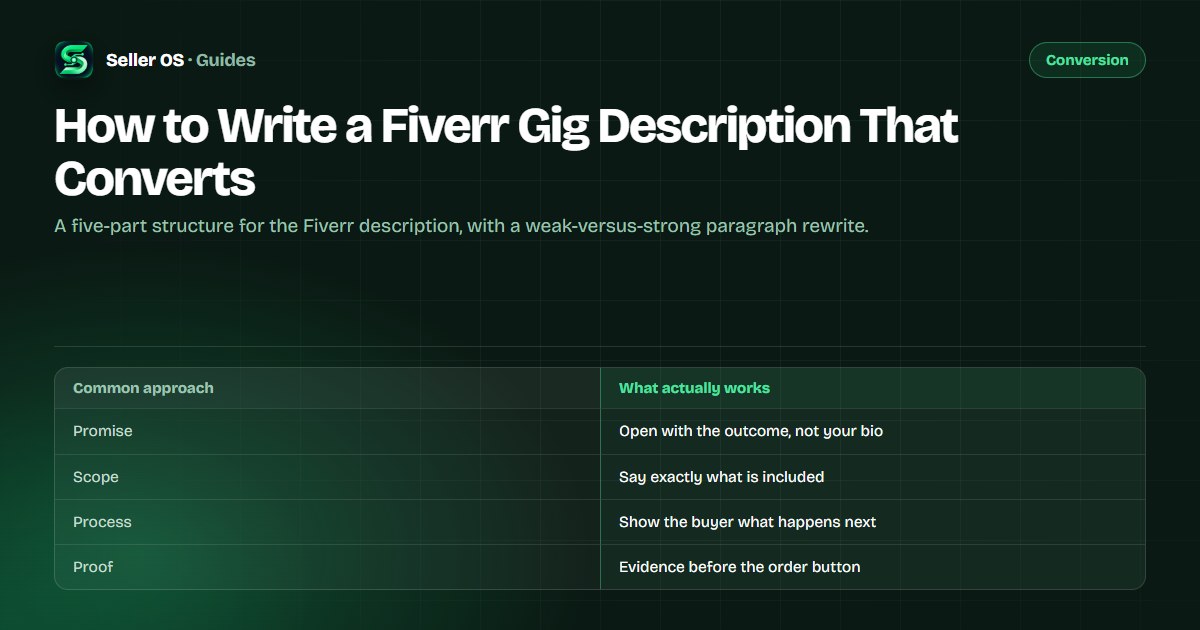
Here is the working order. Each part answers one buyer question: is this for me, what do I get, how does it happen, can I trust it, and how do I start. If a paragraph does not answer one of those five, cut it or move it into the FAQ field.
The structure also fits the character budget. A 1,200-character field is roughly 200 words, which is enough for a promise, a scope block, a short process list, and a proof sentence if every sentence earns its place. Padding with adjectives is how descriptions run out of room before the specifics.
Opening promise
two or three lines naming the buyer, the outcome, and the deliverable
Scope
what is included, what the revision count means, and what needs a custom offer
Process
three or four steps from order to delivery, written from the buyer's side
Proof
a real sample, a relevant result, or a specific fact about how you work
Next step
tell the buyer what to do, what you need from them, or when to message you
Weak versus strong: one paragraph rewritten
Weak version, as sellers often write it: I am a passionate designer with five years of experience. I love creating designs that make clients happy. I will do my best for your project. It says nothing about the buyer's job, the deliverable, or what happens after ordering, so the reader has to guess all three.
Strong version of the same paragraph: You get a logo your customers recognize at a glance. I design three concepts, you pick one, and one revision round turns it into files ready for print and web. Same length, and four buyer questions answered: what it is, how many options, what happens next, and what the files are for.
Read the two versions with the buyer's questions in mind. The weak paragraph makes the reader hunt for the deliverable; the strong one states it, counts it, and explains the next step. Neither version is longer than the other, which shows the problem was never the word count.
The rewrite works because it trades self-description for specifics. Experience claims do not survive scanning; deliverables do. The number of concepts, the revision behavior, and the file formats are exactly what a buyer compares across tabs.
Where keywords belong in the description
Fiverr's Advanced Analytics article states that the algorithm prioritizes title text first, then the positive keywords field, then the description. That order tells you where the main phrase belongs: in the title first, then the keyword field and tags, and only then a natural mention inside the description.
Write for the buyer and let the phrase appear where it honestly fits — once in the opening, once in scope, once in the FAQ if it answers a real question. A description stuffed with variants reads like spam and pushes the specifics out of the visible area, which costs more orders than the extra mentions could ever win.
The stuffing trap is worth naming directly. Repeating a phrase three times does not triple its weight, and it spends the space where specifics would have gone. One honest mention placed where the buyer reads beats a paragraph of near-synonyms no person would say aloud.
Keep the field's job straight: the title carries the strongest matching weight, and the description supports the buyer's decision. A description that competes with the title for keyword density weakens both.
Scope writing and the FAQ handoff
Scope paragraphs fail in one of two directions: too vague to compare, or too detailed to scan. Name the deliverable, the format, the revision count, and one boundary for what needs a custom offer. Boundaries prevent the revision conversations that erode both conversion and margin.
Details that do not belong in the description belong in the FAQ field, which Creating a Gig documents as holding up to 10 questions. Write the questions buyers actually ask in your inbox, and answer them the way you would in a message. The gig FAQ guide covers that field in depth.
Write FAQ answers as direct responses, starting with yes, no, or the number. Front-loading the answer means the skimmer gets the fact even if they read only the first line, and the full response serves the buyer who wants the reasoning.
| Weak line | Why it fails | Strong line |
|---|---|---|
| High quality work | Not comparable across tabs | Three concepts, one revision round |
| Fast delivery | No number attached | First draft in three days |
| Unlimited support | Reads as scope creep | Seven-day post-delivery questions |
Proof without invented credibility
Proof is evidence a buyer can check: delivery files in your portfolio, the Live Portfolio entries Fiverr tags as made on Fiverr, and reviews that describe the work. A specific sentence about how you handle a common problem in your category often beats a generic quality claim.
What you cannot do is manufacture proof. No invented numbers, awards, or client names, and no copied portfolio pieces. One honest sample that resembles the buyer's job outperforms a wall of adjectives, because the buyer is imagining their project landing in your workflow.
Placement matters as much as the files. Portfolio projects and Live Portfolio entries appear on your profile, your gig page, and your profession page, so a buyer can meet the work before they reach the packages. Keep the strongest sample where the decision happens.
Reviews work the same way. A review that mentions the situation, the deliverable, and the outcome tells a better story than a row of stars, which is why the details you build into the delivery experience eventually show up in proof you cannot fake.
Description mistakes that cost orders
The common mistakes are consistent: opening with biography, hiding the deliverable below a wall of adjectives, stuffing keywords until the specifics disappear, and ending without telling the buyer how to start. Each one breaks a different part of the decision.
One more mistake deserves naming: writing the description before the packages are settled. The description promises what the packages must deliver, so draft the tiers first and let the copy describe them accurately.
Also resist promising a turnaround you cannot hold. A description that advertises speed creates orders that start with pressure, and late deliveries erode the reviews that made the description credible in the first place. Write what you can repeat every week.
And leave the FAQ out of the description. Duplicating questions and answers uses characters the opening and scope sections need, and it makes the page repeat itself in a way buyers notice. Before you rewrite a live page, run it through the gig description checker field by field.
- Opening with who you are instead of what the buyer gets
- Listing tools rather than deliverables
- Cramming every edge case into the opening lines
- Ending without a clear next step
- Duplicating the FAQ inside the description
Where Seller OS helps
Seller OS helps with the parts sellers find hardest to draft. The Gig Builder can start from a one-line idea or a competitor URL and turn it into a structured gig with the copy laid out in the promise, scope, process, and proof order, then fill the Fiverr wizard while you complete Save and Publish. The Gig Performance Optimizer reviews a live description against the gig's own performance data when you want to revise instead of rewrite.
The character counter on this site is free and keeps you inside the field limits. Nothing here publishes for you, and any AI-assisted drafting runs through your own provider account or an eligible browser session — Seller OS does not include AI credits.
How to Write a Fiverr Gig Description That Converts questions
What should the first two lines of a gig description say?
The first two lines decide whether the rest gets read. Lead with the deliverable and the outcome for a specific buyer, then one line on how you work. For example: “I write product descriptions for Shopify stores that turn browsers into buyers. You get copy plus a style note in three days.” Detail can wait.
Do keywords in the description help me rank on Fiverr?
They play a smaller role than the title and keyword fields. Fiverr's Advanced Analytics article states that the algorithm prioritizes title text first, then the positive keywords field, then the description. Write the phrase naturally where it fits and keep the rest focused on the buyer.
Should I copy a competitor's description?
No. Their description is written for their proof, packages, and positioning, so copied text matches neither your offer nor your buyer. Use competitor pages to learn what buyers compare, then write your own structure with your own deliverables and samples.
How do I know if my description change worked?
Compare the same conversion metric over equal windows before and after the change, and change only the description so the result stays readable. Two to four weeks is a reasonable first window for a small gig. If clicks and orders are both thin, lengthen the window.
Write in the buyer's order
Start with the outcome, prove it before the order button, and end with one clear next step.