 Seller OS
Fiverr gig description checker: how to optimize your description
A description checker answers one question: does this description help a buyer decide, or does it just fill space? Fiverr allows up to 1,200 characters, which is enough room for a clear promise, a scannable scope, and a next step, and also enough room to bury all three.
This guide is an audit, not a writing lesson: four checks you can run on the description that is live right now, a worked example with three common failures, and the field limits Fiverr publishes. The writing craft itself lives in the description guide we link below.
Free plan available. Local-first data. Human review on every change.
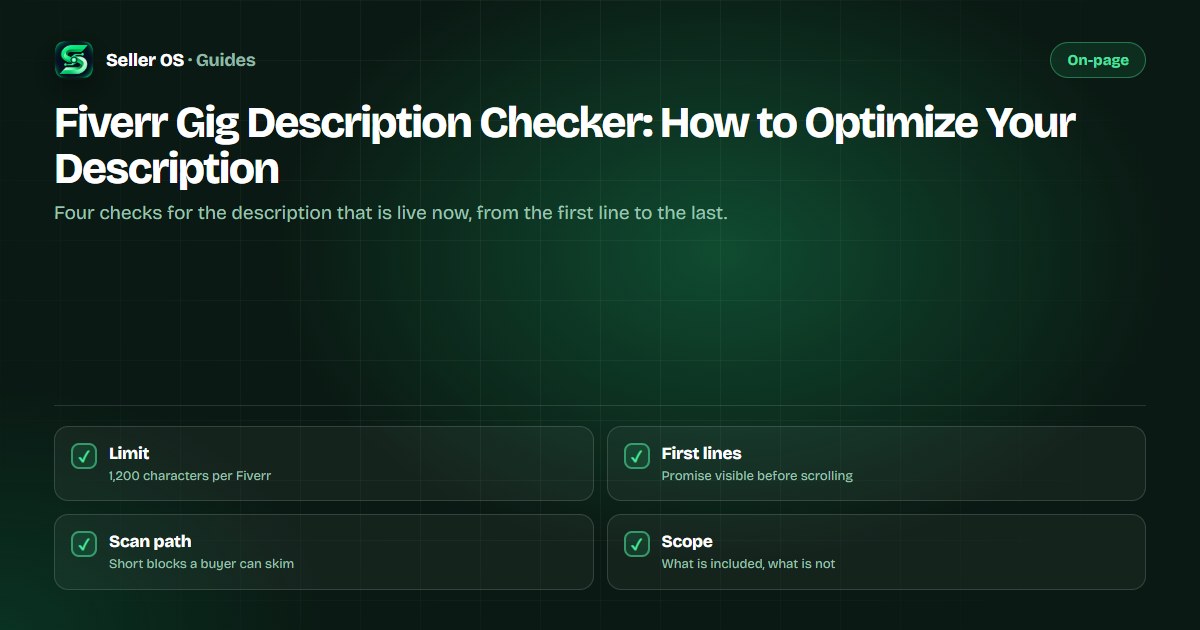
The published limits you are checking against
Fiverr's help center says to write a description of up to 1,200 characters, and it requires the English description to carry all the information even if you add another language. The FAQ field is separate and holds up to 10 questions. Those are the only hard numbers you need; the rest of this audit is about clarity. The rule is published in Fiverr's Creating a Gig article.
Two practical notes before you start. First, a character counter is the only reliable way to know where you stand against 1,200, because the draft changes as you trim. Second, the limit is a ceiling, not a target: filling all 1,200 characters is not an achievement.
Check 1: the first lines earn the scroll
Most buyers read the first two lines, then decide whether to keep reading or jump straight to packages. The opening should name the outcome and the audience in plain language: what exists at delivery and who it is for. A generic welcome spends the only attention you were guaranteed.
A useful test: cover everything after the second line and read only the opening. Can you tell what is sold, for whom, and what changes for the buyer? If not, the opening is a greeting, not a promise.
Compare the weak and strong versions of the same opening. Weak: Welcome to my gig, I am a professional with years of experience. Strong: I will make your WordPress site load faster, without breaking your theme. The second version names the deliverable and the boundary in one line, which is all the opening has to do.
Check 2: the description scans in blocks
Buyers skim on the way to the order button. Long unbroken paragraphs hide the scope; short paragraphs and a few plain bullets expose it. Structure comes from line breaks and ordering: promise first, then what is included, then how the process runs, then the next step.
Read the description in a phone-width column. If any paragraph runs longer than three or four lines there, split it. Scanning is the buyer's default mode, and density is what stops it.
Order the blocks the way a buyer decides: what they get, what is included, how the work runs, then the next step. A description that opens with process and buries the deliverable makes the reader hunt for the answer they came for.
- Opening: the promise and the audience, in the first two lines.
- Scope: what is included, as a short list.
- Process: how the work runs, without a lecture.
- Next step: what happens when the buyer orders.
Check 3: keywords support, not stuff
Fiverr's documentation puts the description third in matching priority: the algorithm prioritizes title text first, then the positive keywords field, then the description. The description confirms context; it is not the place to repeat a phrase five times.
Check that the primary phrase appears once, naturally, and that supporting phrases appear only where they describe real scope. If a phrase appears in the description but nowhere in the title, tags, or packages, either the phrase is wrong for the gig or a field is missing it.
A supporting phrase earns its place only when it describes work you actually do. If a phrase fits the search you want but not the service you deliver, it belongs in a different gig, not in this description.
Check 4: the scope is unambiguous
A buyer should not have to message you to learn what is included. State the deliverables, the revision approach, and the boundary: what this gig does not cover. Fiverr's help center lists order cancellations as one factor in your overall Success Score, so ambiguity here has a measurable cost later.
Cross-check the description against the packages. If the Basic tier includes one page and the description promises a full site, the page contradicts itself, and the buyer will trust the cheaper reading.
One boundary worth writing down: revisions. State how revisions work in the description the same way the packages state it, so the buyer learns the rule before the order starts, not during delivery.
Worked example: auditing a live description
The excerpt below is a hypothetical description for a WordPress speed gig, audited with the checks above. Each row shows the problem, the evidence, and the smallest fix. None of these require rewriting the whole description.
After the fixes, the description keeps its voice but passes all four checks. Note the order of work: fix the opening, then the structure, then the scope. If you are testing the change, run one layer per window so the movement has a cause you can name.
| Finding | Why it fails the check | Smallest fix |
|---|---|---|
| Opens with Welcome to my gig | First lines carry no outcome | Replace with what the buyer gets |
| One nine-line paragraph of features | Scan check fails at phone width | Split into a promise and four bullets |
| Fast, cheap, professional, reliable | Adjectives with no scope | Name the deliverable and the boundary |
Description mistakes the checks catch
The classic failures: a greeting opening, a wall of features, a keyword repeated until it reads like spam, and scope written to sound generous rather than precise. Each one fails a specific check, which is why the audit is a sequence instead of a vibe.
There is also a length problem: a description can fill all 1,200 characters and still say nothing, because length was treated as the goal. Trim to what a buyer must know, and let the packages carry the detail.
One more: leaving the description untouched while packages change. The description is the page's explanation layer, so when the offer changes, the explanation has to change with it, or the cheapest reading wins.
Where Seller OS helps
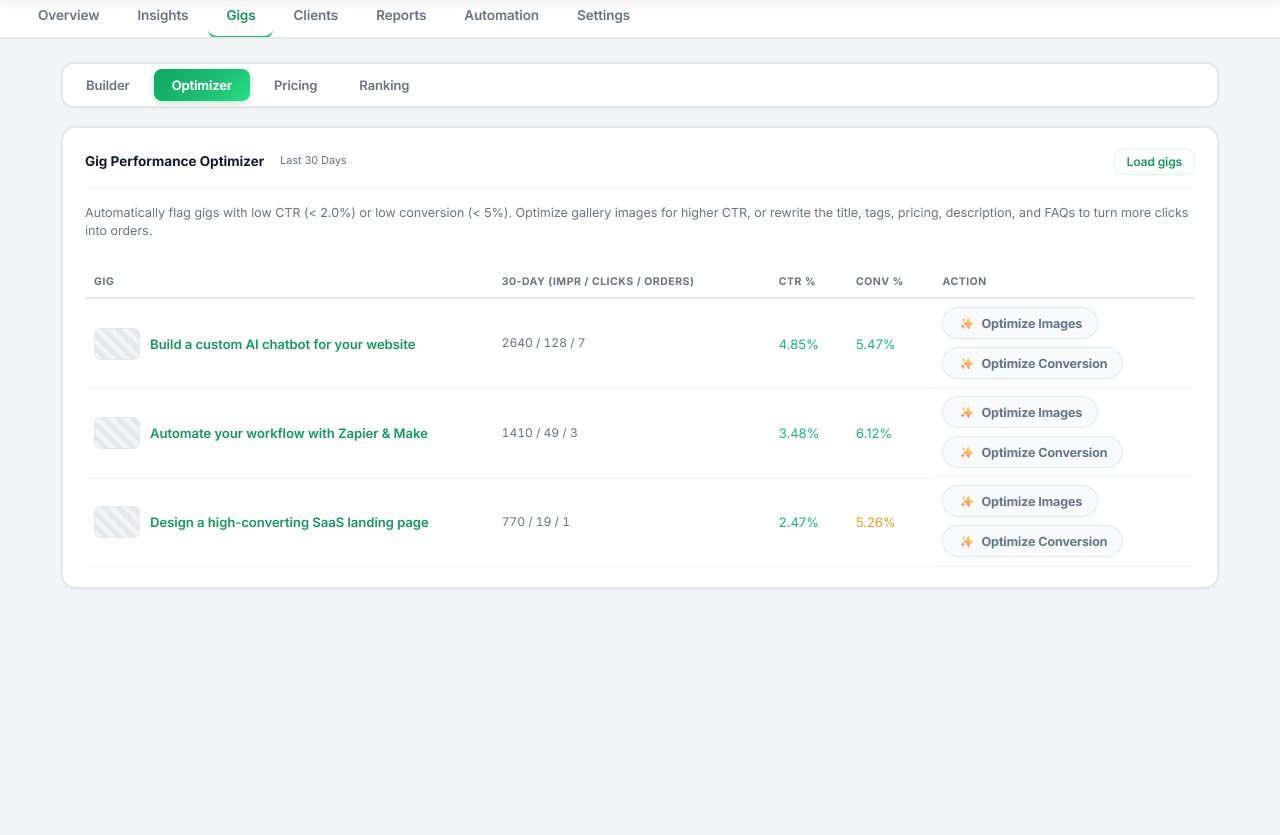
Seller OS's gig audit reviews a live gig's copy, description included, against the gig's own performance data and proposes changes with the reason attached. For a description pass, that means it can flag the same failures this guide checks for: an opening with no promise, density that blocks scanning, or scope that contradicts the packages.
It proposes; you edit and Save in Fiverr. The audit and your gig data stay in Chrome local storage, and nothing is published or sent on your behalf.
Fiverr Gig Description Checker questions
How long should a Fiverr gig description be?
Fiverr allows up to 1,200 characters, and that is a ceiling rather than a target. The practical test is whether the description covers the promise, the scope, and the next step without padding. A tight description that answers buyer questions beats a full-length one that repeats itself.
Should I repeat my main keyword in the description?
Once, naturally, is enough. Fiverr's documentation says the algorithm prioritizes title text first, then the positive keywords field, then the description, so the description confirms context rather than driving the match. Repetition reads as spam to buyers and adds nothing to relevance.
Does the description affect my gig's search ranking?
Fiverr lists the description third in matching priority, after title text and the positive keywords field, so it plays a supporting role in being found. It matters more for conversion: it explains the offer a buyer clicked. Treat it as a conversion field that also confirms context.
How do I check my description against the character limit?
Fiverr's editor shows a character count as you type, and you can paste the draft into a counter to measure edits outside the page. Watch the count after every addition, because trimming as you go is easier than cutting a full draft at the end.
Audit the description that is live.
Run the four checks, fix the opening first, and measure the change over a full window.