 Seller OS
Is selling on Fiverr still worth it in 2026?
Fiverr still works in 2026 for sellers whose orders come from higher-value, niche, or repeat work, and it stops working for listings that compete only on price. The 20% fee is the entry ticket: it buys access to buyers, handled payments, and a review record you did not have to build yourself. Decide with your own numbers rather than with a general verdict.
Free plan available. Local-first data. Human review on every change.
Is selling on Fiverr still worth it in 2026?
It is worth it when the marketplace brings you work you could not easily find alone, and it is not worth it when your only advantage is a low price. That is the whole decision: compare what Fiverr brings you against the 20% it takes, using your own orders rather than averages.
The market around that decision has changed. According to Fiverr's first-quarter 2026 results, published April 29, 2026, the company reported 2.9 million annual active buyers as of March 31, 2026, down from 3.5 million a year earlier, while annual spend per buyer rose to $356 from $309. According to Fiverr's second-quarter 2026 results, published July 29, 2026, the company revised full-year 2026 revenue guidance to $356–372 million (down 17%–14% year over year) and cited "AI-related demand and traffic headwinds" and "persistent weakness across categories most exposed to AI automation."
“AI-related demand and traffic headwinds” and “persistent weakness across categories most exposed to AI automation.”
— Fiverr, second-quarter 2026 results, published July 29, 2026
Fiverr said those results reflected a strategic shift toward higher-value work, with a proprietary Knowledge Graph deployed live. Fewer buyers who each spend more is a market where scoped, higher-value work matters more than transaction volume.
The fee math on a real order
Fiverr takes a 20% seller fee, so the math is simple to run before you publish. A $100 order nets $80, and a $500 order nets $400, before other costs such as AI credits or tools. Ten $100 orders in a month net $800.
The percentage feels different at every price. On a $10 gig you keep $8, which is why low-price volume needs a large order count to add up; on a $500 order the $100 fee buys access that could otherwise take weeks of client hunting. Run your own averages through these numbers.
What the 20% fee actually buys
The fee buys four things that are expensive to build alone: access to buyers who are already shopping, handled payments and order records, a public review history that keeps working between orders, and less time spent hunting clients.
Disputes, delivery records, and payment handling also sit inside the platform. Whether that is worth $100 on a $500 order changes with how full your own pipeline already is.
Who Fiverr still works for
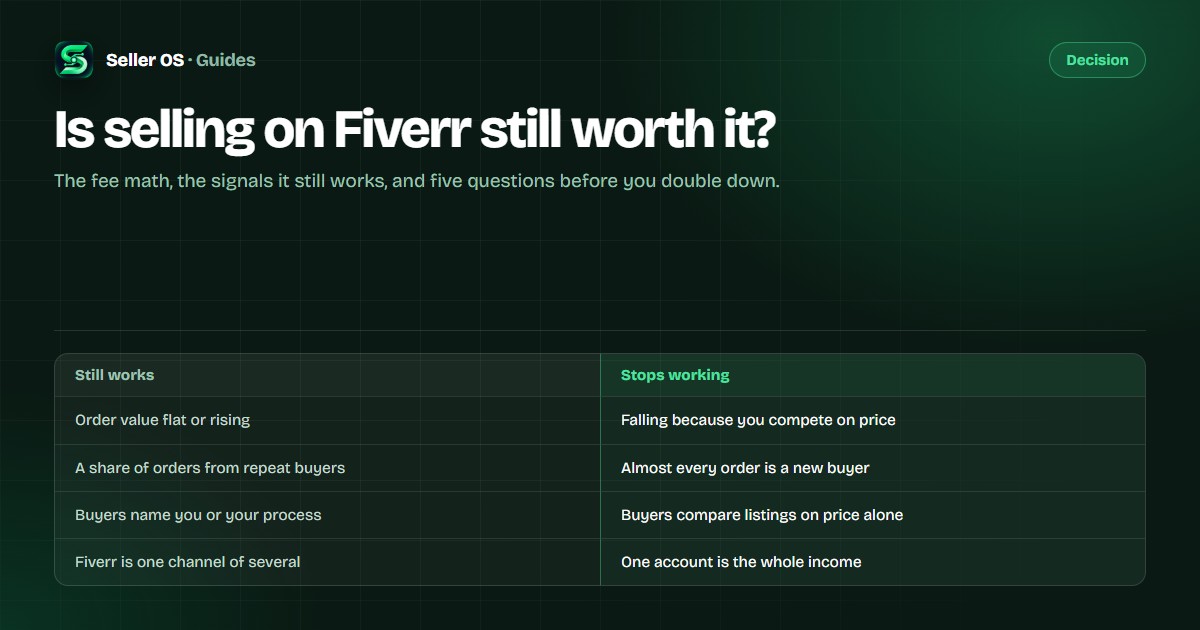
Fiverr still works for sellers whose average order value is rising, who own a niche buyers search for, and who turn first-time buyers into repeat ones. When a buyer returns through the platform, the fee pays for a trusted checkout and a record rather than for a cold introduction.
The reported data points the same way: annual spend per buyer rose to $356 even as the buyer count fell, so the money on the platform is concentrating in buyers who spend more.
| Signal | Still working | Stops working |
|---|---|---|
| Average order value | Flat or rising as you scope better | Falling because you compete on price |
| Repeat buyers | A share of orders comes from returning clients | Almost every order is a new, price-first buyer |
| Differentiation | Buyers name you, your niche, or your process | Buyers compare listings on price alone |
| Revenue mix | Fiverr is one channel among several | One account is the whole income |
Who it stops working for
Fiverr stops working when price is the only differentiator, when every order is a brand-new buyer, and when a low average order value makes the 20% fee bite hardest. None of that is permanent, but it is a signal to change the offer rather than to work more hours at the same price.
The same reported market makes this sharper: Fiverr cited persistent weakness in categories most exposed to AI automation, which are often the same categories sold as commodity tasks. If your category is one of them, the fix is positioning, not denial.
The risk of one account
Every marketplace seller carries concentration risk: one account holds your reviews, your buyer history, and your access to demand. A suspension, a policy change, or a category slowdown touches all of it at once.
Treat the account as a channel rather than as the business. Export your records where the platform allows it and build at least one path that does not depend on the marketplace being open tomorrow.
The hybrid path
The practical middle is running both: let Fiverr fund the month and validate offers, then move proven work into direct relationships over time. Your best-performing gig is market research: it shows which outcome buyers pay for and what they consider expensive.
Start small. Keep platform orders clean and deliver well, and build the direct side where Fiverr's terms allow it. Nothing here is legal or tax advice; for contracts, entity choices, and tax handling, consult a qualified professional.
Five questions before you double down
Score each question honestly, then act on the pattern rather than on one answer.
- Is your average order value flat or rising over the last three months?
- What share of this month's orders came from repeat buyers?
- Can you name one thing your gig does that a cheaper listing cannot copy?
- If the account were limited tomorrow, where would next month's income come from?
- Are you using Fiverr as a channel inside a plan, or as the whole plan?
Three or more weak answers point to concentration and commodity pressure; strong answers point to a marketplace that is still earning its fee. Fiverr controls ranking, matching, and fees, so keep your own numbers visible.
Where Seller OS helps
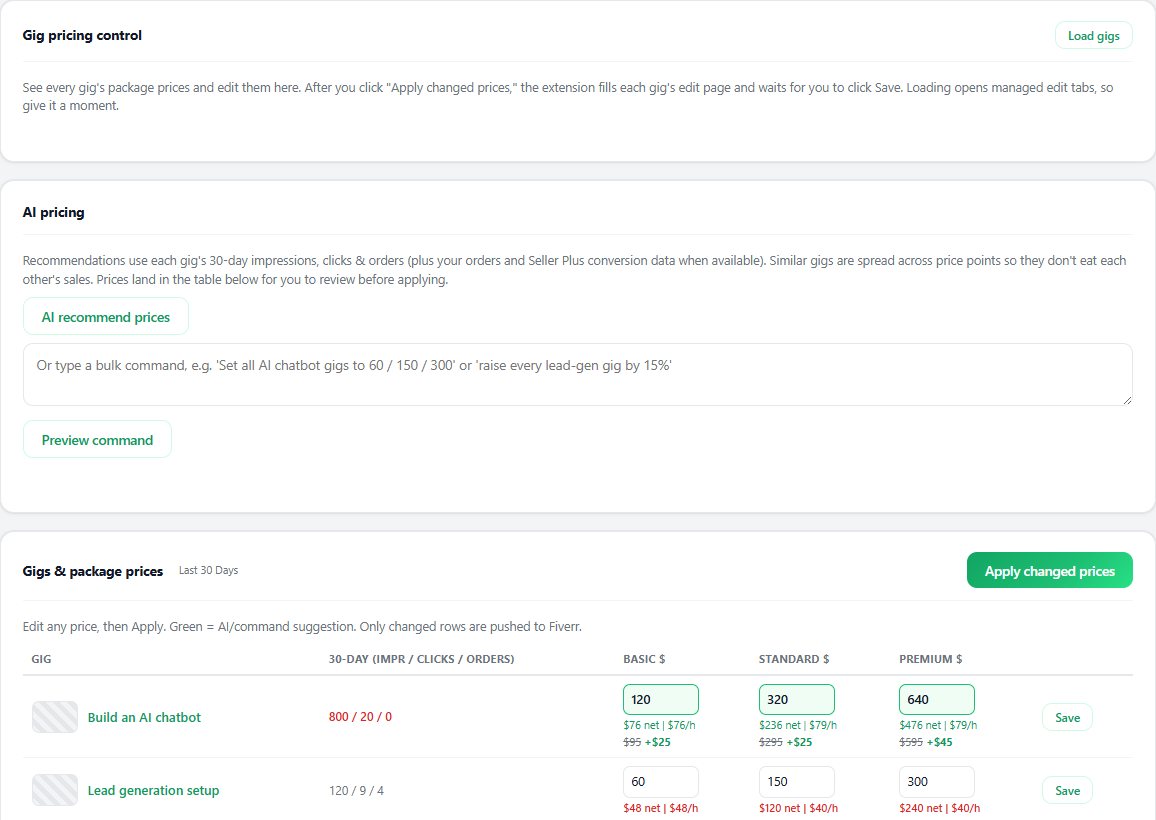
Seller OS keeps the numbers behind these decisions local: pricing review with profit guardrails and a recent-price write guard, client records with notes, tags, and repeat history, and reports plus a daily action queue. Run a price change and the guard stops a stale recent price from being overwritten.
It drafts and fills; you review and decide. A person performs every Send, Save, Continue, and Publish, and nothing runs automatically. Monitors are Pro and run only while Chrome is open. No tool guarantees orders, and Fiverr controls rankings and fees.
Sources
Fiverr's reported results and its own documentation:
- Fiverr's first-quarter 2026 results, published April 29, 2026.
- Fiverr's second-quarter 2026 results, published July 29, 2026.
- Fiverr's help center for the current fee and field documentation.
Fiverr worth-it questions
How much does Fiverr take from each order?
Fiverr's seller fee is 20%, so a $100 order nets $80 and a $500 order nets $400 before other costs. Fiverr's help center documents the current terms, and the platform sets them.
Is the 20% fee worth it on a $10 gig?
Run the math for your own volume. A $10 order nets $8, so the fee is small in dollars and large as a share, and low-price work needs a high order count to add up. Scoped, higher-value work changes both numbers.
Can I move repeat buyers off Fiverr?
Fiverr's terms govern what contact and work can leave the platform, so read them and stay inside them. Many sellers keep repeat work on Fiverr instead and treat the fee as the cost of a trusted checkout and a clean record.
What should I do if Fiverr sales drop?
Separate the cause before you decide. If impressions, clicks, or conversion moved, fix the gig; if your category is shrinking, weigh the hybrid path and rebuild a direct channel. Fiverr's second-quarter 2026 results cited persistent weakness in categories most exposed to AI automation.
Run the math before you decide.
See net pay per order, keep profit guardrails on price changes, and judge the fee against your own numbers.