 Seller OS
Did AI kill Fiverr?
No. Fiverr's own 2026 reporting shows a marketplace under pressure at the low end, not a dead one. Buyers are still spending, and annual spend per buyer rose even as the buyer count fell. The mix of work moved toward longer projects and higher-value services, and offers that sell a result rather than a file are the ones that still get paid.
Free plan available. Local-first data. Human review on every change.
What Fiverr's 2026 results actually show
The reported numbers describe pressure on low-value, transactional work rather than the end of the marketplace.
According to Fiverr's first-quarter 2026 results, published April 29, 2026, the company reported 2.9 million annual active buyers as of March 31, 2026, down from 3.5 million a year earlier, while annual spend per buyer rose to $356 from $309.
According to Fiverr's second-quarter 2026 results, published July 29, 2026, the company revised full-year 2026 revenue guidance to $356–372 million (down 17%–14% year over year) and cited 'AI-related demand and traffic headwinds' and 'persistent weakness across categories most exposed to AI automation.'
Quarter one showed fewer buyers paying more each. Quarter two showed the revenue outlook cut and the weak spots named. Together they describe a marketplace where volume is thinning while the value per remaining buyer holds up.
Why buyers still come even as the count falls
The buyers who stayed spend more. According to Fiverr's reported first-quarter figures, annual spend per buyer rose to $356 from $309 while the buyer count fell from 3.5 million to 2.9 million.
That changes what a good month looks like. Instead of chasing more first-time orders, the stronger move is depth: a repeat client with a longer project, an add-on that continues the result, and a reason for that buyer to return to your profile by name.
The platform still controls who sees you. Search results vary by time, account, and location, Fiverr sets ranking rules, and no offer or tool guarantees orders.
Which categories feel AI pressure first
Transactional, low-value work that a model can draft in one pass feels the pressure first.
Short copy, simple edits, template layouts, and isolated asset files are easy to compare against a free first draft. Work tied to a decision, a launch, or a risk someone has to own holds its price better.
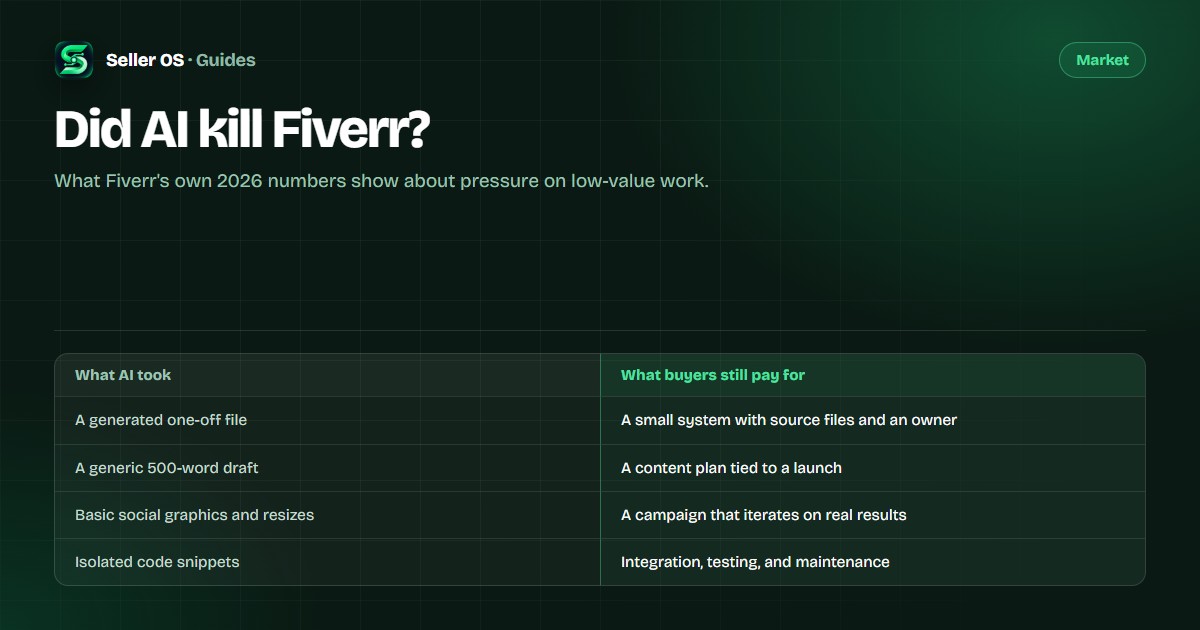
| What AI took | What buyers still pay for |
|---|---|
| A one-off file generated from a short prompt | A small system with source files, usage rules, and a named owner |
| A generic 500-word article draft | A content plan tied to a launch and reviewed by someone accountable |
| Basic social graphics and resizes | A campaign that iterates on real results |
| Isolated snippets of code | Integration, testing, and maintenance with a person on the hook |
Read the rows as a filter for your own listings: if the deliverable is the whole product, the price is under pressure; if the deliverable carries a decision or a promise, the price survives.
How Fiverr is repositioning the marketplace
Fiverr is steering the marketplace toward longer, higher-value projects, and it said so in its own results.
Fiverr said its second-quarter 2026 results reflected a strategic shift toward higher-value work, with a proprietary Knowledge Graph deployed live.
The company's pitch to buyers leans on expertise and accountability. Your gig copy and proof have to match that pitch, or the buyer compares you to the free draft instead of the cost of a failed project.
Fiverr's chief executive frames the shift this way:
“While AI absorbs high-volume, low-value, transactional tasks, it is also unlocking the need for longer duration projects where AI tools enhance human expertise, workflow management, and accountability.”
— Micha Kaufman, founder and CEO of Fiverr, second-quarter 2026 results.
What sellers should change now
Sell the outcome, keep the buyer, and keep the proof current.
Take a plain listing: “I will design a logo” describes a file a buyer can approximate in minutes. Rewrite it as “I will build a logo system with source files and a usage guide” and the offer describes a result that survives a print run and a website. The title field allows 80 characters including the 6 characters of the “I will” prefix, the description allows 1,200 characters, the profile bio allows 600, and five search tags of up to 20 characters each carry your keywords. Spend that space on the outcome, not the tool.
Then reduce dependence on new buyers. Offer a follow-up that continues the same result: a monthly review, a maintenance block, or the next deliverable in a sequence. Repeat clients are the closest thing to predictable revenue a marketplace offers.
Keep samples current and match them to the outcome you sell. A buyer choosing between two similar sellers picks the one whose proof answers the question the buyer already has.
Where Seller OS helps
Seller OS is a local-first Chrome extension that reads your own Fiverr numbers and turns them into a daily action queue.
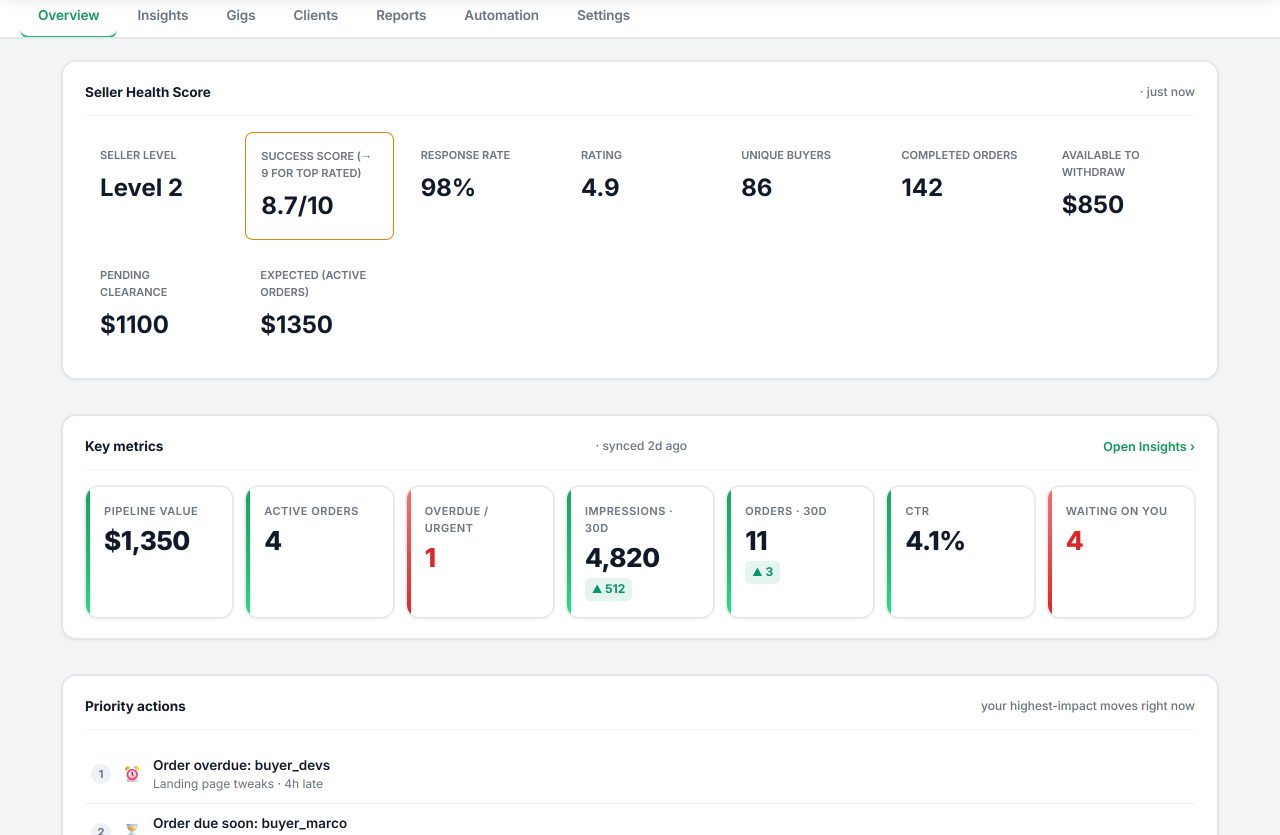
The overview dashboard shows seller health, gig metrics, impressions, clicks, and conversions, plus pricing guardrails and rank history for tracked keywords. Pro monitors watch briefs, deadlines, follow-ups, ranks, competitor moves, and Success Score drops while Chrome is open, and raise one alert instead of a stream. It works without Seller Plus.
Every output is a draft or a filled field. You perform Send, Save, Continue, and Publish; nothing runs automatically, and monitors run only while Chrome is open.
See how it fits your workflow on the Seller OS tools page.
Sources
Numbers and platform behavior here come from Fiverr’s investor releases and help center.
Fiverr and AI questions
Did AI kill Fiverr?
No. Fiverr still reported 2.9 million annual active buyers as of March 31, 2026, and annual spend per buyer rose to $356 from $309. What changed is the mix of work: demand weakened in categories most exposed to AI automation while higher-value projects held up.
What did Fiverr blame in its second-quarter 2026 results?
The release published July 29, 2026 cited 'AI-related demand and traffic headwinds' and 'persistent weakness across categories most exposed to AI automation.' Fiverr also described a strategic shift toward higher-value work, with a proprietary Knowledge Graph deployed live.
Which Fiverr services still avoid AI pressure?
Work that needs context, accountability, and a decision: branded systems, audits, integrations, launches, and anything where a buyer wants one person responsible for the result. Transactional, low-value tasks that a model can draft in one pass face the most pressure.
What should a Fiverr seller do right now?
Rewrite gigs as outcomes, keep proof current, and build repeat business. Annual spend per buyer is rising while the buyer count falls, so depth with fewer clients is safer than chasing volume with one-off orders.
Sell the outcome, not the file.
Track your own numbers, and let a Pro monitor watch the signals while Chrome is open.