 Seller OS
Did AI kill freelancing?
No. AI absorbed the low end of freelance work, and the high end still gets hired. Fiverr's 2026 reporting shows fewer buyers who each spend more, which means the transactional middle is thinning while accountability, context, and judgment keep their price.
Free plan available. Local-first data. Human review on every change.
Did AI kill freelancing? What changed
Freelancing split rather than died: commodity deliverables lost their price, and work that needs a responsible person kept its value.
The split shows up in the numbers. A shrinking buyer count with rising spend per buyer describes a market that stopped buying cheap deliverables at the same rate, not one that stopped buying.
Three things stayed on the paid side of the line: someone to own the result, knowledge of the specific business, and decisions a model cannot make from the information it was given.
What got cheap
Anything a model can produce in one pass is cheap to make and easy for a buyer to price against zero.
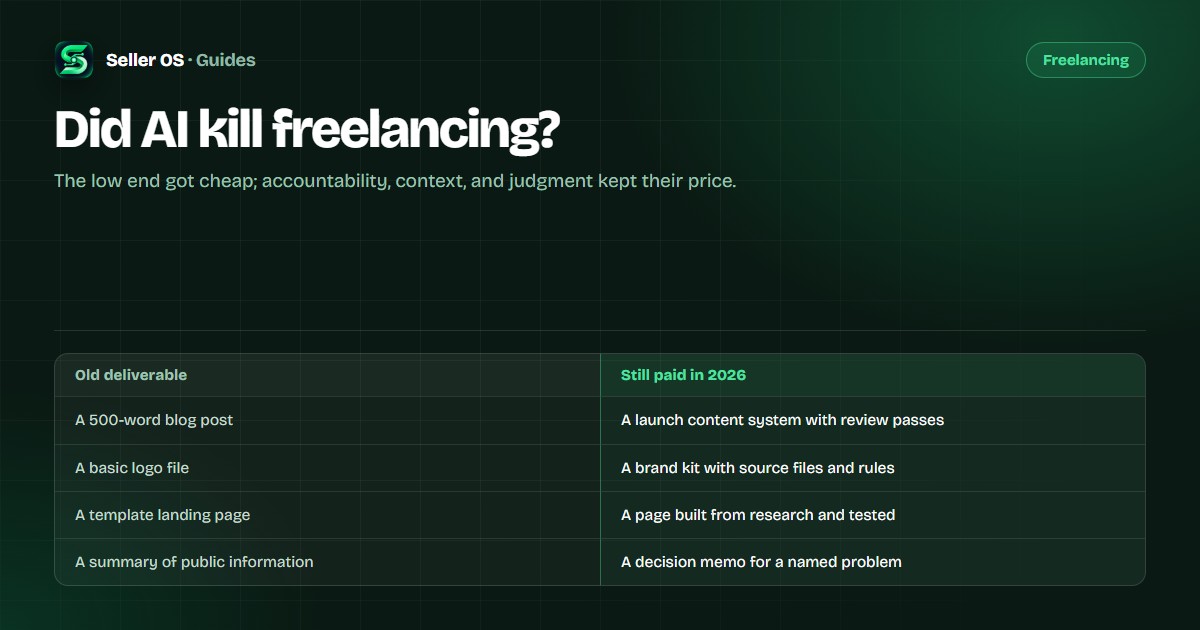
Short copy, simple edits, template layouts, and summaries of public information all fit that description. The table maps common deliverables to the version that still sells.
| Old deliverable | AI-era version that still gets paid |
|---|---|
| A 500-word blog post | A launch content system with briefs, review, and edit passes |
| A basic logo file | A brand kit with source files and usage rules |
| A template landing page | A page built from research, tested after launch, and handed off |
| A summary of public information | A decision memo for a named business problem |
Every row follows the same pattern: the file alone lost value, and the work around the file kept it.
What got more valuable
Accountability, context, judgment, and taste got more valuable because none of them can be generated from a prompt.
Accountability means a person answers when the result misses. Context means you know the client's market, customers, and constraints well enough to make the draft usable. Judgment means choosing what not to ship. Taste is the hundred small calls that separate a plausible file from a finished one.
Fiverr's chief executive describes the same split from the platform's side:
“While AI absorbs high-volume, low-value, transactional tasks, it is also unlocking the need for longer duration projects where AI tools enhance human expertise, workflow management, and accountability.”
— Micha Kaufman, founder and CEO of Fiverr, second-quarter 2026 results.
The spend-per-buyer signal
Fiverr's reported buyer numbers describe a market thinning in the middle rather than collapsing.
According to Fiverr's first-quarter 2026 results, published April 29, 2026, the company reported 2.9 million annual active buyers as of March 31, 2026, down from 3.5 million a year earlier, while annual spend per buyer rose to $356 from $309.
According to Fiverr's second-quarter 2026 results, published July 29, 2026, the company revised full-year 2026 revenue guidance to $356–372 million (down 17%–14% year over year) and cited 'AI-related demand and traffic headwinds' and 'persistent weakness across categories most exposed to AI automation.'
Fewer transactions at the low end and more value per remaining buyer favor depth, specialization, and repeat work over volume. No one can promise that a repositioned offer wins orders; clients decide what to pay.
Move from tasks to outcomes
Rewrite your service as the business result it produces, then price that result.
“I will write 10 blog posts” is a task a model can approximate. “I will run your monthly content engine: research, drafts, edits, and a performance review” is an outcome the buyer cannot generate alone.
Make the outcome measurable where you can. A launch that ships on the promised date, a support queue that clears within a day, or a landing page that stops leaking signups gives the client something to weigh against the fee.
Price the judgment, not the output
The fee follows the consequence of the decision, not the number of words or the hours logged.
Two buyers want the same one-page plan. One reads it and moves on; the other uses it to commit budget and staff. The second is buying risk reduction, and the price should reflect the cost of getting it wrong.
This also sidesteps the comparison trap. When a buyer can generate a draft for free, your quote competes against the cost of an unfinished project rather than the cost of a file.
Where Seller OS helps
Seller OS drafts the work around the service you sell, starting with the gig that sells it.
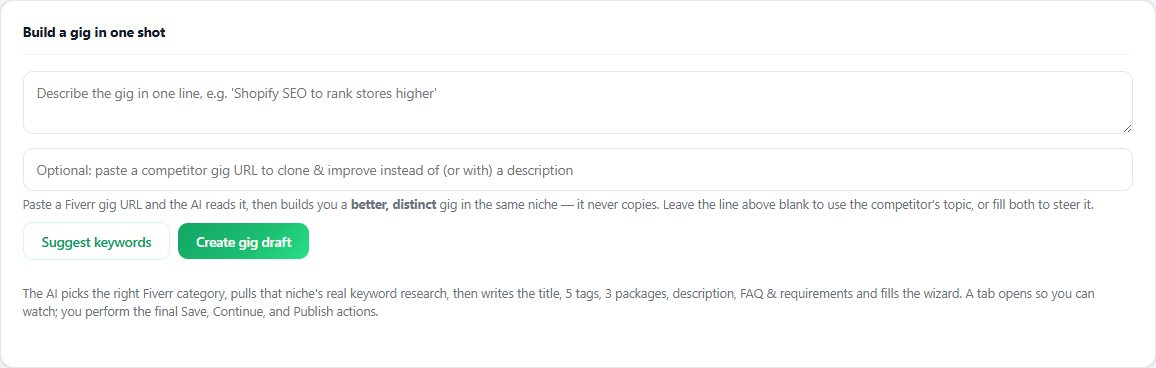
Gig Builder turns an idea or a competitor URL into a full draft and fills the Fiverr wizard. Keyword suggestions and per-keyword rank history show which terms your gig already earns impressions for, and Pro monitors track ranks and competitor moves while Chrome is open.
It drafts and fills; you perform Send, Save, Continue, and Publish. Nothing runs automatically, and monitors run only while Chrome is open. Data stays in local Chrome storage, and the extension works without Seller Plus.
See the keyword and rank side on the Fiverr SEO tool page.
Sources
The market data here comes from Fiverr’s first- and second-quarter 2026 investor releases.
Freelancing and AI questions
Did AI kill freelancing?
No, but it changed what pays. Fiverr's first-quarter 2026 results reported 2.9 million annual active buyers as of March 31, 2026, down from 3.5 million a year earlier, while annual spend per buyer rose to $356 from $309. The market shrank at the low end and paid more at the high end.
Which freelance services are safest from AI?
Services where a client needs a person responsible for a business result: strategy, systems, integration, launches, and ongoing support. Simple deliverables that a model can draft in one pass face the most price pressure.
How do I raise rates without losing clients?
Attach the price to the outcome and the risk you carry, then show the work behind it. Buyers who need accountability compare the cost of a wrong result, not the cost of a file.
Is freelancing still worth starting in 2026?
It is harder at the commodity end and still viable where judgment matters. Pick a service tied to a measurable business result, keep proof visible, and build repeat clients instead of chasing one-off tasks.
Sell the result, not the task.
Draft the offer, track the keywords, and keep the final click yours.