 Seller OS
Freelancing in the age of AI
Clients can generate a plausible first draft in seconds, so the paid part of freelance work moved to the decisions around it. Position your offer around accountability, context, judgment, and taste, price the outcome, and show the receipts that make AI-assisted work safe to buy.
Free plan available. Local-first data. Human review on every change.
The four things clients still pay for
Clients pay for accountability, context, judgment, and taste: the parts of the work a model cannot own.
Accountability is a person who answers when something misses. Context is knowing the client's market, customers, and constraints well enough to make a draft usable. Judgment is deciding what not to ship. Taste is the set of small calls that separate a plausible file from a finished one.
Together they explain why a buyer with a real deadline still hires. The file is cheap now; the decisions around it are not.
Fiverr's chief executive describes the market's own signal this way:
“While AI absorbs high-volume, low-value, transactional tasks, it is also unlocking the need for longer duration projects where AI tools enhance human expertise, workflow management, and accountability.”
— Micha Kaufman, founder and CEO of Fiverr, second-quarter 2026 results.
Rewrite your offer as an outcome
Turn each service line into the result it produces, then add the parts a buyer cannot generate alone.
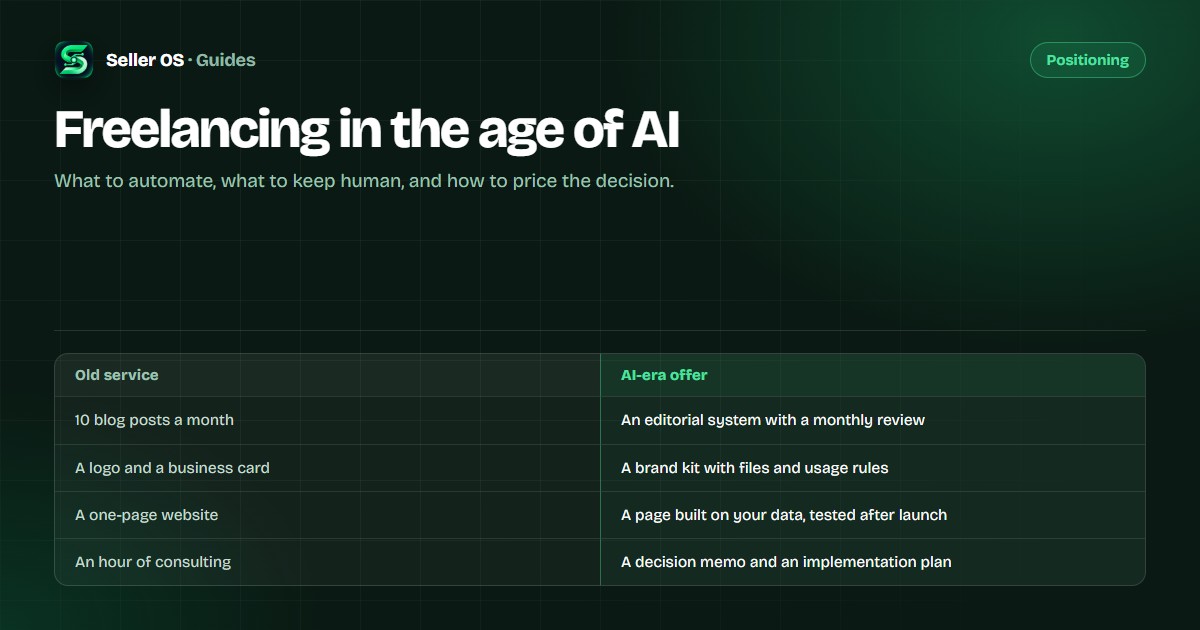
The table maps common listings to the version that survives a market full of free drafts.
| Old service | AI-era offer |
|---|---|
| 10 blog posts a month | An editorial system: research, drafts, edits, and a monthly performance review |
| A logo and a business card | A brand kit with source files and usage rules you own |
| A one-page website | A conversion-focused page built on your data and tested after launch |
| An hour of consulting | A decision memo and an implementation plan your team can run |
Take the first row literally. “I will write 10 blog posts” invites a comparison with a free draft. “I will run your launch content system: research, drafts, edits, and a review of what performed” describes a result the buyer cannot assemble alone.
Price the decision, not the file
Set the price around the decision the client is making and the risk they are avoiding.
A landing page priced by the hour invites comparison with a free draft. The same page priced as a decision — copy that has to convert a specific audience, tested after launch, with revisions included — is weighed against the cost of a launch that underperforms.
A fair price covers research, review, revisions, handoff, and a short accountability window after delivery. Name those parts in the offer so the buyer sees what the fee buys beyond the file.
Show your process and receipts
Proof beats claims, and in an AI-assisted market the receipt matters more than the portfolio piece.
Show the path: the brief, the research notes, the directions you discarded, the test results, and the change log between versions. A before-and-after pair with the reasoning attached tells a buyer that a person made the calls.
Keep samples current and honest. If AI assisted the work, say how it was used and what you verified before delivery.
Use AI without shipping its mistakes
AI is safe in the drafting layer and risky at the shipping layer, so put human review at the boundary.
Verify every fact, number, quote, and claim before it reaches a client. Check rights and licenses for generated assets, and confirm that the tool's terms allow the use you have in mind.
Keep confidential client material out of third-party AI tools. Do not upload files you lack the right to share, and ask the client in writing when the rules are unclear.
Choose clients who need judgment
Work with clients whose problem is a decision, not a file.
They tend to have a budget tied to an outcome, a stakeholder who needs convincing, a deadline that matters, and a reason to keep one person accountable across the project. Those conditions support the prices and the repeat work you want.
Positioning improves your odds rather than guaranteeing work, because clients decide what to buy.
Where Seller OS helps
Seller OS keeps the context and the proof in one place, so the positioning is easier to repeat.
Client records hold notes, tags, and repeat history. The inbox assistant drafts replies, offers, and follow-ups in your voice, and reports plus CSV exports turn your own numbers into receipts you can show. Pro monitors watch deadlines, follow-ups, ranks, and Success Score drops while Chrome is open.
It drafts and fills; you perform Send, Save, Continue, and Publish. Nothing runs automatically, and monitors run only while Chrome is open. Data stays in local Chrome storage, and the extension works without Seller Plus.
See the client and reporting side on the Seller OS tools page.
Sources
The market context comes from Fiverr’s second-quarter 2026 results, and the platform rules come from Fiverr’s help center.
According to Fiverr's second-quarter 2026 results, published July 29, 2026, the company revised full-year 2026 revenue guidance to $356–372 million (down 17%–14% year over year) and cited 'AI-related demand and traffic headwinds' and 'persistent weakness across categories most exposed to AI automation.'
Freelancing in the age of AI questions
What does freelancing in the age of AI actually look like?
You use AI for first drafts and routine production, then apply human review before anything ships. The paid part is the context you gather, the decisions you make, and the accountability you carry for the result.
How should I price AI-assisted work?
Price the decision and the outcome, not the time the tools saved. If a deliverable carries real business risk, the price reflects the judgment and the revisions, not the keystrokes.
Can I use client data with AI tools?
Not without permission. Keep confidential files out of third-party tools, check what your client allows, and never upload material you do not have the right to share. When in doubt, ask the client in writing.
What should I stop selling first?
Stop selling single, generic deliverables that a buyer can generate in one pass. Bundle the surrounding decisions, revisions, and handoff into an offer that a model cannot finish alone.
Position for the judgment.
Keep the context, the drafts, and the receipts in one local place.