 Seller OS
How to learn new skills and turn them into Fiverr gigs
Pick a skill your current buyers keep asking for, not the one with the loudest course ads. Practice it on real deliverables, package it as a clear offer, and launch one small gig before you spend on equipment. Adjacency beats ambition: your existing reviews and delivery habits carry over.
Free plan available. Local-first data. Human review on every action.
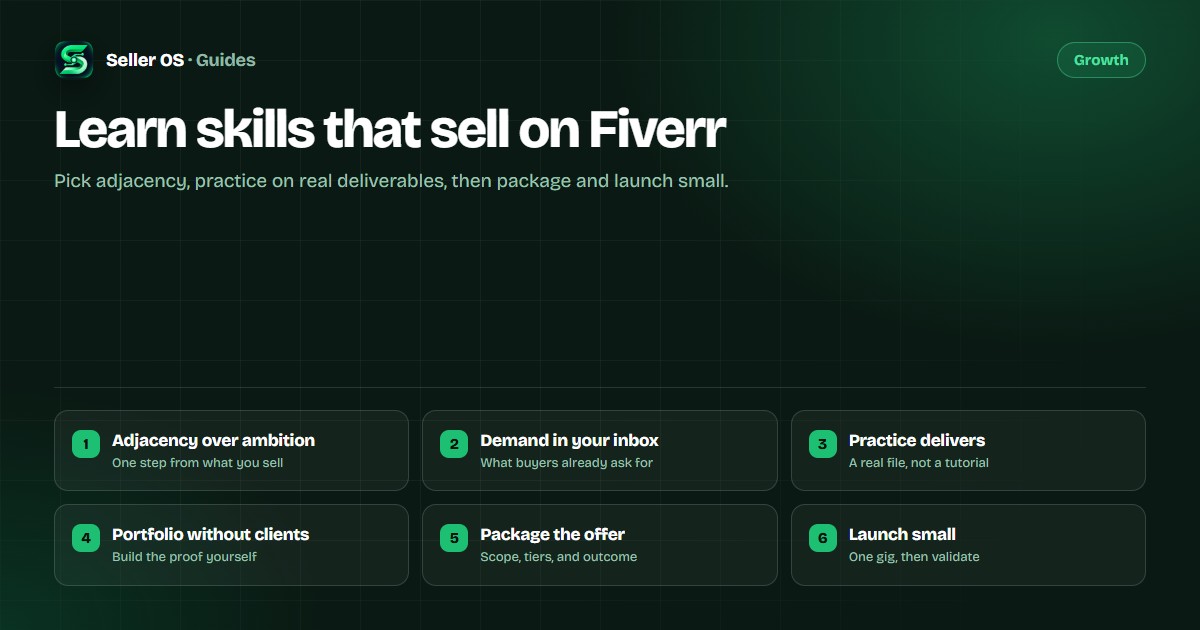
Pick adjacency over ambition
A brand-new direction means new buyers, new proof, and a long ramp. A skill next to your current work lets you reuse your reviews, your delivery habits, and your feel for the buyer. Edit video? Motion graphics is close. Write product descriptions? Technical documentation is close. The shorter the hop, the faster the first order.
Read the demand already in your inbox
Your briefs and messages are free market research. What do buyers keep asking you to add, fix, or explain? What do they hire someone else for after the order ends? One seller who keeps getting asked for "a version in Spanish" has a translation gig sitting in their inbox. Seller OS can surface brief and inbox signals while you work, so the pattern is visible instead of remembered.
Practice ends with a deliverable
Learning that stays theoretical does not sell. Set two or three practice projects with a real deliverable at the end: a landing page, a short animation, a content calendar. Use your own project, a local business, or a public dataset as the subject. The goal is work you can show, not a certificate.
Time-box the practice. A narrow skill you can deliver on a deadline beats a broad one you cannot finish.
Build a portfolio without client work
What to show
Two strong samples beat ten average ones. Show the brief you set yourself, the process, and the result; the process is what proves you can repeat the work for a paying buyer.
What to write
For each sample, write one short paragraph: the goal, the constraint, what you did. That paragraph becomes your case study and the raw material for the gig description.
Where to keep it
A simple gallery, a PDF, or the gig gallery once you launch. Update it as your work improves, and delete samples that no longer represent your level.
Package the skill as an offer
Decide the deliverable, the turnaround, and what the buyer must provide. Build three tiers with a real reason to upgrade: wider scope, faster delivery, or an extra asset. Price against your delivery time and remember the 20% Fiverr fee when you set the number; the free Fiverr fee calculator shows what you keep.
Write the title around what the buyer gets and keep it inside 80 characters, including the 6 that "I will" eats. Five tags of up to 20 characters each cover the phrases that did not fit, and 1,200 characters of description is enough for scope, process, and requirements if you write tightly.
Launch small and validate
Launch one gig, not five. Give it time to collect impressions and clicks, then read the leak: impressions without clicks points at the title and thumbnail; clicks without orders points at the description and packages. Change one thing at a time.
Demand evidence beats enthusiasm. If a sensible keyword brings no impressions at all, the offer or the phrasing needs work — more practice samples will not fix it.
Do not buy the equipment yet
A course, a new laptop, and a subscription feel like progress, but they are bets on demand you have not confirmed. Start with what you own, sell a small version of the service, and reinvest after the orders arrive. If the skill finds no buyers, you are out of time rather than money.
Where Seller OS helps
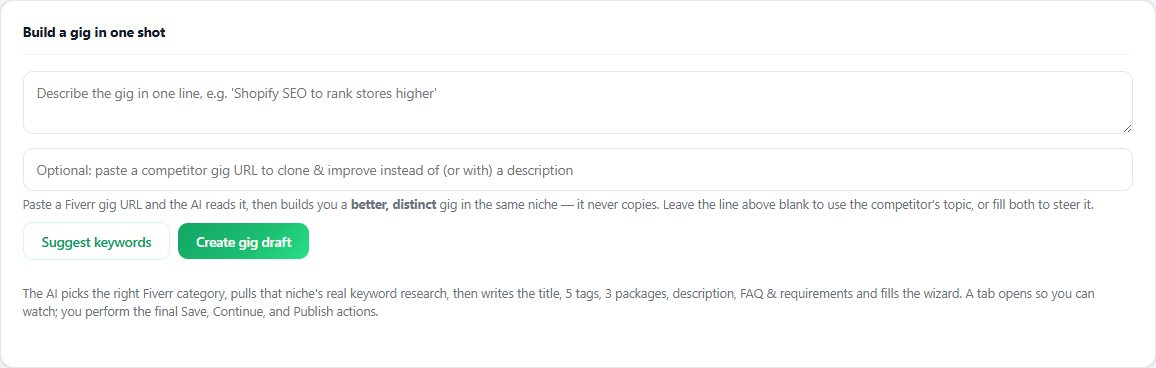
Seller OS's Gig Builder turns a one-line idea or a competitor URL into a full draft — title, description, tags, packages, and FAQ — and fills the Fiverr wizard while you watch; you still press Save, Continue, and Publish. Brief and inbox signals help you notice the requests your existing buyers already make before you commit months to a new skill.
Nothing is published automatically, plans do not include third-party AI credits, and no tool can create demand that is not there — but building and testing the offer gets much faster. See the Fiverr seller tools guide for the full workflow.
Learning and launching questions
How do I choose which skill to learn next?
Start with what your existing buyers already ask for, then pick the option closest to your current service. Adjacent skills reuse your reviews, delivery habits, and buyer knowledge.
Do I need client work to build a portfolio?
No. Set yourself a small number of practice projects with real deliverables, document the goal and the process, and show the results. Two or three strong samples are enough for a first gig.
Should I change my niche when I launch a new skill?
Not necessarily. A new gig can sit alongside your current one. Add a skill when it serves the same buyer, and change direction only when the evidence says the demand is elsewhere.
How many new skills should I learn at once?
One. Take it to a launched gig and a first measured result, then decide whether to expand. Splitting attention across several new skills slows all of them down.
Turn the next skill into a live draft.
Build a gig from an idea or a competitor URL, then review every field before it goes live.