 Seller OS
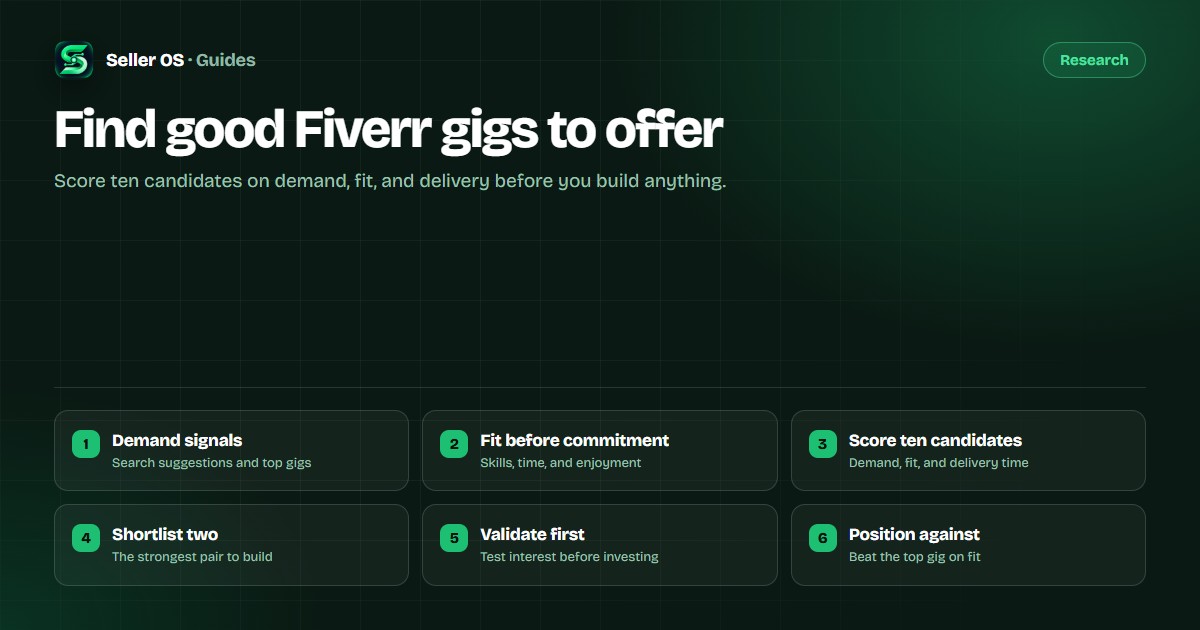
How to find good Fiverr gigs to offer
Before you build a gig, check three things: can buyers find it, can you deliver it well, and can you price it so the work pays after Fiverr's 20% seller fee? Score ideas against those before you spend a week on gallery art and copy.
Free plan available. Local-first data. Human review on every change.
What good means: demand, fit, and delivery
Work the numbers first. A $100 order keeps $80 after Fiverr's 20% seller fee, so a four-hour build pays $20 an hour before revisions and messages. If that rate does not cover your week, a different niche is the better move.
Then run three tests: are buyers searching for this, can you deliver at the quality the category expects, and does the price hold up after the work is done? Miss demand and you get no impressions to learn from. Miss fit and deliveries slip. Miss pricing and you have volume without profit. Fiverr search results vary by time, account, and location, so treat any read on demand as an estimate.
Read the demand signals on Fiverr
Start with autocomplete. Type "podcast" and note what Fiverr suggests: podcast editing, podcast editing with captions, podcast production. Longer phrases are where buyers search with intent, and they tell you what belongs in a title or tag. Tags cap at 20 characters each, so "podcast editing" fits and "podcast editing and mixing" does not.
Next, look at category depth: how many subcategories exist and how many gigs compete inside them. A deep category with active sellers is an established market. A thin one is either low demand or an opening, and your other signals have to tell you which.
Finally, scan the top gigs for signs of life. Recent, steady reviews mean buyers are still ordering. When the top gig's last review is months old, the category may be thinner than it looks.
Check the fit before you commit
List what you can deliver today, not what you could learn in six months. Skill adjacency beats a new category you would need months to reach, and buyers can tell practiced work from a first attempt.
Be honest about turnaround. Can you finish inside the package window, including revisions, without pushing other orders late? Then run the price: estimate your delivery hours, subtract the 20% fee, and compare what is left to what the category charges. The Fiverr fee calculator shows the net per order, so a low headline price cannot hide a loss.
Score ten candidates, then shortlist two
Write down ten ideas and score each one from 1 to 5 on demand, skill fit, delivery confidence, and how different it is from the gigs already ranking. Comparing scores beats falling for the idea you like most.
One example: a Notion dashboard template might score 5 on fit, 2 on demand, and 4 on difference; a podcast editing gig scores 4, 5, and 3. The first is a hobby, the second is a business. Shortlist two, because two can be tested well and one strong gig usually beats three neglected ones. If the scores do not separate, narrow the niche until they do.
Validate before you invest heavily
Before you spend hours on gallery work and copy, check what the searches you plan to target actually return. If every top gig looks polished and well reviewed, look for a narrower angle where your skill stands out: a format, an industry, or a turnaround the leaders ignore.
Build the draft first and read it as a buyer would. If the offer is not clear in the title and the first two lines of the description, fix it before you publish. Validation is cheap. Rebuilding a live gig after it collects weak signals is not.
Use a competitor gig as a positioning reference
Pick one top gig and study how it is built: what the title promises, how the packages are layered, what the FAQ answers, what the gallery shows. You are hunting for the gap, not a template. Maybe every competitor bundles a slow process, leaves deliverables vague, or ignores a buyer segment entirely.
Position against that gap with something you can honestly deliver, and never copy another seller's text or images. The full checklist is in the Fiverr competitor research guide.
Where Seller OS helps
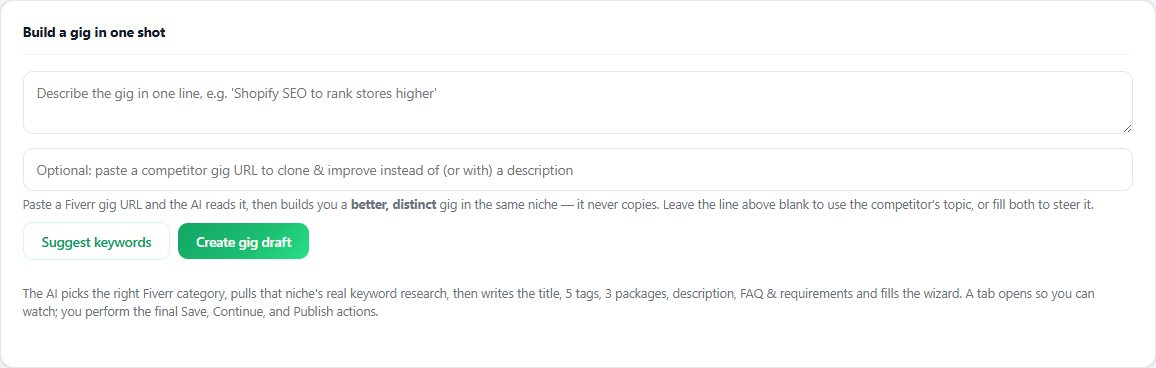
Seller OS's one-shot Gig Builder turns a one-line idea or a competitor URL into a full draft: title, tags, description, packages, FAQ, and requirements, written to the field limits. It fills the Fiverr wizard while you watch, and you still perform the Save, Continue, and Publish clicks yourself.
Keyword suggestions and rank history help you confirm a term is worth targeting before you commit, and all of it stays in local Chrome storage. Read the full Fiverr SEO tool guide for the details.
Fiverr gig research questions
How many Fiverr gigs should I offer at once?
Start with one or two live gigs you can deliver well. A small catalog that converts is easier to improve than a large one that spreads your time and splits your performance data.
How do I know if there is demand for a gig idea?
Read the demand signals before you build: Fiverr autocomplete suggestions, how deep the category is, and how established the gigs near the top look. If suggestions and active competitors exist, demand is likely there; the real question is whether you can differentiate.
Should I copy a top competitor's gig?
No. Study the structure, packages, and positioning to understand the category, then write your own gig around the gap you can fill. Copies compete on price and give buyers no reason to choose you.
When should I add a second gig?
When the first gig is stable, you have delivery time to spare, and your buyers are asking for something adjacent. That demand is a strong signal, but validate it on Fiverr before you build.
Validate the idea, then build the gig.
Turn an idea or a competitor URL into a full draft, with every field written to the limits.