 Seller OS
Fiverr competitor research: how to read a top gig
Open five top gigs in your category and read them the way a buyer deciding where to spend $150 would. What does each title promise, how do the packages differ, and what does every one of them get wrong? That last answer is your opening.
Free plan available. Local-first data. Human review on every change.
What to capture from each competitor
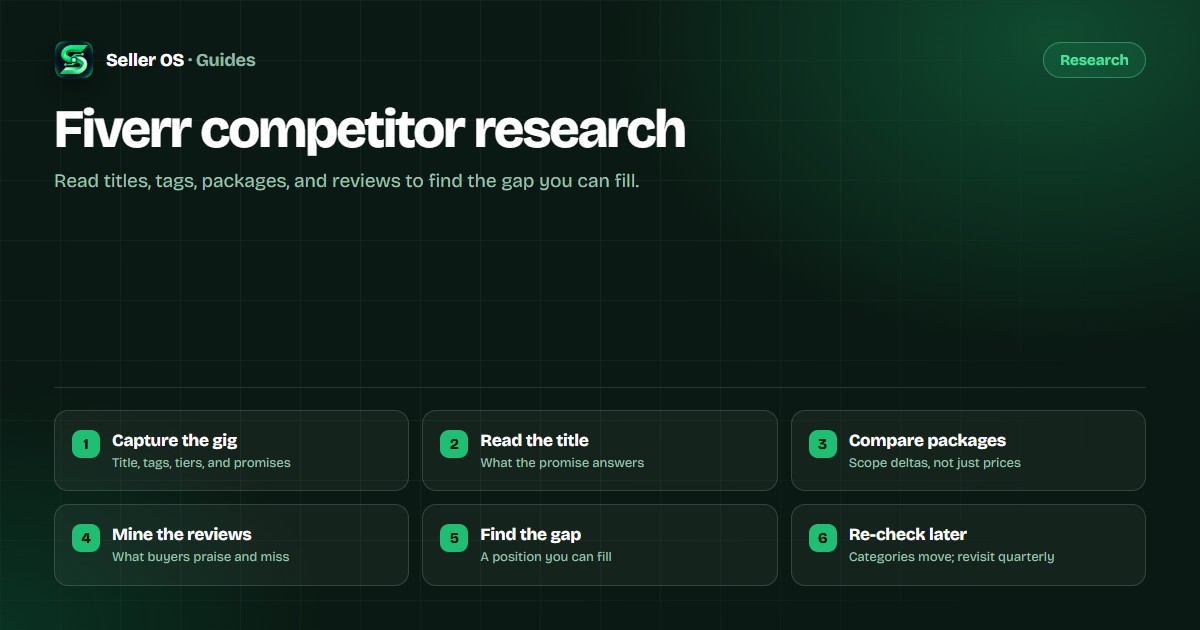
Work from three to five gigs that rank for your main keyword. For each one, record the title structure, the tags it targets, the package tiers and what separates them, the price ladder, the deliverables, the FAQ, the gallery promise, and the themes that repeat in reviews.
Keep one row per gig in a single sheet. Memory will not hold five gigs' worth of details, and the point of the exercise is comparing them.
Read the title like a buyer
Cover the gig cards and read only the titles. Say them out loud. Which one tells you what you get and why it is better? Note where the primary keyword sits, whether the outcome comes before or after it, and which differentiator the seller chose: speed, revisions, niche, or a bundle.
When several top gigs share a pattern, that pattern is category convention, and matching it is safer than fighting it. When every title reads "I will design a Shopify product page," the seller who adds the outcome gets the second look.
Compare packages, not just prices
A price means little without the deliverables next to it. Line the tiers up side by side: what is included at each level, how many revisions, what turnaround, what the buyer must provide. Then study the ladder itself. How far does the price jump between tiers, and does the added work justify it?
Positioning mistakes show up here too. If every competitor's cheapest tier excludes something buyers clearly need, a clearer entry package can win the click. Translate what you find into your own tiers with the Fiverr pricing guide.
Mine reviews for the gap
Reviews describe what buyers wanted, not just what they received. Read for repeated requests and recurring complaints: a deliverable buyers keep asking to add, a communication step that keeps going wrong, a turnaround that keeps coming up. The same complaint across three gigs points at a category-wide gap.
Quote nothing and copy nothing. Use the themes to shape your own scope, then check that the promise you write matches what you can deliver.
Find the gap you can fill
Gaps show up in three shapes: an underserved niche inside a broad category, deliverables that stay vague, or a turnaround nobody wants to match. Pick the one that lines up with your strongest skill and the hours you actually have.
A gap is only real if you can serve it well. If the whole category is racing to be fast and cheap, competing on speed can be a trap. A narrower specialist offer is often the stronger position.
Position against, never copy
Copy a competitor's text or images and you get a gig indistinguishable from the one above you, competing on price alone. Positioning means saying who the gig is for and what changes for the buyer, in your own words.
Never republish another seller's work as your own, and do not promise their results. Use research to understand the category, then make claims you can defend with your own delivery.
Re-check periodically
Competitors change: prices move, packages get rebuilt, new sellers appear. Re-check after a meaningful change in your own results, and whenever the category starts to feel different. Keep it occasional and deliberate rather than a daily habit.
Your notes make the comparison quick. They show whether the gap you targeted has been filled or whether something else moved. One limit to keep in mind: Fiverr search results vary by time, account, and location, so any snapshot is just that.
Where Seller OS helps
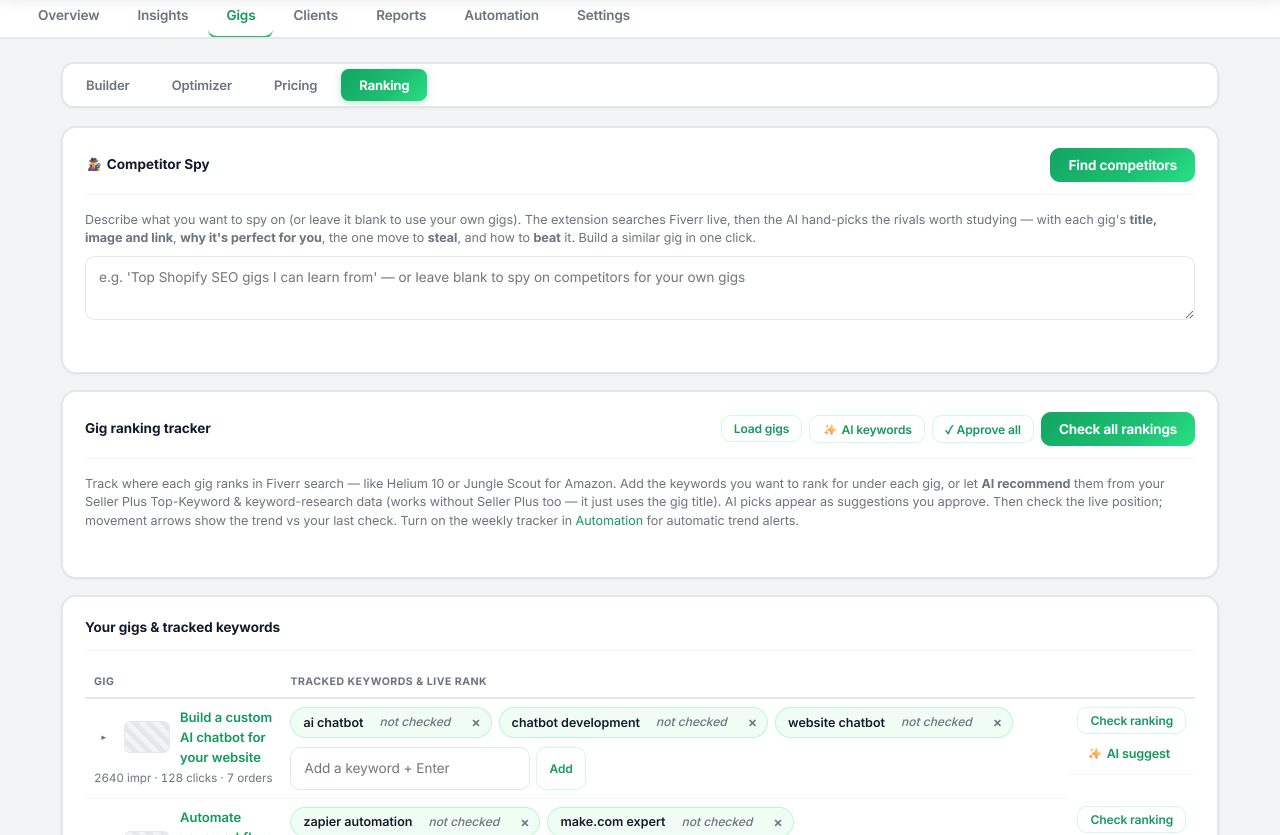
Seller OS connects competitor research to your own gig instead of leaving it in a document. Pro monitors watch competitor gigs while Chrome is open and alert you when a title, tag, or price changes, so a re-check does not depend on memory. The Gig Performance Optimizer audits your live gig against its own impressions, clicks, and conversions to show where you are losing buyers against the pattern you studied. For the manual version of that review, see how to run a Fiverr SEO audit.
The one-shot Gig Builder can turn a competitor URL into your own draft, structured from what you learned rather than copied, and every change stays under your review. Read the full Fiverr SEO tool guide for the workflow.
Fiverr competitor research questions
How many competitors should I study?
Three to five gigs that rank for your main keyword is enough to see the pattern. More than that usually repeats the same information and slows you down.
What should I track for each competitor?
Title structure, tags, package tiers, price ladder, deliverables, turnaround, FAQ, and recurring review themes. Record them in one place so you can compare over time instead of relying on memory.
Is it okay to use a competitor's gig as a template?
Use it as a reference, not a template. Study how the gig is structured and positioned, then write your own copy and packages around the gap you can serve better. Copying text or images does not differentiate you.
How often should I re-check competitors?
Re-check after a meaningful change in your own results, and whenever the category feels different, such as when new sellers appear or prices shift. Keep it occasional and deliberate rather than a daily habit.
Research the category, then beat it on fit.
Track competitor changes, audit your own gig, and build drafts from what you learn.