 Seller OS
Selling on Fiverr or starting your own business?
Fiverr and your own business solve different problems: the marketplace rents you demand, while independence gives you margin and control. The faster answer is that most sellers do not choose one forever, because the hybrid path uses marketplace cash and proof to fund direct relationships. Compare the two honestly, then decide with your own numbers.
Free plan available. Local-first data. Human review on every change.
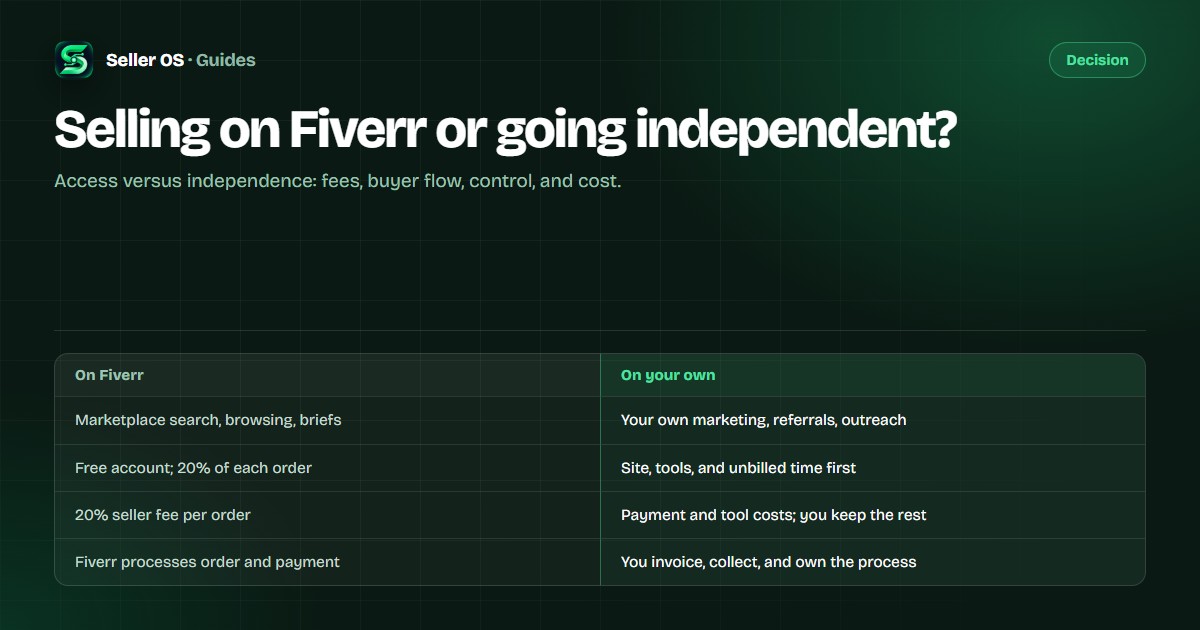
Should you stay on Fiverr or go independent?
Start on Fiverr if you need buyers now; start your own business if you already know where your next five clients come from. Fiverr sells access, your own business sells ownership, and the right answer for this year is usually a mix rather than a switch.
The market context supports the mixed approach. According to Fiverr's second-quarter 2026 results, published July 29, 2026, the company revised full-year 2026 revenue guidance to $356–372 million (down 17%–14% year over year) and cited two pressures by name:
“AI-related demand and traffic headwinds” and “persistent weakness across categories most exposed to AI automation.”
— Fiverr, second-quarter 2026 results, published July 29, 2026
Fiverr said those results reflected a strategic shift toward higher-value work, with a proprietary Knowledge Graph deployed live. Weaker transaction volume and more valuable projects at the same time is the case for a hybrid path: keep the marketplace channel while you build something you own.
Fiverr and independence, side by side
The table below is the decision on one screen. Read each row as a trade rather than as a verdict: every path asks you to pay in money, time, or control.
| Decision | Selling on Fiverr | Your own business |
|---|---|---|
| How clients find you | Marketplace search, category browsing, briefs, and matching | Your own marketing, referrals, networks, and outreach |
| Upfront cost | An account is free; the platform takes 20% of each order | Site, tools, and unbilled time before the first invoice |
| Fees | 20% seller fee per order | Payment and tool costs vary; you keep the rest |
| Who handles payment | Fiverr processes the order and the payment | You invoice and collect, and you own the process |
| Pricing control | You set prices inside platform rules and market pressure | You set prices and terms directly with the client |
| Client relationship | The platform stands between you and the buyer | The relationship is yours to keep and grow |
| Admin load | Lower: checkout, disputes, and records sit with Fiverr | Higher: quotes, invoices, follow-ups, and bookkeeping |
| Risk concentration | One account decides your access and visibility | Your pipeline spreads across clients and channels |
| Speed to first sale | Faster when you list into demand that already exists | Slower until your own pipeline exists |
| Ceiling | Set by platform demand and platform rules | Set by your capacity and your reach |
Fiverr is a demand engine; direct work owns the margin
Fiverr hands you demand you did not have to build, and it takes 20% of every order for the introduction. Direct work pays you the full amount and asks you to create the demand yourself, usually through referrals, a portfolio, and consistent follow-up.
The trade is real in both directions. A seller who closes ten $100 orders on Fiverr nets $800; the same seller with ten direct orders at $100 keeps $1,000 before tool and admin costs. The missing $200 is the price of not hunting, and whether that trade is good depends on what your own hunting time is worth.
The hybrid path: fund and validate on Fiverr
Use Fiverr to discover what sells and to keep cash moving, and use those orders to build the direct side. The marketplace shows you which outcomes buyers pay for, which questions come up before they order, and which price points survive.
Then move carefully. Deliver excellent work on the platform, keep the relationship warm where Fiverr's terms allow it, and let repeat buyers find your own offer when they are ready. The goal is not to escape the marketplace; it is to make the marketplace one channel among several.
Five questions that show which fits now
Answer these with dates and numbers, not with a feeling.
- Can you name where your next five clients come from without naming a marketplace?
- Do you have one service that buyers already pay a premium for?
- How many hours a week can you spend on sales, follow-ups, and admin rather than delivery?
- Would you rather rent access to buyers or build a list of your own?
- What happens to next month's income if one account is limited tomorrow?
Independent answers point toward building your own pipeline now. Marketplace answers point toward staying, improving your position, and building direct channels with the cash the platform provides.
What independence actually costs in time
Independence replaces the fee with a workload. Marketing, follow-ups, quoting, invoicing, collections, and bookkeeping all become yours, and nobody sends you a brief while you sleep.
Budget the first year for that shift. Direct work often starts slower than a marketplace listing because trust has to be built one conversation at a time, and the margin improves only after the pipeline holds. Contracts, entity choices, and tax handling vary by country; consult a qualified professional rather than copying advice from a forum.
The honest limits of both paths
Fiverr controls ranking, matching, fees, and access, so no listing or tool can guarantee impressions or orders. Going independent removes the fee and keeps the risk: nothing sends demand your way until your own marketing and reputation do.
Neither path is safe by default, and neither is a mistake. Build on the one that funds the other, and keep enough records that a bad month is a problem you can diagnose rather than a surprise that ends the business.
Where Seller OS helps
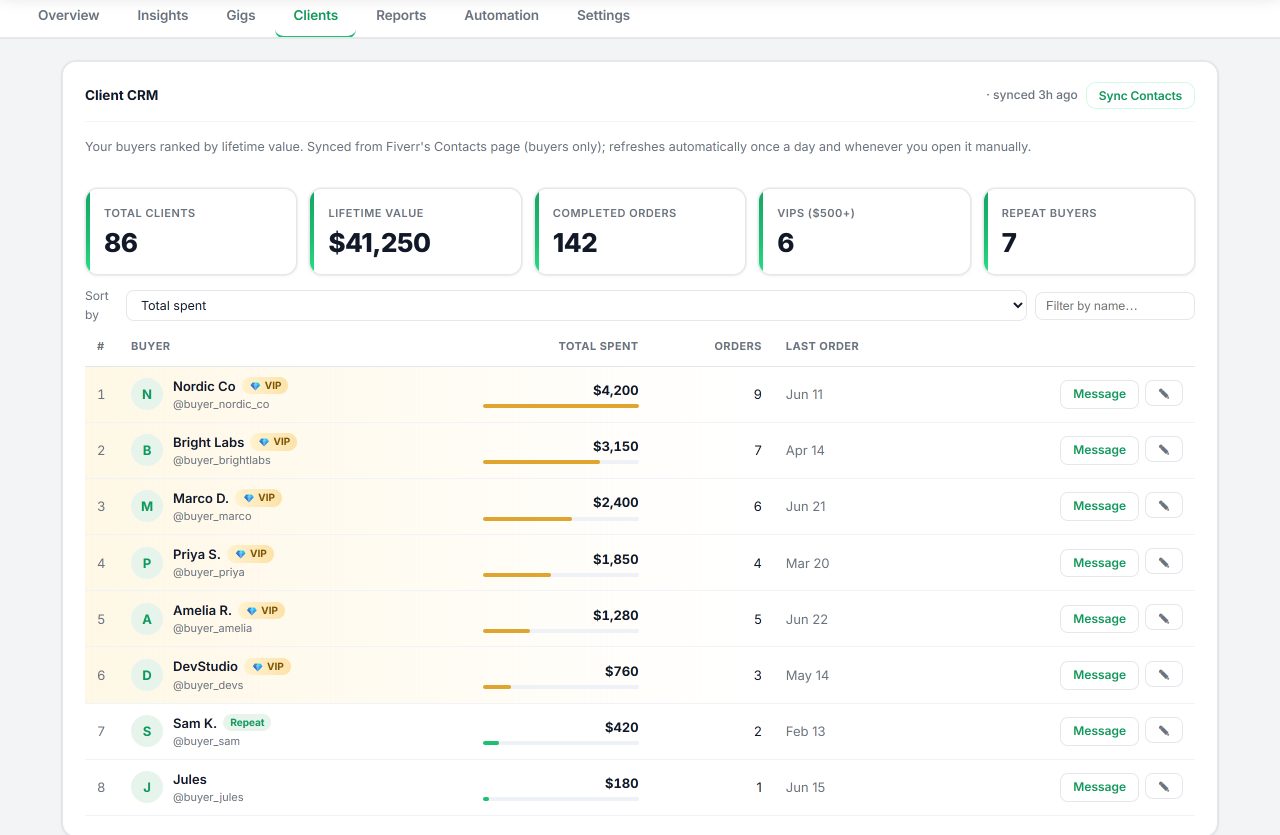
Whichever path you are on, Seller OS keeps the evidence local. Client records hold notes, tags, and repeat history so you can see who pays and who returns; reports and the daily action queue show what needs attention; CSV exports keep your data portable.
Monitors run only while Chrome is open, and everything the extension produces is a draft for review. A person performs every Send, Save, Continue, and Publish; nothing runs automatically, and no tool guarantees orders.
Sources
Fiverr's reported results and its own documentation:
- Fiverr's second-quarter 2026 results, published July 29, 2026.
- Fiverr's help center for current fee and platform documentation.
Fiverr versus your own business questions
Can I use Fiverr to fund my own business?
Yes, and many sellers do. Keep delivering well on the platform for cash flow, then reinvest part of that income into your own site, portfolio, and outreach. The marketplace stays one channel rather than the whole plan.
Do I keep my clients if I leave Fiverr?
Fiverr's terms govern how buyers and sellers can contact each other and move work off the platform, so read them before you act. Anything that happens inside Fiverr stays inside its rules and records.
Is starting my own business cheaper than Fiverr?
Not on day one. You skip the 20% order fee but pay in time for marketing, invoicing, and follow-up, plus whatever your site and tools cost. The margin improves only after the pipeline exists.
Which path is less risky?
They carry different risks. Fiverr concentrates access in one account; independence spreads access across clients but removes the demand the platform supplied. A mix keeps both risks smaller than either extreme.
Keep the record either way.
Track clients, repeat history, and the numbers behind each channel, then review every change yourself.