 Seller OS
Orders needed for $2,000 a month on Fiverr
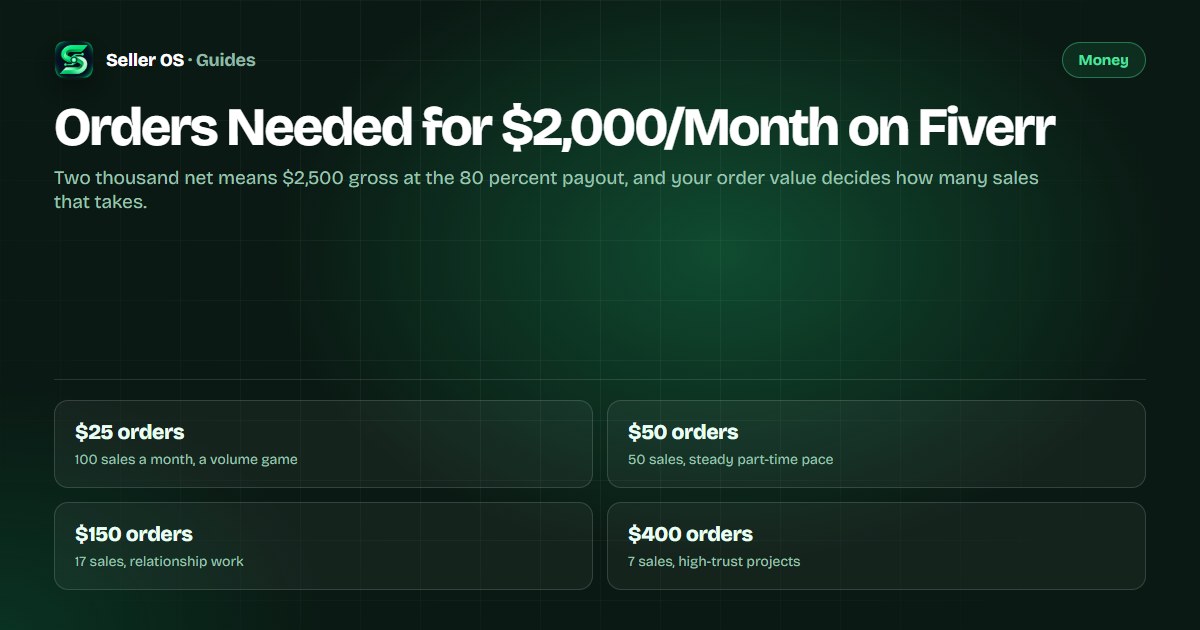
Two thousand dollars net a month is a concrete target, so it deserves concrete math. At the 80 percent seller payout, $2,000 net means $2,500 gross, and the number of orders that requires depends entirely on your average order value.
This guide shows the order counts at $25, $50, $150, and $400 values, converts them to a weekly pace, and compares the two ways to close the gap: more orders or higher prices. All figures are illustrative examples, and the live fee calculator can model your exact mix.
Free plan available. Local-first data. Human review on every change.
The target math at four order values
Start from the payout Fiverr describes in the Help Center: sellers earn 80 percent of each completed order. Dividing $2,000 by 0.8 gives $2,500 gross, which is the number your orders must total before the fee.
The table below divides that gross by four illustrative order values. Read your row as the workload the target implies: a hundred small sales is a systems operation, while seven large ones is a relationships operation. Neither is better in the abstract; they demand different skills.
| Order value | Gross needed | Orders per month | Orders per week |
|---|---|---|---|
| $25 | $2,500 | 100 orders | About 23 |
| $50 | $2,500 | 50 orders | About 12 |
| $150 | $2,500 | 17 orders | About 4 |
| $400 | $2,500 | 7 orders | About 2 |
What the weekly pace feels like
Monthly totals hide the weekly reality, so divide by 4.3 weeks. Twenty-three small orders a week means three or more deliveries every single day with no days off, including intake, revisions, and messages. Twelve mid-size orders means twoish a day, still a full schedule. Four larger orders means one most working days, with room to think.
Match the pace to your actual availability before committing to it. A part-time seller with evenings free can sustain the $50 row for a while but not the $25 row, and burnout shows up in late deliveries and thin reviews long before it shows up in your mood. Choose the row your calendar can carry for months.
Raising price versus adding volume
When the math shows too many orders, you have two levers. Adding volume means more buyers, more messages, and more delivery slots, with income growing linearly against your hours. Raising order value through packages, extras, and custom offers grows income against the same buyer count, which is why it usually wins once proof exists.
A worked comparison makes it plain. Moving from $50 to $75 average value at 50 orders a month adds $1,000 gross without a single new buyer. Reaching the same gross at $50 needs 20 more orders, each with intake and delivery attached. Price moves the target with paperwork; volume moves it with hours.
- Volume path: more buyers, more messages, linear hours for linear income.
- Value path: stronger packages and extras against the same buyer count.
- Combined path: raise value first, then add volume on the better base.
What breaks first at high volume
High order counts stress three things: delivery times, quality consistency, and your inbox. Delivery buffers that worked at five orders a month collapse at fifty, small quality slips multiply across more reviews, and response times sag under message load. Each of these feeds the metrics Fiverr shows buyers, so volume without systems quietly taxes future orders.
Protect the target by designing capacity before chasing it: realistic gig delivery times with margin, requirement questions that prevent revision loops, and a daily inbox routine. The goal is a pace you can hold for a year, because a $2,000 month followed by a penalized quarter is worse than steady growth.
Track your own numbers and adjust
Your average order value is the number to watch monthly. Total gross divided by completed orders gives it, and the trend tells you whether packages and extras are working or order values are drifting down. If the average climbs, the same order count earns more; if it falls, you need more orders for the same net.
Recompute the table with your own average each month, and let the result choose your next move: sourcing when orders lag, or value work when volume is full. The income ranges guide frames the profiles, the raise playbook details the value lever, and the pricing guide covers the foundations.
Where Seller OS helps
Seller OS tracks the two numbers this guide runs on: orders and average value per gig. Its analytics views show how each gig converts and what each order is worth, so you can see whether sourcing or value work is the right next move.
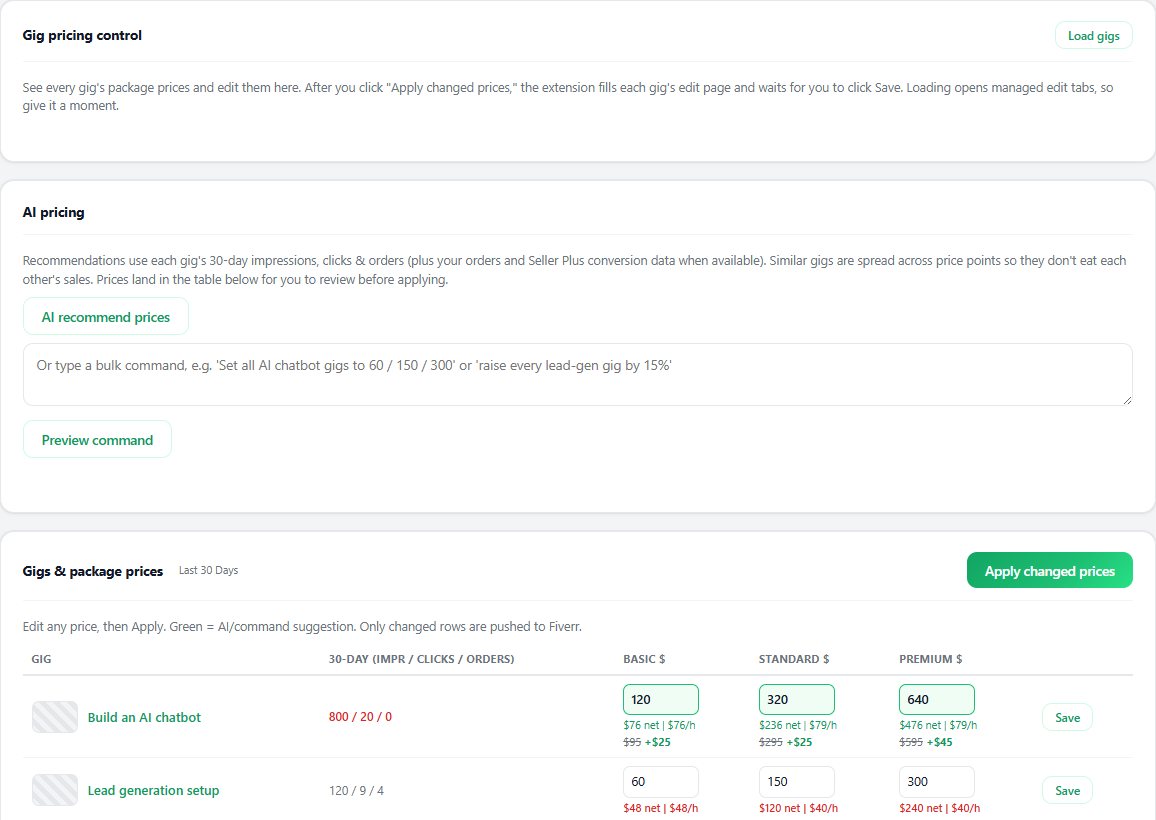
The pricing review checks your package tiers against assumptions you set and remembers recently applied prices. All data stays in Chrome local storage, and every change on Fiverr stays in your hands.
Orders Needed for $2,000/Month on Fiverr questions
How many Fiverr orders equal $2,000 a month?
At the 80 percent payout, $2,000 net needs $2,500 gross. That is 100 orders at $25, 50 at $50, 17 at $150, or 7 at $400. Your average order value decides the workload, which is why raising value usually beats chasing volume once reviews exist.
Is $2,000 a month realistic on Fiverr?
It is achievable but not typical for beginners, because it needs either high volume or solid order values plus steady demand. Fifty $50 orders a month is a full part-time schedule, while seven $400 orders need high-trust positioning. Treat it as a second-stage target built on reviews, repeats, and systems.
Should I get more orders or raise prices to grow?
Raise order value first once proof exists, because it grows income without adding delivery hours. Moving from $50 to $75 average at 50 monthly orders adds $1,000 gross with no new buyers, while matching that by volume needs 20 more deliveries. Add volume after the value base improves.
How many orders per week is $2,000 a month?
Divide monthly orders by 4.3 weeks: about 23 a week at $25 values, 12 at $50, 4 at $150, or 2 at $400. The weekly view exposes whether your calendar can carry the target, since daily deliveries, messages, and revisions all scale with order count rather than revenue.
Pick your row, then close the gap.
Compute your average order value and choose volume, value, or both.