 Seller OS
Fiverr income in your first 3 months
Your first three months on Fiverr follow a pattern: setup and silence, then a first order or two, then the first signs of repeat demand. Sellers who expect that rhythm plan calmly. Sellers who expect instant income usually quit during the quiet part.
This guide walks through days 30, 60, and 90 with honest expectations for each, shows what actually moves the needle month by month, and closes with a worked fee example. It is a timeline, not a promise, and your pace depends on your category and effort.
Free plan available. Local-first data. Human review on every change.
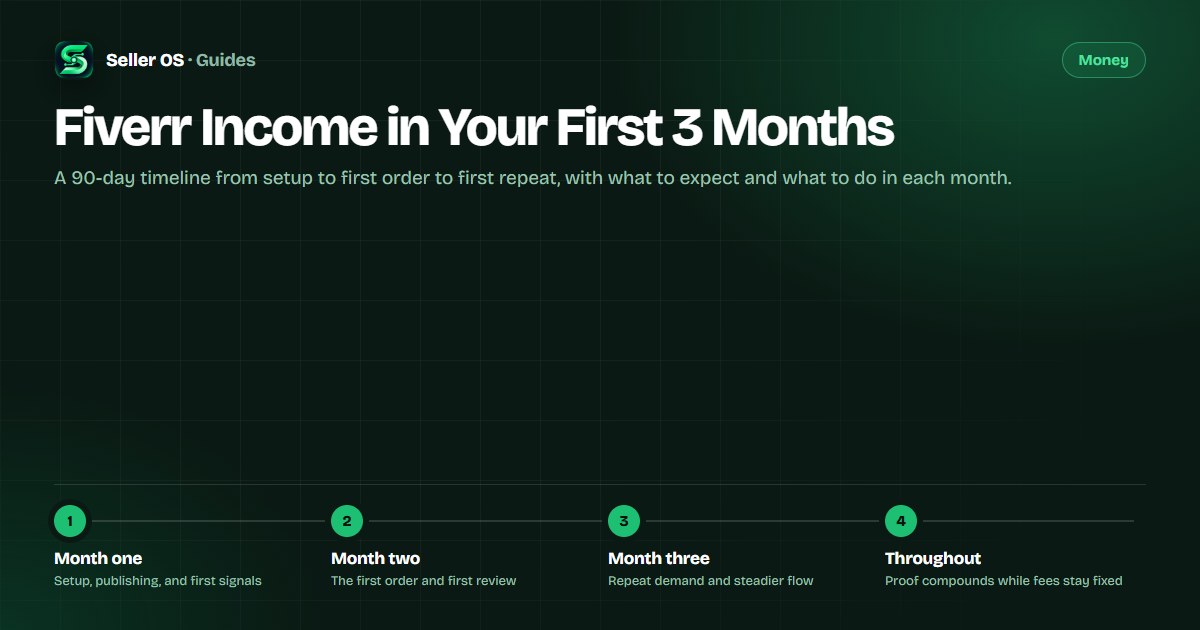
Month one: setup and first signals
Month one is building work, and income is usually zero. You publish your profile and your first gigs, study the search results you want to appear in, and send your first buyer requests or responses. Impressions trickle in slowly because a new gig has no order history for search to trust yet.
What moves in month one is everything upstream of money: a complete profile, gigs with clear packages, and your first few conversations. Track impressions and clicks rather than earnings, because those are the signals that arrive first. The first-order guide covers this stretch in practical detail.
- Publish one narrow gig well rather than five vague ones.
- Watch impressions and clicks, not revenue, in the first weeks.
- Answer every inquiry fast while volume is low enough to allow it.
Month two: the first order
Most active beginners land their first order somewhere around the second month, often a small one from a buyer taking a chance on a new seller. The amount is modest by design: you priced to earn trust, and the buyer bought because the risk felt low. One completed order with a good review changes your gig more than any edit can.
What moves in month two is proof. That first review, plus your response time and on-time delivery record, gives the next buyer a reason to choose you. Overdeliver slightly on these early orders, deliver early, and ask politely for feedback once the work is accepted. Do not raise prices yet; volume of proof matters more than margin right now.
Month three: the first repeat
By month three the pattern either starts or it does not. A buyer returns, or a past buyer refers someone, or your gig begins earning steady impressions from its early history. Income is still small, often tens of dollars net, but the shape is different: some of it arrives without fresh hunting.
What moves in month three is leverage on proof. Two or three reviews let you tighten the gig description around what buyers actually praised, add an extra that early orders suggested, and consider a second gig in an adjacent niche. If nothing has moved by day 90, the diagnosis is usually positioning or demand, and the low-competition method is the right next read.
A worked fee example
Say month three brings three orders at $30 each. Gross revenue is $90, and at the 80 percent payout Fiverr describes in the Help Center, you keep $72. That figure surprises sellers who did the math in gross terms, which is why every plan in this series uses net numbers throughout.
The table below scales the same arithmetic so you can locate yourself. These are illustrative examples, not benchmarks, and your mix of order sizes decides your row.
| Orders | Average value | Gross | You keep |
|---|---|---|---|
| 2 orders | $20 | $40 | $32 |
| 3 orders | $30 | $90 | $72 |
| 5 orders | $40 | $200 | $160 |
| 8 orders | $50 | $400 | $320 |
What does not move yet, and why that is normal
Three things stay flat in the first 90 days for almost everyone: search position, pricing power, and passive inquiries. Search needs history before it trusts a gig, buyers pay premiums for proof you are still building, and inbound messages arrive only after visibility exists. None of this signals failure; it is the standard shape of the ramp.
Judge the quarter by inputs and leading signals instead. Published gigs, conversations started, orders delivered on time, and reviews earned are the scoreboard. The income ranges guide shows where those inputs lead once they compound, and the first-$100 plan turns them into a concrete near-term target.
Where Seller OS helps
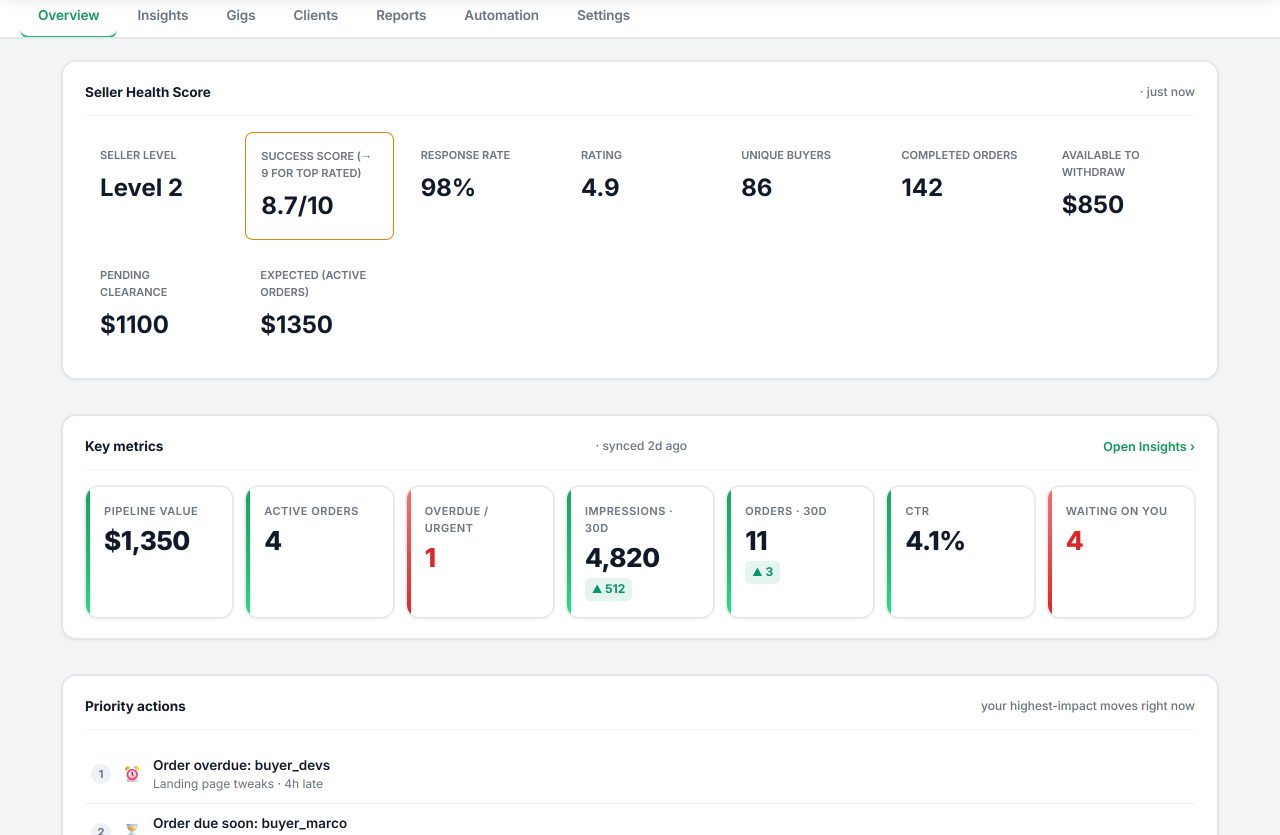
Seller OS is built for the quiet months, when small signals matter most. Its analytics views show impressions, clicks, and orders per gig, so a new seller can tell a positioning problem from a patience problem instead of rewriting a gig that only needed time.
Drafts stay local and nothing publishes itself. The gig builder prepares structured drafts for your review, tracking stays in Chrome local storage, and every Save or Publish on Fiverr is completed by you.
Fiverr Income in Your First 3 Months questions
How much will I earn in my first month on Fiverr?
Usually nothing, and that is normal. Month one is setup work: publishing gigs, learning your search results, and earning first impressions. New gigs have no order history for search to trust, so revenue lags behind effort. Track impressions, clicks, and conversations in the first weeks, and judge month one by inputs completed rather than dollars earned.
When do most new Fiverr sellers get their first order?
Active beginners commonly land a first order around the second month, often a small one from a buyer willing to try a new seller. Pricing modestly, responding fast, and keeping requirements simple all shorten the wait. One completed order with a good review changes your gig more than further editing, so the whole early strategy points at earning that first proof.
What should my Fiverr income look like after 90 days?
Still small for most sellers, often tens of dollars net, but different in shape: some of it starts arriving without fresh hunting as buyers return or refer others. Two or three reviews, steady impressions, and a first repeat are a healthy 90-day scoreboard. If nothing has moved, revisit positioning and demand rather than effort alone.
Should I raise my Fiverr prices in the first 3 months?
Generally no. Early months are for accumulating proof, and modest prices lower the risk a buyer takes on an unreviewed seller. Keep prices sustainable but accessible until several good reviews exist, then tighten the offer around what buyers praised and raise gradually. Margin comes after proof, not before it.
Plan the quarter in inputs, not income.
Publish, converse, deliver, collect proof, and let the timeline do its work.