 Seller OS
How to find low-competition gigs on Fiverr
Low competition is not a lucky category; it is a readable gap between what buyers want and how many sellers serve them well. Any seller can learn to spot that gap by reading Fiverr search pages the right way: result counts, review counts on page one, and the age and strength of the accounts holding the top spots.
This guide teaches the method, not the list. You will learn which signals to read, how to score demand against competition, and how to shortlist three ideas. For ready-made examples, see the 2026 picks, and for the final go or no-go test, use the validation checklist.
Free plan available. Local-first data. Human review on every change.
What low competition actually means
A low-competition gig is one where buyer demand visibly exceeds the supply of credible sellers. That is different from low demand, where few sellers exist because few buyers ever arrive. Your job is to tell the two apart before you invest weeks building a gig nobody searches for.
Three conditions mark a real opening. Buyers ask for the service in search terms you can find, the current top gigs show thin proof such as low review counts or new accounts, and you can deliver work at least as good as page one within a reasonable learning period. Miss any one of the three and the gap is either imaginary or out of reach.
Timing matters as much as the gap itself. A thin page in a rising category rewards the first credible seller, while a thin page in a fading one stays thin because buyers left. Check review dates across the top gigs: recent orders on weak listings signal a gap worth taking, and silence across the page tells you to keep looking.
- Demand: buyers search for it in words you can observe.
- Thin proof: top gigs hold few reviews or young accounts.
- Reach: you can match page-one quality within months, not years.
Read a Fiverr search page in ten minutes
Open an incognito window and search the exact phrase a buyer would type. The result count gives a rough sense of crowding, but the first page tells the real story. Click into the top five gigs and note each one's review count, seller level, and account age signals such as portfolio depth and review history.
A page dominated by new sellers with under fifty reviews each is readable as thin competition. A page where every top gig holds thousands of reviews from leveled sellers is readable as a wall. Between those extremes, look for the soft spots: outdated galleries, vague packages, slow response times, and complaints repeated in reviews, which the gap-mining workflow turns into your opening.
| Signal | Thin competition | Crowded page |
|---|---|---|
| Page-one review counts | Mostly under fifty reviews | Thousands per gig |
| Seller levels | New and unrated accounts | Top rated and Pro throughout |
| Gallery freshness | Dated or generic samples | Polished, specific proof |
| Review complaints | Same gripe repeated | Praise with no pattern |
Score demand against competition
Signals become decisions once you score them. Rate each candidate idea from one to five on demand evidence: autocomplete suggestions, related searches, buyer requests, and the order flow implied by review dates on competing gigs. Then rate competition strength from one to five using the page reads above. Subtract competition from demand; positive scores deserve a shortlist slot.
Keep the scoring honest by writing the evidence beside each number. A demand score of four should point at specific autocomplete phrases and recent reviews, not a feeling. The orders-per-seller method adds a five-minute demand estimate from review counts and account ages when you want a second opinion.
- Demand 1-5: autocomplete depth, related queries, buyer requests, review recency.
- Competition 1-5: page-one reviews, seller levels, gallery quality, complaint patterns.
- Shortlist rule: demand minus competition of plus two or better earns a validation run.
- Evidence rule: every score above three must cite something you observed.
Shortlist three ideas, then validate one
End the session with exactly three candidates ranked by score, each with its evidence notes. Three is small enough to research properly and large enough that one failure does not end the project. Do not publish all three; validation comes next, and most ideas should die there cheaply.
Take the top candidate through the validation checklist, which tests buyer language, price ceiling, and delivery feasibility with a pass or fail at each gate. If it passes, borrow positioning ideas from the gig-finding guide and build one focused gig. If it fails, you spent an evening, not a quarter.
Where Seller OS helps
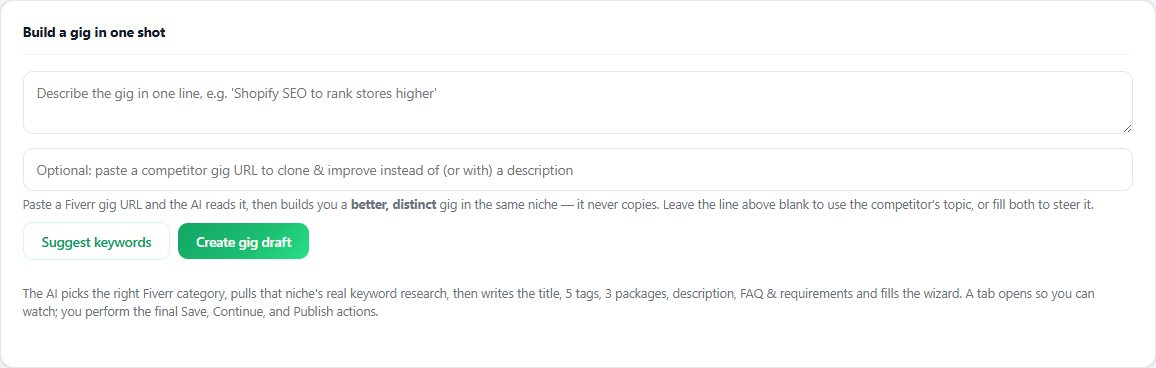
Seller OS supports the research loop without replacing your judgment. The gig builder turns a shortlisted idea or a competitor URL into a structured draft you review, and the gig optimizer compares a live gig's copy and conversion signals against the gig's own performance data once it starts earning visits.
Your shortlists and notes stay in Chrome local storage, drafts are filled into Fiverr pages for your review, and a person completes every Save, Continue, or Publish action. The extension drafts and tracks locally; it never publishes a gig on its own.
Low-Competition Fiverr Gigs questions
How do I know if a Fiverr niche has low competition?
Search the buyer phrase and read page one: review counts, seller levels, and gallery quality on the top five gigs. Mostly new sellers with under fifty reviews each reads as thin competition, while thousands of reviews on leveled accounts reads as a wall. Pair that read with demand evidence such as autocomplete depth and recent review dates before you commit.
Is low competition the same as low demand?
No, and confusing them is the costliest mistake in niche research. Low competition with visible demand is an opening; few sellers with no buyer searches is simply an empty room. Always confirm demand separately through autocomplete suggestions, related queries, buyer requests, and the dates on competitor reviews, which show whether orders still flow.
How many gig ideas should I shortlist?
Shortlist exactly three, ranked by your demand-minus-competition score with evidence notes beside each number. Three is small enough to research properly and large enough that one failed validation does not end the project. Validate the top candidate first with the five-gate checklist, and only move to the next idea if it fails.
Can a new seller win against leveled competitors?
Sometimes, where the top of the page is soft: outdated galleries, vague packages, repeated complaints in reviews, or slow responses. New sellers win by being specifically better at one thing the incumbents neglect, not by matching them everywhere. If page one shows no soft spots and thousands of reviews per gig, pick a narrower sub-niche instead.
Score three ideas this week.
Ten minutes per search page beats months on a gig nobody wants.