 Seller OS
Fiverr niche validation checklist: five gates before you publish
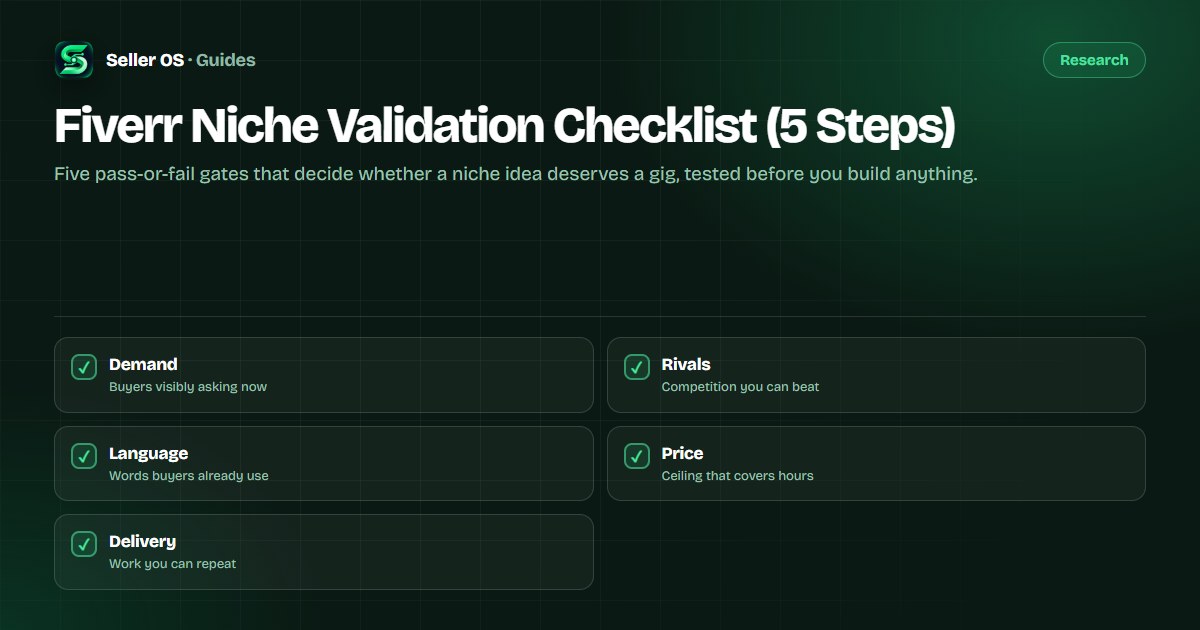
Most failed gigs were never validated; they were published on enthusiasm and left to fade. Validation is the week of checks that happens before you build: confirming buyers exist, competition is beatable, language matches, prices cover your hours, and delivery repeats without burning you out.
This checklist gives you five gates with a pass-or-fail test at each one. Fail any gate and you pause or pivot; pass all five and you publish with evidence. For the search method that produces candidate ideas, read the finding guide first.
Free plan available. Local-first data. Human review on every change.
Gate 1: demand you can see
Demand must be observable, not assumed. Collect autocomplete suggestions for the buyer phrase, note related searches, and check buyer requests for matching wording. Then open the top competing gigs and look at review dates: recent reviews mean orders still flow, while a silent last six months means the niche cooled.
Pass this gate only if you can point at three independent demand traces, such as autocomplete depth plus recent competitor reviews plus matching buyer requests. One trace is a hint; three is a pattern worth money.
- Pass if: three demand traces, including reviews dated within the last month.
- Fail if: searches exist but no gig shows a recent order.
Gate 2: competition you can beat
Beatable does not mean absent. Read the top five gigs for review counts, seller levels, gallery freshness, and repeated complaints. You pass when you can name the specific weakness you will exploit: sharper samples, clearer packages, faster delivery, or a sub-service the incumbents bundle poorly.
Mine low-star reviews for the complaint patterns, using the review-mining workflow, and summarize what you find in your own words without quoting or identifying buyers. A page with no visible weakness and thousands of reviews per gig is a fail; pick a narrower slice instead.
- Pass if: you can name one concrete weakness you will beat.
- Fail if: page one is flawless, leveled, and deeply reviewed.
Gate 3: buyer language you can mirror
Buyers search in their own words, and gigs written in seller jargon miss them. Gather the exact phrases from autocomplete, gig titles that rank, buyer requests, and questions buyers ask in forums. Your shortlist should hold ten or more phrases you did not invent.
Pass when your planned title, tags, and FAQ can be built entirely from observed phrases. Fail when you must invent terminology to describe the offer, because that means buyers have no shared words for it yet and your gig will sit outside their searches. The keyword competition guide shows how to test phrase difficulty.
- Pass if: ten observed phrases cover your title, tags, and FAQ.
- Fail if: you must invent the vocabulary buyers would search.
Gate 4: a price ceiling worth your hours
A niche can have demand and still pay badly. Note the price range on page one for work like yours, then compute your floor: hours per order times your minimum hourly rate, grossed up for Fiverr's commission using the fee calculator. The ceiling buyers accept must sit above your floor with room for extras and revisions.
Pass when at least the middle package clears your floor at a delivery pace you can sustain. Fail when only the top package works, because most first orders land on the lower tiers. General price pressure from automation tools belongs in this math too; if buyers can get a rough version free, your premium must be visibly better.
- Pass if: the middle package beats your hourly floor after fees.
- Fail if: only the top tier covers your time.
Gate 5: delivery you can repeat
The final gate is operational: can you deliver this order ten times in a month without late deliveries, quality slips, or exhaustion. Map the workflow step by step, time a trial run, and add a buffer for revisions and buyer delays. Skills you are still learning belong here as a risk, not a plan.
Pass when a timed trial fits inside your promised delivery window with a day to spare. Fail when the trial barely fits or needs tools you do not own yet. A failed delivery gate is a pause, not a rejection: learn the skill, build templates, then re-enter at gate one.
- Pass if: a timed trial finishes a day inside your delivery promise.
- Fail if: delivery needs skills or tools you lack today.
Your go or no-go decision
Tally the five gates without sentiment. Five passes means publish one focused gig and measure for sixty days. Four passes means fix the failed gate first, usually price or delivery, then recheck. Three or fewer means shelve the idea and validate your next shortlisted candidate from the finding guide.
| Passes | Meaning | Next move |
|---|---|---|
| Five | Evidence on every gate | Publish one gig, review in 60 days |
| Four | One weak gate | Repair that gate, then recheck |
| Three or fewer | Idea lacks support | Shelve it, validate the next idea |
Where Seller OS helps
Seller OS fits the validation workflow because it keeps research cheap. The gig builder turns a passing idea into a structured draft for your review, and the gig optimizer checks a published gig's copy and signals against its own performance data during the sixty-day measurement window.
Notes, drafts, and order history stay in Chrome local storage, and every draft is filled into Fiverr pages for your review. A person completes each Save, Continue, or Publish step, so validation evidence always precedes anything public.
Fiverr Niche Validation Checklist questions
How long should niche validation take?
About a week of evenings for one idea: two for demand and competition reads, one for buyer language collection, one for price math, and one for a timed delivery trial. Longer than that usually means the evidence is thin and you are hoping. Validate three ideas in rotation rather than perfecting one, and let failing gates kill ideas quickly.
What if my niche fails the price gate?
First check whether packaging fixes it: a middle tier with a sharper scope, paid extras for revision-heavy steps, and delivery buffers that protect your effective rate. If only the top package clears your hourly floor after fees, most first orders will still land below it. Shelve the idea or narrow to a premium slice whose buyers already pay more.
Can I validate without any seller account history?
Yes. Every gate uses public evidence: autocomplete, search pages, review dates, buyer requests, and your own timed trial. Account history helps after publishing, when your own analytics replace estimates, but validation happens before that. New sellers actually validate more cleanly, because no existing gig biases which ideas they test.
How is this different from keyword research?
Keyword research answers whether buyers search; validation answers whether you should serve them. Language is only one of five gates here, alongside demand recency, beatable competition, workable pricing, and repeatable delivery. A keyword can pass research with strong volume and still fail validation on price or delivery, which is why both steps exist.
Pass five gates, then publish.
One validated gig beats five hopeful ones every time.