 Seller OS
Orders-per-seller: read Fiverr demand in five minutes
Result counts on Fiverr tell you how many sellers compete, not how much work exists. A search with 8,000 gigs can still support a newcomer if buyers order often, and a search with 400 gigs can be a dead end if nobody buys. You need a demand read, not a competition count.
Orders-per-seller is a five-minute estimate built from public signals: review counts, account ages, and queue hints on the top gigs. This guide shows the inputs, the math with stated assumptions, and how to read the result before you commit to a niche.
Free plan available. Local-first data. Human review on every change.
What orders-per-seller means
Orders-per-seller is an estimate of how many orders each competing gig completes in a month. It answers the only question that matters at research stage: if you ranked beside these sellers, would there be enough buyer activity to feed one more gig. Total result counts cannot answer that, because they mix active sellers with dormant listings.
The inputs are all public. Fiverr shows review counts on gig pages and seller tenure on profiles, and many gigs state an average queue or current workload. None of these equals orders exactly, which is why the method treats the output as an estimate with stated assumptions rather than a measured figure.
- Result counts measure supply; reviews over time approximate demand.
- Account age plus review count gives a rough orders-per-month pace.
- Queue hints confirm whether that pace is current or historical.
Collect the inputs in five minutes
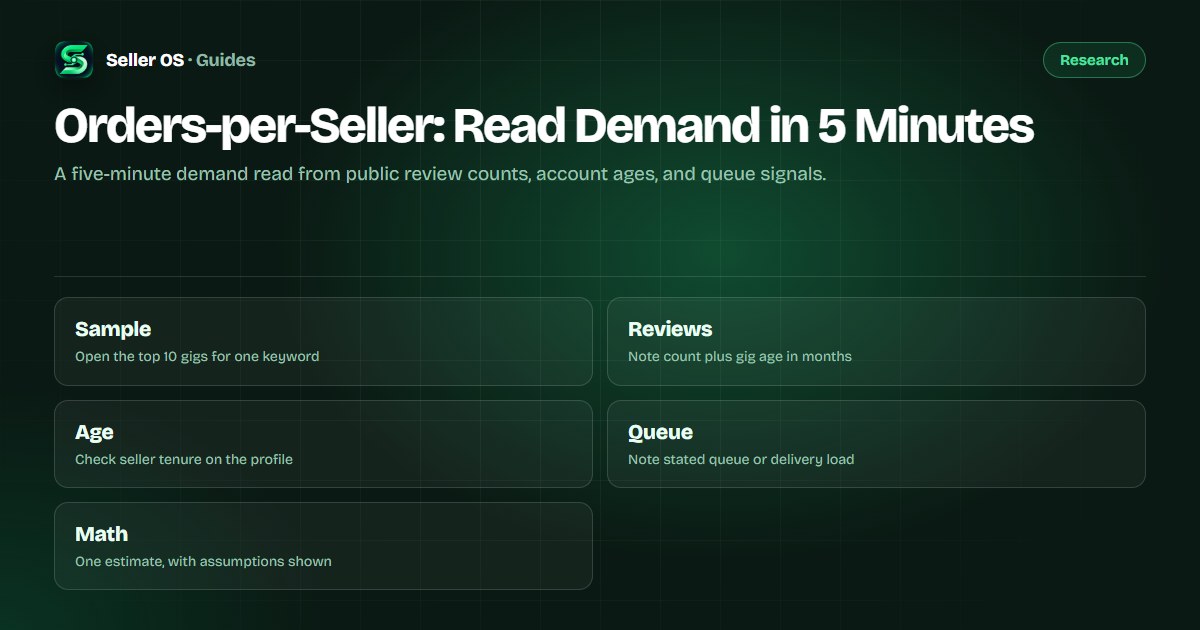
Pick one keyword you would actually target, open the top ten gigs, and record three numbers per gig: total reviews, months since the gig or account started, and any queue signal such as orders in queue or stated delivery load. Five minutes is enough because you are sampling, not auditing the whole category.
Search one keyword
use the exact phrase your gig would target, not the broad category.
Open the top 10 gigs
skip promoted slots if you can spot them and take the organic row.
Record reviews and age
total reviews beside months active for each gig.
Note queue signals
stated queue, delivery times under load, or review dates clustered this month.
Drop outliers
ignore the single runaway leader and any gig younger than one month.
One worked estimate with stated assumptions
The following example is an estimate, not a Fiverr-published figure. It assumes one review for roughly every three to five completed orders, since many buyers never leave feedback, and it spreads the inferred orders across the months the gig has been active. Change the assumptions and the number moves, which is the point: you are testing sensitivity, not finding a true value.
Run the same table on your own keyword with your own review-to-order guess. The niche validation checklist uses this estimate as one of its five gates, beside price ceiling and delivery feasibility.
| Input | Value | Note |
|---|---|---|
| Total reviews | 180 | As shown on the gig page |
| Months active | 12 | From gig history or seller tenure |
| Reviews per month | 15 | 180 divided by 12 |
| Orders per review | 3 to 5 | Assumption, labeled as such |
| Estimated orders per month | 45 to 75 | 15 times 3 to 5 |
How to read the result
Repeat the estimate for five to eight of the sampled gigs and look at the middle of the range, not the best case. If most page-one sellers infer to a steady monthly pace and review dates show recent activity, the keyword feeds its sellers. If most gigs show thin lifetime reviews spread over years, the niche is quiet no matter how few competitors appear.
Then read the queue beside the math. Short delivery times with empty queues on old, well-reviewed gigs suggest demand has cooled. Long queues or extended delivery times on mid-tier sellers suggest current load, which is a healthier sign for a newcomer than a famous seller with a stale calendar.
Limits and walk-away signals
This method cannot see cancellations, private repeat orders, or off-gig buyer contact, and review rates differ by category, so two niches with the same review counts can hide different order volumes. Treat the number as a comparison tool between keywords rather than a forecast of your own sales.
Walk away when the middle of page one shows fewer than a handful of reviews per month over a long tenure, when recent review dates are months old, or when the only active sellers are accounts years deep with thousands of reviews. Those patterns mean you would need to displace an entrenched seller rather than join an active queue. Fiverr describes how orders and reviews connect in the Help Center, which is the right place to confirm current review and order behavior before you rely on it.
- Stale review dates across page one point to cooling demand.
- Lifetime reviews under 30 on a two-year-old gig point to a thin niche.
- One dominant seller with quiet followers means displacement work, not entry work.
- Compare two keywords with the same assumptions instead of trusting one absolute number.
Where Seller OS helps
Seller OS keeps this kind of sampling fast without storing anything about other sellers. You can shortlist keywords, draft the gig angle each estimate points to, and track your own impressions once the gig is live, all in Chrome local storage.
The comparison stays yours to make. The extension never scrapes buyer data or publishes anything, and every gig edit waits for your review before anything reaches Fiverr.
Orders-per-Seller questions
What is orders-per-seller on Fiverr?
It is a rough estimate of how many orders each competing gig completes per month, inferred from public review counts spread over the gig age. It helps you judge whether a keyword feeds its sellers or just lists them. The output is an estimate with stated assumptions, not a platform-reported figure.
How many reviews equal one order on Fiverr?
There is no fixed rate, because many buyers complete orders without leaving feedback and the share varies by category. A common working assumption is one visible review for every three to five orders. State the ratio you use, test both ends of the range, and compare keywords with the same assumption.
How many gigs should I sample for a demand read?
Ten gigs for one exact keyword is enough for a five-minute read, with the middle five to eight carrying the most weight. Drop the runaway leader and any gig younger than a month. If the middle of that set shows steady recent reviews, the keyword has current activity worth validating further.
When does a good estimate still mean no-go?
When the price ceiling cannot support your delivery time, when the skill gap needs months you do not have, or when the queue sits entirely with entrenched sellers you cannot displace yet. Demand is one gate. The niche checklist adds competition, buyer language, price, and delivery feasibility before you commit.
Estimate demand before you build the gig.
Sample ten gigs, run the math with stated assumptions, then validate the niche.