 Seller OS
How to find low-competition Fiverr keywords
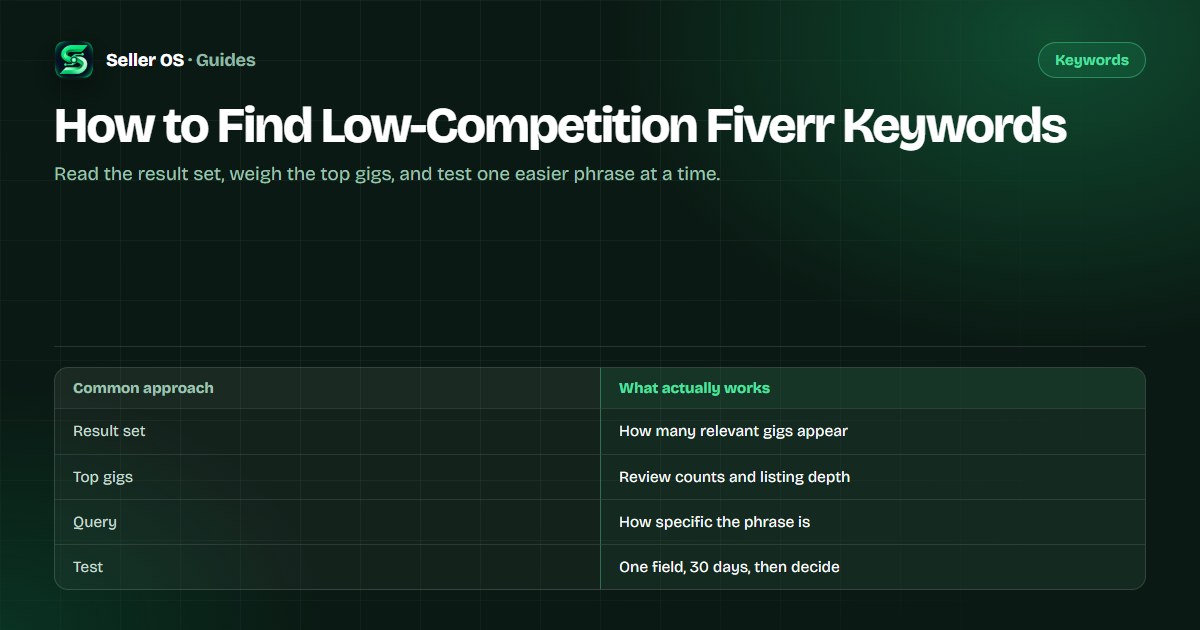
A low-competition Fiverr keyword is a phrase where the visible result set gives you a realistic chance: fewer strong gigs, less polished listings, and a buyer with a specific need. Fiverr does not publish a difficulty score, so this is a judgment you make from what the search page shows, not a number a tool hands you.
This guide shows what to inspect in the results, how to tell a genuinely easier phrase from a dead end, and how to test one change without risking the fields that already bring you orders.
Free plan available. Local-first data. Human review on every change.
What low competition means on Fiverr
There is no Fiverr difficulty score. Keyword Research inside Seller Plus shows a Competition metric with a lower-is-better note, but Fiverr documents that view as limited to Standard and Premium members. Everyone else reads the public result page, which is why the practical definition of low competition is simpler: can a gig like yours compete here?
That framing matters, because competition is relative to your gig's age, reviews, and price. A phrase that is soft for a Level 2 seller with hundreds of completed orders can still be hard for a new listing. Low competition is not a property of the keyword alone; it is a relationship between the keyword and your gig.
Three checks before you call a keyword easy
Start with relevance. If the top results sell a different service than yours, the phrase may be easier because buyers there want something else, which is worse than competition. Then look at strength: how many reviews do the top gigs carry, and do their pages look complete or sparse? Finally, look at specificity: more qualifiers in the query usually mean fewer competing gigs and a clearer buyer.
The three checks work together. A narrow query with weak, thin results is the definition of an opening. A narrow query with polished giants is still a wall. A broad query with weak results is usually a mirage, because weak results on a broad term often mean the traffic is not converting for anyone.
- Relevance: do the top gigs sell what you sell?
- Strength: how many reviews, and how complete are the pages?
- Specificity: how much does the query narrow the buyer's need?
- Your fit: how does your gig compare with the first page, line by line?
Worked example: one service, four phrasings
The same service looks different depending on the phrase. Below is an illustrative read of four queries for a WordPress fix service. The labels describe what you would look for on the page; they are not measured platform data, and your own result pages may differ by session and location.
Notice that the broadest phrase is the hardest and the least clear. The narrowest one, phrased the way a buyer describes a problem, is usually the easiest to enter and the easiest to satisfy once an order arrives.
| Query | Result set | Top gig strength | How to read it |
|---|---|---|---|
| website fix | Broad, mixed services | High, dominant sellers | Hard and unclear intent |
| wordpress fix | Focused, many gigs | Medium to high | Competitive but relevant |
| fix wordpress plugin conflict | Narrow, fewer gigs | Mixed, some thin pages | Specific and winnable |
| fix woocommerce checkout error | Narrow, problem language | Few exact matches | Strongest candidate |
When an easy keyword is actually a trap
A phrase can look easy because nobody sells it well, and also because nobody buys it. The difference is evidence. If the phrase never appears in autocomplete, in your inbox, or in buyer requirements, its small result set may reflect low demand rather than opportunity. Empty pages are cheap to rank in and expensive to wait on.
Category mismatch is the other trap. A specific phrase that sits outside your category's language can pull traffic that Fiverr's matching then filters for you, so the impression never becomes a click. Keep candidates inside the vocabulary of your subcategory and the buyers who already message you.
Where low-competition phrases usually hide
They hide in qualifiers: a platform, an industry, a format, a turnaround. They hide in problem language, the way a buyer phrases a fix rather than a service. And they hide in your own order history, where buyers describe what they wanted in words you would never have chosen for yourself.
They also hide in places you can see but rarely browse: subcategory filters, service type lists, and the longer tails Fiverr's autocomplete offers after three or four typed words. None of these places requires a paid tool; they require attention and somewhere to write things down before they disappear.
- Platform or tool qualifiers: shopify, wordpress, figma, excel.
- Problem phrasing: fix, error, broken, not working, rejected.
- Format or size: 60 second, single page, one minute, per episode.
- Buyer stage: for startup, for etsy shop, for students, for agencies.
How to test an easier keyword safely
Treat a new phrase as an experiment, not a rescue. Change one field, ideally a tag or a single positive keyword slot, and leave the title alone until you have evidence. Then let the gig run for the window Fiverr recommends before you touch anything again.
The order of escalation matters. Start where the cost of being wrong is lowest, prove the phrase has demand and relevance, and only then consider moving it into the title, which is the field your current performance rests on.
Record the current state
note the fields you will touch and the gig's recent impressions and clicks.
Change one slot
swap a single positive keyword or tag, not three fields at once.
Wait 30 days
the review window Fiverr gives for new or updated keywords.
Compare the same metric
this gig's impressions and clicks against the previous period.
Keep, revert, or promote
if the phrase performs, consider its next slot; if not, restore the old field.
“Give any new or updated keywords at least 30 days before reviewing their impact and analyzing their performance.”
— Fiverr's Advanced Analytics for Seller Plus help article, September 2026
Mistakes when chasing easier keywords
The most expensive mistake is swapping a working title for an easier phrase and losing the impressions the old title earned. The second is collecting twenty candidates and testing all of them at once, which makes the outcome unreadable. The third is judging a phrase by its result count alone, as if a small page were the whole story.
Low competition is a starting advantage, not a result. An easier phrase buys you a clearer shot at being seen. The gig card, the packages, the proof, and the delivery still have to close the order, and those are the parts a keyword can never fix.
Where Seller OS helps
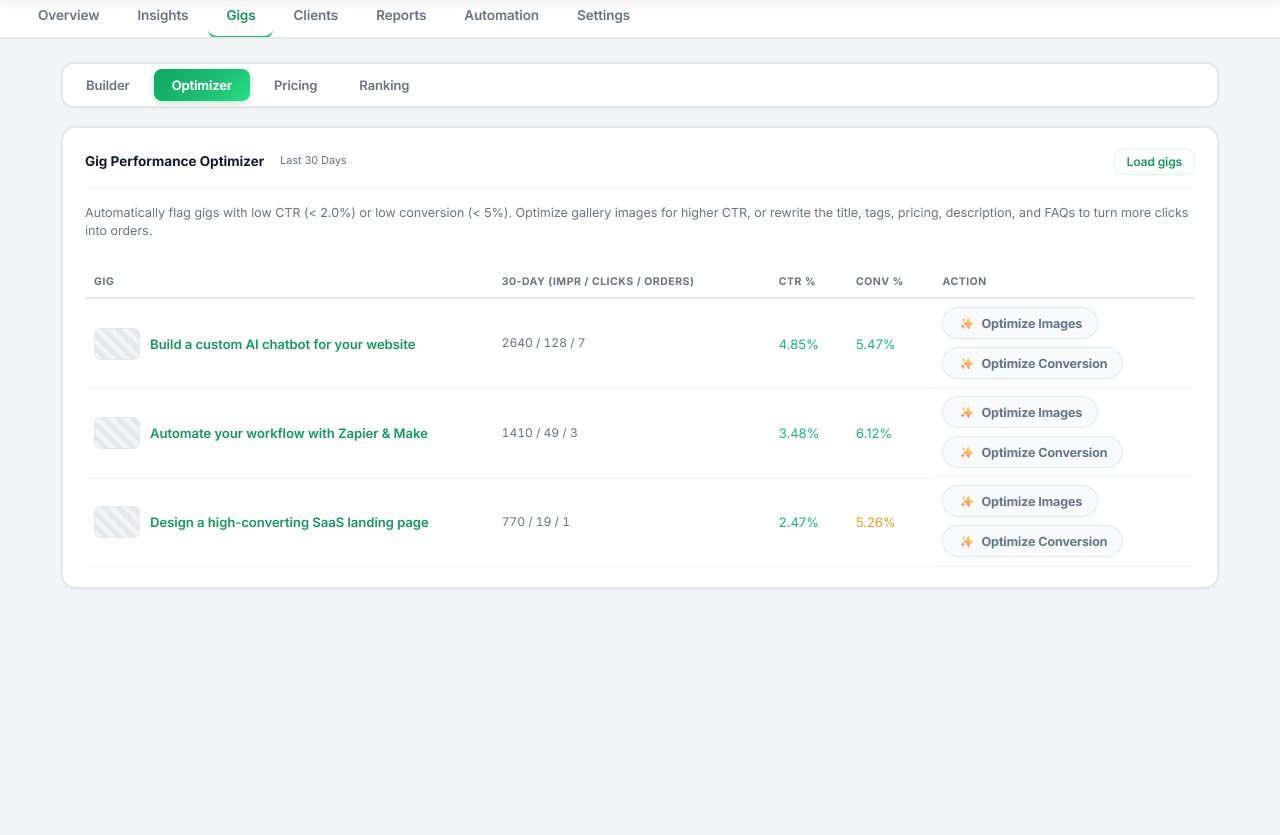
Seller OS keeps your candidate list and your live gig in the same place: the Gig Performance Optimizer reviews a gig's fields against its own performance data and proposes specific changes, while keyword help suggests terms that fit the slots you are trying to fill. You decide which candidate to test and when.
The rank tracker then records whether the test moved your position over the following weeks, so the 30-day judgment has history behind it. Data stays in Chrome local storage, and nothing is published until you click Save yourself.
How to Find Low-Competition Fiverr Keywords questions
What does low competition mean on Fiverr?
It means the visible result set for a phrase looks beatable for a gig like yours: fewer strong listings, thinner pages, and a buyer with a specific need. Fiverr does not publish a difficulty score, so it is a judgment from the result page. Seller Plus members also see a Competition metric in Keyword Research.
How do I find low-competition keywords for a new gig?
Start with narrow, problem-shaped phrases from autocomplete and your own buyer messages, then check the top results for review counts and listing quality. A phrase with few exact matches and mixed-quality pages is a candidate. Test it in a tag or one positive keyword slot first, and give it 30 days.
Are low-competition keywords always worth targeting?
No. A phrase with a small result set can also have little demand, especially if it never appears in autocomplete or real buyer messages. Empty results are not an opportunity. Confirm the phrase comes from buyer language first, then treat easy competition as a reason to test it rather than a reason to commit.
Should I change my gig title to an easier keyword?
Only after the phrase has proven itself in a weaker slot. Fiverr reads the title before any other field, so it is your most valuable and most disruptive line to change. Test the candidate in a tag or positive keyword slot, watch impressions and clicks for a window, then promote it if the data supports the move.
Find the phrase you can actually win.
Install Seller OS, score the result set honestly, and test one easier keyword per 30-day window.