 Seller OS
Mine Fiverr bad reviews for gig gaps
Low-star reviews on competing gigs describe unmet buyer expectations in plain language. Late delivery, thin communication, files that needed rework, scope that shifted mid-order: buyers write exactly what bothered them, which is more direct than any keyword tool.
This guide gives you a workflow to sample those reviews fairly, group complaints into patterns, and convert each pattern into a fix in your offer, description, or packages. You summarize what many buyers report, and you never quote or identify any individual buyer.
Free plan available. Local-first data. Human review on every change.
Why low-star reviews show usable gaps
A one- or two-star review usually names the gap between what the gig promised and what the buyer received. Across ten such reviews, repeats appear: the same delivery complaint, the same file-format problem, the same silence after payment. Repeats are the signal, because one angry review can reflect one bad day while five similar ones reflect a structural gap.
Your job is not to judge the competitor. It is to read the expectation underneath the complaint and decide whether your gig can meet it by design. If buyers repeatedly report slow replies, a gig built around daily updates fills a real opening.
- One complaint is an anecdote; a repeated complaint is a gap.
- Delivery, communication, and file quality produce most repeats.
- The fix belongs in your offer structure, not in your opinion of the seller.
Sample without cherry-picking
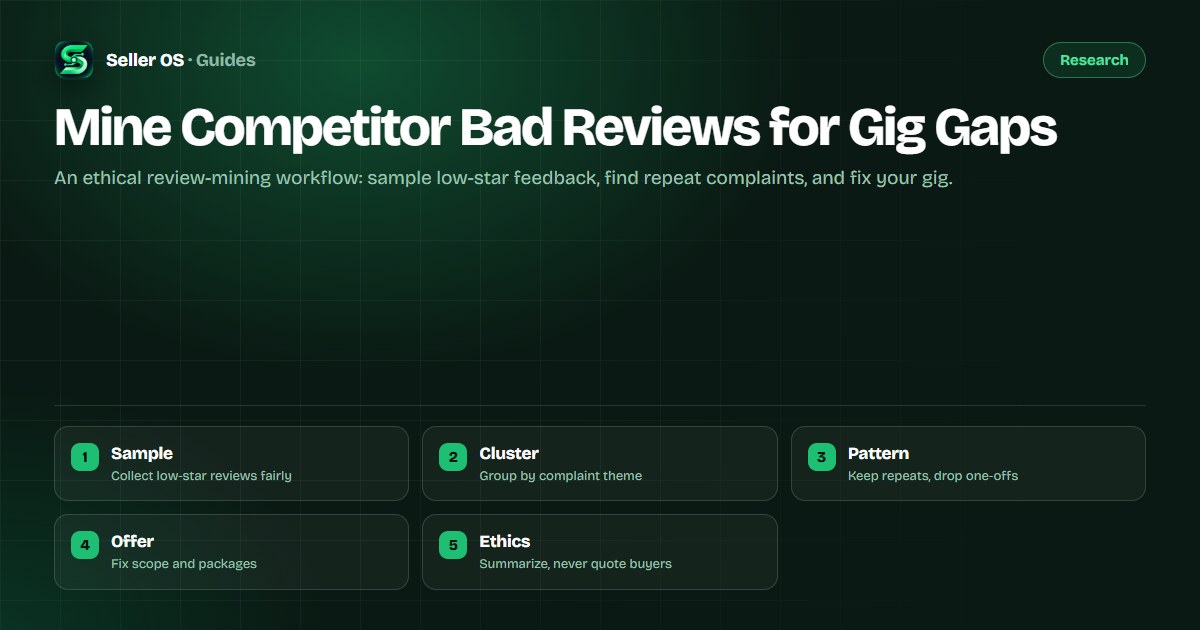
Pick five to eight competing gigs that rank for your target keyword and read their lowest-rated reviews in order, newest first, instead of hunting for the worst cases. Cap the sample at around thirty to forty low-star reviews so one prolific complainer cannot dominate the set.
Pick 5 to 8 rivals
gigs you would realistically compete with on the same keyword.
Read newest first
take low-star reviews in date order, not the most dramatic ones.
Cap the sample
stop near 30 to 40 reviews so the set stays comparable.
Note the gig promise
record what each gig page claimed beside each complaint.
Log themes, not names
write delivery, communication, or quality, never buyer identities.
Cluster complaints into fix types
Sort each sampled review into one theme and count. Most Fiverr complaints fall into five buckets, and each bucket points to a different part of your gig. The table below maps the common clusters to the gig element that actually fixes them, so you change structure instead of adding adjectives.
Keep only clusters with at least three mentions across different gigs. A single unusual complaint, however vivid, does not justify reshaping your offer.
| Cluster | What buyers report | Fix in your gig |
|---|---|---|
| Delivery speed | Late arrival, long queues | Buffer in delivery time, rush extra |
| Communication | Silence after payment | Update schedule in description, FAQ |
| File quality | Needs rework, wrong format | Requirements plus delivery checklist |
| Scope drift | Extras charged mid-order | Package boundaries, extras listed upfront |
| Mismatch | Not what the gallery showed | Gallery proof tied to each package |
Turn each pattern into a gig fix
Work cluster by cluster and make one concrete change per pattern. A delivery cluster becomes a delivery buffer plus a paid rush extra. A communication cluster becomes a stated update rhythm in your description and a matching FAQ entry. A file-quality cluster becomes tighter requirements and a delivery checklist you follow every time.
Write the fix where the buyer reads it. Package boundaries belong in the package table, turnaround promises belong near the delivery control, and file-format guarantees belong in requirements and the FAQ. The description guide shows where each promise lands so the page reads as one coherent offer.
- Delivery pattern: add a buffer day and price the rush option separately.
- Communication pattern: promise an update rhythm you can keep, such as daily.
- Quality pattern: name formats, rounds, and checks in requirements.
- Scope pattern: list what each tier includes and what triggers an extra.
Ethics and what not to copy
Summarize patterns in your own words and never quote a review, name a buyer, or screenshot feedback into your gallery or description. Buyer reviews belong to the buyer and the platform, and reusing them as your marketing reads as hostile even when it is legal. Describe the lesson, such as buyers want source files named clearly, without pointing at anyone.
Do not copy a competitor's text, images, or positioning while you mine their reviews either. The point is to build a structurally better offer, not a paraphrased clone. Fiverr explains how buyer feedback works in the Help Center, and the competitor research guide covers the rest of the ethical sampling method.
Where Seller OS helps
Seller OS helps you act on the patterns without keeping dossiers on anyone. Draft the description fixes, package boundaries, and FAQ entries the clusters point to, and review each change yourself before it goes near your gig.
Nothing about competitors is stored or tracked. Your notes, drafts, and order history stay in Chrome local storage, and a person completes every publish step.
Mine Competitor Bad Reviews for Gig Gaps questions
How many bad reviews should I read per competitor?
Read low-star reviews newest-first across five to eight competing gigs, capped near thirty to forty reviews total. That size keeps one prolific complainer from dominating the set. Keep clusters with three or more mentions across different gigs and drop vivid one-offs that never repeat.
Should I quote competitor reviews in my gig?
No. Never quote, name, or screenshot another gig buyer feedback into your page or proposals. Summarize the pattern in your own words, such as buyers want daily updates, and build the fix into your packages or FAQ. Quoting reads as hostile and misuses words that are not yours.
What if every competitor has great reviews?
Read three-star reviews and the text inside four-star ones, where buyers praise but note small frictions. Delivery speed, file naming, and post-delivery support often appear there. If even those are uniformly positive, the gap may sit in pricing structure or gallery proof rather than service quality.
How do I know a gap is worth building around?
A gap is worth building around when at least three buyers across different gigs report it, when the fix fits your delivery capacity, and when buyers would pay for the difference. Test it through the niche checklist: demand, competition, buyer language, price ceiling, and whether you can deliver the fix every time.
Read the complaints, build the better offer.
Sample fairly, cluster repeats, and fix one pattern per package or FAQ entry.