 Seller OS
How to make your Fiverr gig stand out
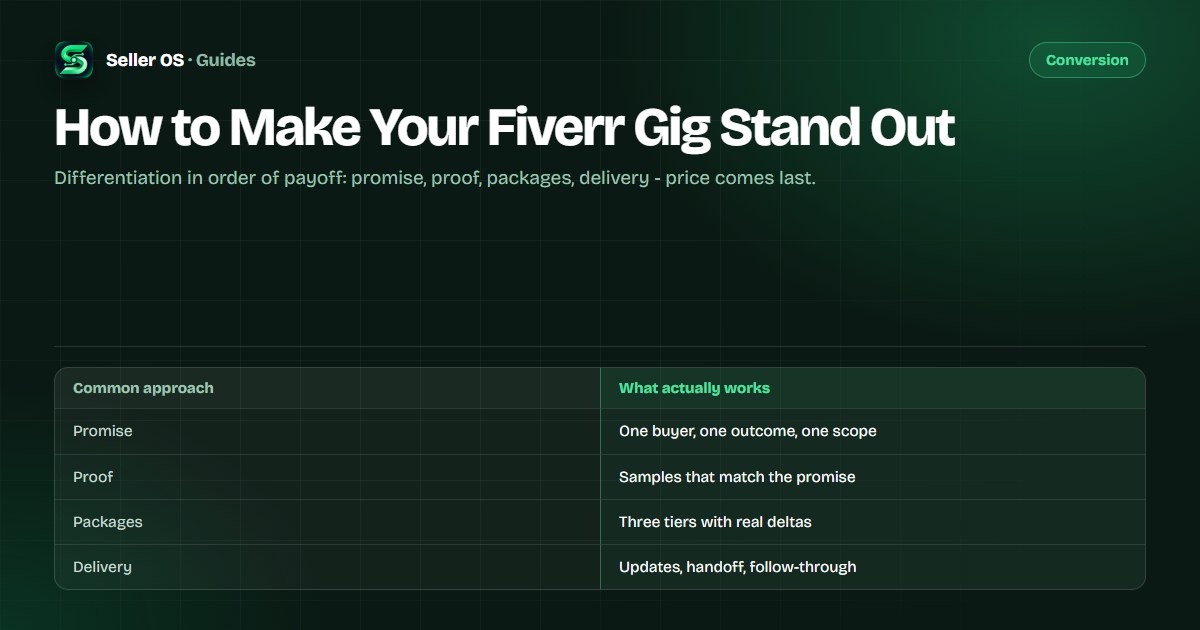
Standing out on Fiverr is not about a louder thumbnail or a lower price. It is about giving one buyer a clearer reason to choose you: a promise narrow enough to be obviously theirs, proof that you can keep it, packages whose tiers differ in real ways, and a delivery experience that matches what the card implied. Price is the last lever, not the first.
This guide orders the differentiation levers by payoff, shows how to study the three gigs above yours without copying them, and covers the moves that make a gig look different for the wrong reasons. The asset-level details live in the linked guides.
Free plan available. Local-first data. Human review on every change.
Start with a narrower gig promise
The fastest way to become the obvious choice is to be the obvious choice for less. 'I will edit your video' competes on a crowded page; 'I will edit 10-minute interview videos for coaching channels' competes with a handful of sellers and speaks to a buyer with that exact problem.
A narrower promise sharpens every field at once: the title, the thumbnail text, the FAQ, the portfolio selection, and the requirements form. Each one now answers a specific buyer's question instead of describing a general skill, which is why the narrowing usually improves conversion before anything else changes.
Hypothetical example: two gigs offer the same service. Gig A's title promises 'professional video editing'; gig B's promises 'YouTube editing for interview channels, 10-minute episodes'. A buyer searching for interview editing sees B as the match and A as a generalist. Same skill, same price range, different clarity.
Study the top three gigs above you
Before changing anything, build a small evidence file. Search your primary keyword, look at the first three organic gigs, and record four things: the promise in each title, the package deltas, the proof each one leads with, and the outcomes buyers repeat in reviews. You are looking for the pattern a buyer sees.
The competitor research guide covers the full method. For this exercise, one page per competitor is enough. Pay attention to what all three do the same way, because that sameness is where an honest, different promise stands out.
Do not copy the pattern; use it as a boundary. If every top gig leans on a generic promise, the gap is specificity. If they all lead with grids of samples, the gap may be one clear case study. The exercise tells you what to avoid repeating, not what to imitate.
| What to record | Why it matters |
|---|---|
| Promise in the title | Shows the positioning you would overlap |
| Package deltas | Reveals what buyers get at each price |
| Proof style | Tells you what this category treats as credible |
| Review phrases | Names the outcome buyers actually valued |
| Gaps and complaints | The unmet need you can speak to |
Make proof specific and visible
Adjectives do not differentiate; evidence does. 'High quality' appears in thousands of gigs and tells a buyer nothing. A sample one click away, named for the buyer's situation, does the work: 'the launch explainer we cut for a two-person SaaS team' beats 'professional explainer video' on its own.
Use the portfolio slots Fiverr provides. Each project must include at least one file and can hold up to five, and you can publish up to 20 projects. Live Portfolio files from completed deliveries appear automatically when the feature is enabled, tagged 'Made on Fiverr', and those are the strongest proof available because a real order stands behind them.
Order matters as much as content. Fiverr's portfolio article describes the display order as starting with the projects you pinned, so pin the samples that match your narrowed promise rather than the oldest or most decorative work.
Design packages with real deltas
Most package sets fail because the tiers differ only in price and volume. When a buyer cannot see why the middle tier is worth more, they either default to the cheapest option or leave. Give each tier a different job: Basic for the smallest useful version, Standard for the complete outcome, Premium for speed, scope, or rights.
Hypothetical example: a podcast editing gig. Basic covers one episode with two revisions. Standard covers four episodes with a faster turnaround. Premium covers eight episodes plus a set of social clips. Each step changes the outcome a buyer receives, which is what makes the middle tier the natural upgrade rather than the price difference alone.
The packages guide covers what should vary across tiers and what should stay identical. As a rule of thumb, change scope, speed, or format, and keep the quality of the core deliverable the same in every tier.
| Package | What changes | Why a buyer upgrades |
|---|---|---|
| Basic | One episode, two revisions | A safe test of the output |
| Standard | Four episodes, faster delivery | A regular production cadence |
| Premium | Eight episodes plus social clips | A full content pipeline |
The delivery experience is part of the offer
Differentiation often survives or dies after the order starts. A clear requirements form, a message when work begins, a realistic deadline, and a handoff that explains what was delivered all reduce the buyer's uncertainty, and uncertainty is what makes someone second-guess the choice they made.
Small rituals compound. Send one progress update on multi-day orders, deliver early when the scope allows it, and summarize revisions so the buyer can see exactly what changed. The description guide covers how to promise this process on the page; the point here is that the promise has to be kept after the order.
This is also where repeat business starts. Fiverr defines a repeat buyer as someone who has already completed a purchase and orders again, and a delivery experience that felt calm is a common reason a buyer comes back instead of shopping the category again.
Treat price as the very last lever
Discounting is the easiest change to make and the hardest to reverse. It moves the value anchor, attracts buyers who shop on price, and teaches repeat clients to wait for a sale. If a gig is not converting, the earlier levers - promise, proof, packages, delivery - usually carry the fix.
The standing out without lowering your price guide covers the profile-level version of this argument. At the gig level, the test is simple: if a lower number is the only reason to pick you, the listing has not differentiated yet.
When a price change is genuinely needed, treat it like any other test: one change, one window, and compare conversion on a similar traffic base. The pricing vs conversion guide covers how to run that read.
Differentiation mistakes that backfire
The most common mistake sellers make is copying the top gig's wording and presentation. That places you second in a comparison you did not define, and it can blur the signals Fiverr associates with your listing. Another is claiming a specialty you cannot prove at delivery; the promise that wins the click has to survive the order.
Two more to avoid: chasing every trend in the category until the gig promises nothing specific, and using fake scarcity or invented claims. Your delivery record and the reviews it produces are the only durable differentiators; everything else resets with the next competitor or category shift.
Differentiation is a set of small, honest choices made in sequence rather than a single trick. Pick one lever, run it for a window of about two weeks, and keep what moved the numbers before adding the next change.
- One sentence names the buyer and the outcome
- Three proof samples match that promise
- Tiers differ by scope and outcome, not just quantity
- Nothing on the page promises what delivery cannot keep
Where Seller OS helps
Seller OS supports the differentiation work at each layer. The Gig Performance Optimizer reviews a live gig's copy, gallery, and conversion signals against the gig's own performance data and proposes changes, which helps when you are choosing between fixing the promise, the proof, or the package clarity. Keyword rank tracking keeps the phrases you want to own visible, with competitor positions alongside yours.
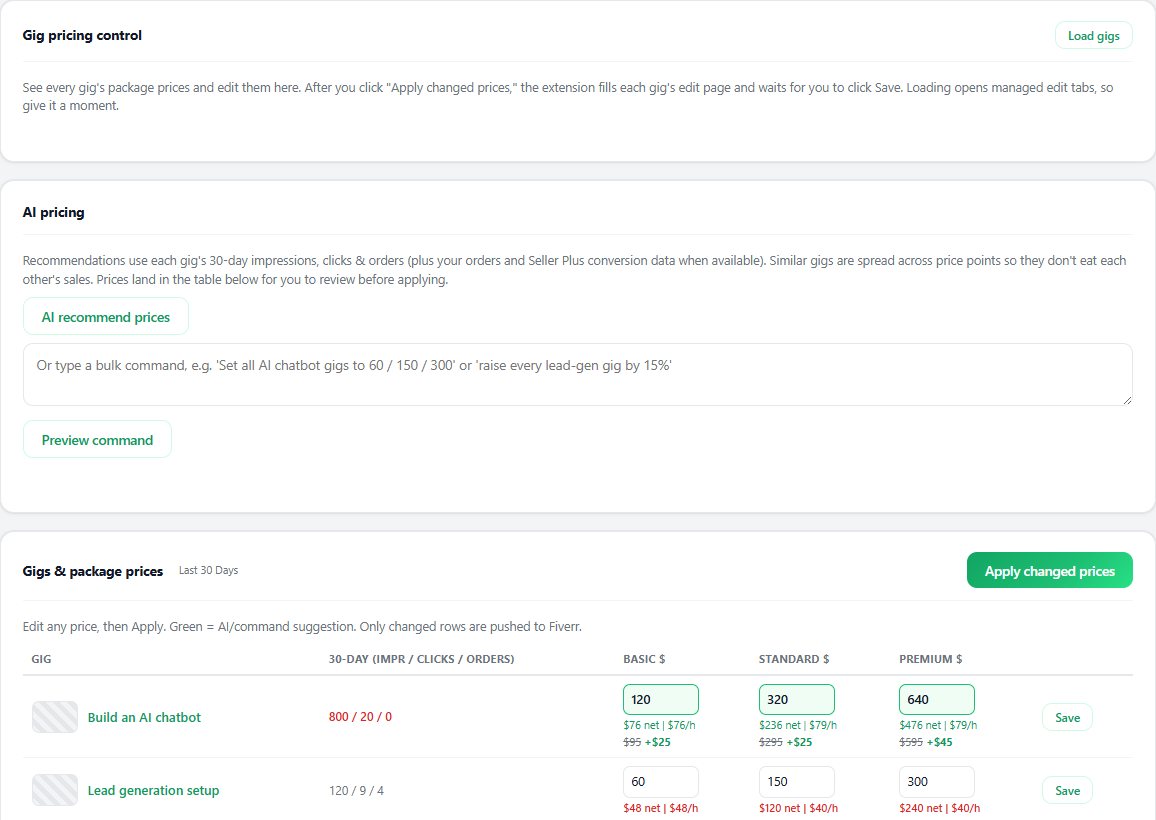
Package pricing review adds guardrails: it works from your profit assumptions and the prices you have recently applied instead of suggesting a discount. It proposes; you make the edit and click Save or Publish, and the records stay in Chrome local storage.
How to Make Your Fiverr Gig Stand Out questions
How do I make my Fiverr gig stand out without lowering my price?
Narrow the promise until it names one buyer and one outcome, then make the proof match. Sharpen the package deltas so the middle tier is an obvious upgrade, and treat delivery communication as part of the offer. These levers compound; a discount only moves the number and attracts different buyers.
How many competitor gigs should I study before editing mine?
Three is enough for a first pass. Record the promise, package deltas, proof style, and review language of the top three organic results for your main keyword. You are looking for patterns and gaps rather than sentences to copy, and the exercise usually takes about an hour.
Can a new seller stand out against established gigs?
Yes, by competing on specificity rather than volume. An established gig usually speaks to everyone; a new gig can speak to one buyer with one problem and be the clearest match for that search. Choose the niche where your samples genuinely fit, and let the delivery record build from there.
Do gig reviews affect how much a gig stands out?
They carry weight because buyers compare them directly, and the words in them name outcomes. Fiverr shows a star rating plus written feedback on the gig page, and the highlighted reviews section summarizes what buyers valued. A specific, honest promise tends to attract reviews that repeat that promise back to future buyers.
Differentiate before you discount
Narrow the promise, line up the proof, and give the packages a real reason to upgrade.