 Seller OS
How to stand out on Fiverr without lowering your price
Undercutting a competitor buys one order and sets a lower baseline for every order after it. Standing out is the other route: change what the buyer compares by shaping the offer, describing your process, showing proof, and replying clearly and fast.
This guide walks the positioning levers one at a time, with a worked example of the same service sold under two different promises, plus how to test one change. It stays honest about the limit: positioning improves your odds of being chosen, but no wording guarantees an order.
Free plan available. Local-first data. Human review on every change.
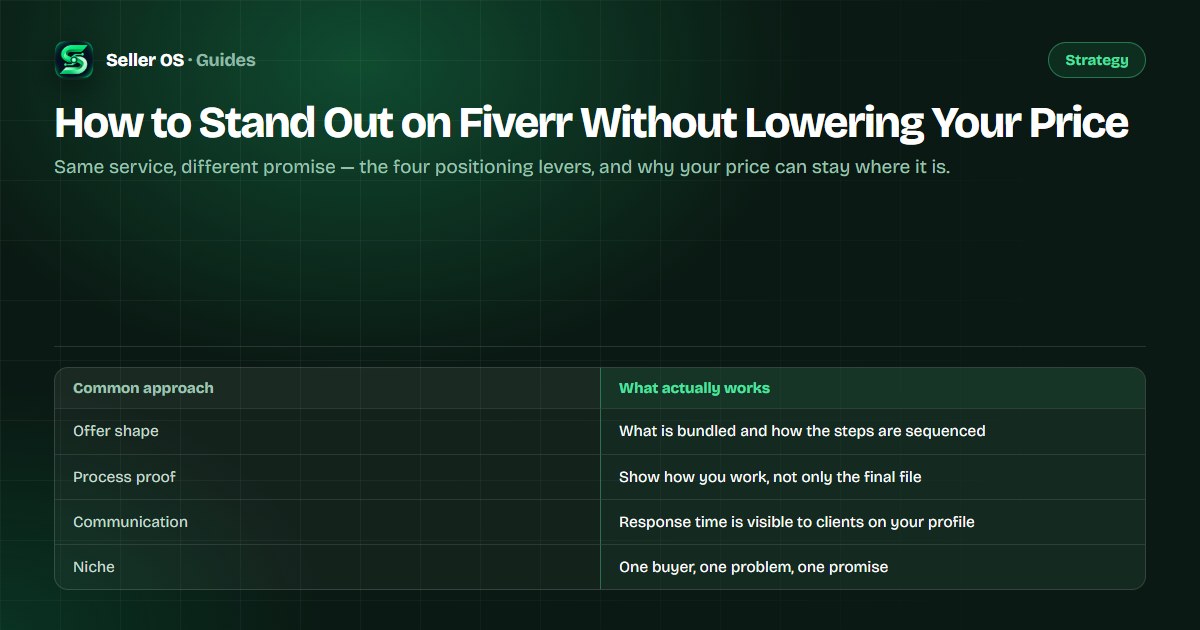
Why cutting your price rarely wins
When two gigs look identical, price becomes the only visible difference. That is a positioning problem wearing a pricing costume. The way out is not to argue that you are worth more; it is to change what the buyer compares. Offer shape, process, proof, and communication all sit in front of price when they are specific enough to be believed.
Discounting is also more expensive than it looks. Fiverr's earnings page states that for every order you complete, you earn 80% of the purchase amount, including extras and tips. So a $20 discount removes $16 from your side of that order, and if the lower number becomes your normal, it resets the margin on everything after it. Run the math with the Fiverr fee calculator before a test becomes a habit.
Same service, different promise: an example
Hypothetical example, same skill, two listings. Seller A writes: "I will edit your video." Seller B, with the same editing skill and the same starting price, writes: "I will turn one recorded webinar into a 60-second clip with captions, a hook, and a vertical cut for social." The second promise names a buyer and a deliverable before price is ever considered.
Nothing about their ability changed. Seller B narrowed who the gig is for, named what arrives, and described the process. That is positioning: the same service with a different promise. The narrowing also reduces revision arguments later, because the buyer purchased a described outcome rather than open-ended editing time.
| Element | Seller A | Seller B |
|---|---|---|
| Buyer | Anyone who needs editing | Course creators with recorded webinars |
| Deliverable | A video edit | A 60-second clip with captions and a vertical cut |
| Process | Send files, receive an edit | Send one recording, receive a described output |
| Comparison | Compared with every editor | Compared with the outcome promised |
Lever one: shape the offer around one buyer
Fiverr lets you offer up to three packages, each with a delivery time, a revision count, and a price, and it requires at least one revision option per package. Most sellers use the tiers to sell a bigger version of the same thing. You can use them to sell a sequence instead: a small entry step, the full deliverable in the middle, and the version a serious buyer asks about. Gig packages covers the mechanics.
Narrowing is the cheapest differentiator you own. Video editing competes with everyone; webinar clips for course creators competes with a smaller field and matches how those buyers describe the need. Testing a narrow promise in one gig also limits the downside, because the rest of your catalog keeps selling while the new promise proves itself.
Lever two: make the process visible
Buyers cannot see your skill; they see artifacts. Fiverr's help center states that a portfolio holds between one and 20 projects, each with up to five files, a title between 15 and 50 characters, and a description between 120 and 1,400 characters. Those limits reward specifics: a short project title that names the work, and a description that says what you did and what it changed. The exact limits live on Fiverr's portfolio page.
When you lack client work, show process: the brief you wrote, the rough first pass, the decision you made at each step, the final file. Proof of process reads as proof of judgment, and it is more honest than a wall of mockups you never delivered. Fiverr portfolio covers ordering, captions, and which pieces to pin first.
Lever three: communication you can be judged on
Fiverr shows clients your response time while your response rate stays visible only to you, and the rate counts first responses to new messages sent within 24 hours. Speed is therefore a positioning surface you control. A seller who answers within an hour reads differently from one who answers the next day, even when both charge the same price.
Structure the first reply like a small proposal: mirror the request in one line, ask the one question that changes the quote, and say what happens next. Respond faster covers the workflow; the positioning point is that communication quality is part of what the buyer purchases, not service around it.
How to test a promise without gambling
Change one element at a time and give it a full window. Pick a single gig, change either the title, the thumbnail, or the entry package description, and leave everything else alone. If two elements change and clicks move, you cannot tell which one did the work or whether they cancelled each other out.
Compare clicks and orders with the previous period rather than with your expectations. If the promise is wrong, clicks stay flat or fall; if it is right, clicks rise and the order rate tells you whether you attracted the buyer you wanted. Keep what worked, revert what did not, then test the next element.
Pick one gig and one element
title, thumbnail, or entry package copy.
Change the promise, not the price
narrowing is the variable under test.
Wait for a full comparison window
Fiverr's guidance for keyword updates is at least 30 days.
Read clicks, then orders
clicks show whether the promise lands; orders show whether the buyer fits.
What quietly undoes the positioning
Copying a competitor's promise puts you straight back into a price comparison, because the buyer now sees two identical listings with one tiebreaker left. Over-promising fails the other way: it wins the click, then produces revision rounds that erase the margin the discount was supposed to protect.
Positioning also cannot fix a listing that is not live. If the gig is paused, denied, or waiting on a review, handle that first; if it is live but nobody clicks, the first fix may be traffic rather than wording. Start from why a profile can look dead, clear a paused gig or a denied gig if that is the case, and only then rewrite the promise.
- Rewriting everything at once instead of changing one promise per window
- Discounting to test demand, then treating the discounted price as the baseline
- Claiming a niche you cannot show any work for yet
- Naming the tool you use instead of the outcome the buyer gets
Where Seller OS helps
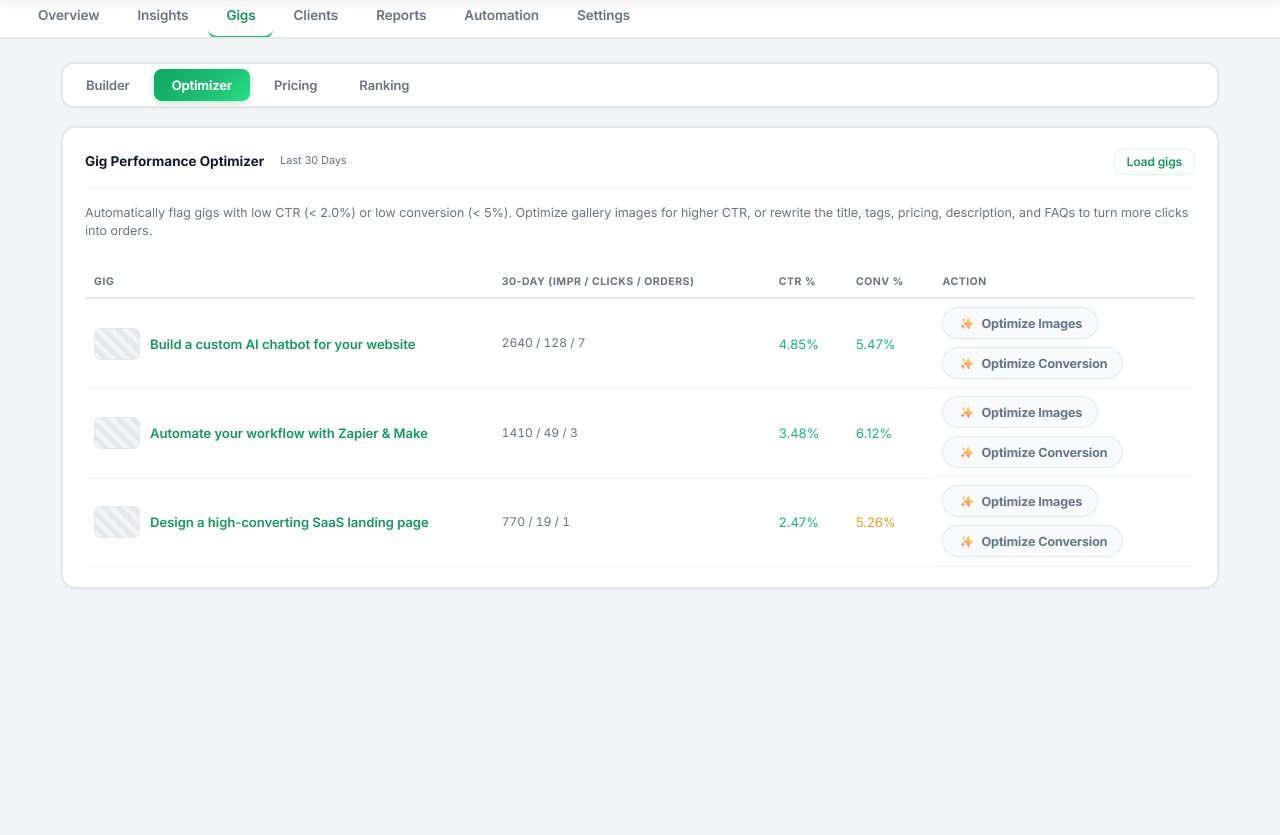
Seller OS treats positioning as evidence rather than slogans. The Gig Performance Optimizer reads a live gig's copy, gallery, and conversion signals against that gig's own performance data and proposes specific changes, and the package pricing review keeps your profit assumptions and recent applied prices in view so a test does not quietly become a lasting discount.
The Gig Builder turns a one-line idea into a structured gig draft — scope, packages, and FAQ — and fills the Fiverr wizard, which makes a narrowed promise cheap to try. It does not choose your price, promise outcomes for you, or publish anything on its own; every Save, Continue, and Publish stays with you.
How to Stand Out on Fiverr Without Lowering Your Price questions
Can I stand out on Fiverr without reviews?
Yes, with proof you control: portfolio projects, a process you can describe, a narrow scope, and a fast, visible response time. Reviews are powerful social proof, but a new seller can still be the clearest option in a small niche. None of this guarantees orders, and it is not a substitute for a gig that gets impressions.
How narrow should my niche be?
Narrow enough that one sentence names the buyer and the deliverable, wide enough that you can actually find those buyers. Webinar clips for course creators is a workable level; clips for everyone is not a niche at all. Test the narrower promise in one gig for a full window before touching the rest.
Is it ever right to lower a price?
Sometimes, as a deliberate test: an entry package with a smaller scope, or a limited promotion with an end date. That is different from matching a competitor's number. Run the fee math first, because a permanent cut changes what you earn on every future order, not just the next one.
How do I compare with competitors without copying them?
Compare promise elements instead of wording: the buyer named, the deliverable, the process described, and the proof shown. Keep the structure that works and change the specifics to match your own work. Copied wording produces near-identical listings, which hands the decision back to price.
Stand out without a discount
Sharpen one promise, tighten one package, and let the work answer the price question.