 Seller OS
Fiverr professional title: how to choose one
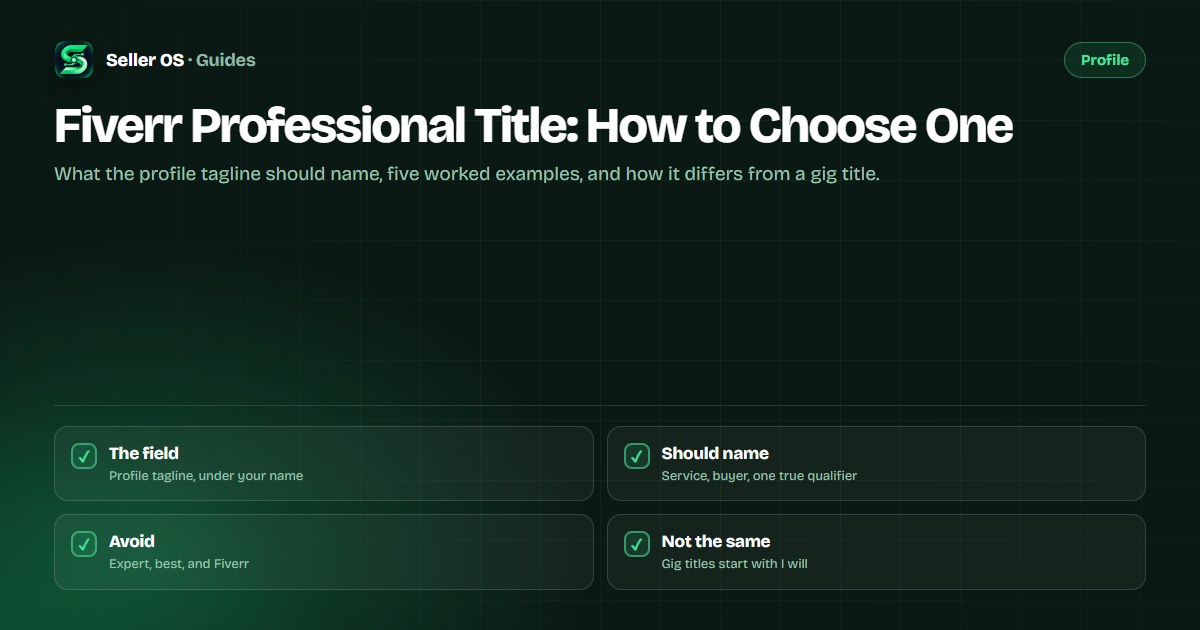
Your Fiverr professional title is the short tagline shown with your name on the profile, the line that tells a buyer what you do before they read anything else. Fiverr's guidance is one sentence: stand out with a short tagline that describes what you do, and avoid words like expert, best, or Fiverr.
This guide covers what a working title should name, five examples from weak to strong, how to keep it aligned with your gigs, and the difference between this title and a gig title, which is a separate field with separate rules.
Free plan available. Local-first data. Human review on every change.
What the professional title actually is
The professional title is your profile tagline: a short line describing what you do, displayed with your name on your freelancer profile. Fiverr's profile article gives it one sentence of guidance and one warning: keep it short, and skip descriptive words like expert, best, or Fiverr itself.
Fiverr does not publish a character limit for this field, so treat any number you have read elsewhere as unverified. Open the profile editor, where the field shows its own limit, and write to that. The profile description guide covers the section directly below it.
“Stand out with a short tagline that describes what you do.”
— Fiverr Help Center, Creating and editing your freelancer profile, September 2026
Professional title versus gig title
These are two different fields with two different jobs. The professional title describes you, the seller, and lives on the profile. A gig title describes one service and appears in search results; Fiverr's gig creation article pre-fills it with I will and advises keeping it short, clear, and free of special characters like ampersands, slashes, quotes, and plus signs.
The confusion is understandable, because both are short lines about your work. The test: if the line names a deliverable and a scope, it belongs on a gig; if it names what you do and for whom, it is a profile title. The profile versus gig guide maps every field to the surface that owns it.
One more practical difference: editing a gig title later does not change the gig's URL, per the same Fiverr article. That makes gig titles safe to revise as you learn which phrases buyers respond to, while the profile title is a positioning choice you change deliberately.
What a working title should name
Three ingredients: the service, the buyer or context, and one qualifier that is true and checkable. Service first, because a buyer scans for the deliverable. Buyer second, because it tells the right person to keep reading. The qualifier is the differentiator, whether that is a format, an industry, a platform, or a turnaround.
Specificity beats superlatives for a simple reason: every seller can claim expert, so the word filters nothing. Animated explainers for SaaS teams filters hard, and the buyers it filters out were not going to order from you anyway. If you serve several markets, name the one you want more of.
A title is a positioning statement, not a summary of everything you can do. If you sell three services, naming one in the title is a decision about which door you want buyers to walk through; your gigs can still cover the rest of the range.
Five title examples, weak to strong
The examples below are hypothetical, written to show the pattern rather than to be copied. Each weak version is a job label; each strong version names a service, a buyer, and a qualifier a competitor could not paste in unchanged.
| Weak: job label | Strong: service, buyer, qualifier |
|---|---|
| Video Editor | Animated explainers for SaaS product teams |
| Graphic Designer | Packaging labels for small food brands |
| Web Developer | Shopify stores for skincare brands |
| Copywriter | Email sequences for online course creators |
| Voice Over Artist | Warm narration for museum audio guides |
- Read each strong version as a buyer would: it says what arrives, who it is for, and one reason the seller is not interchangeable.
- The weak versions are not wrong, exactly; they are just true of thousands of profiles, so they do no filtering at all.
Matching the title to the gigs you sell
The title and the gigs should tell one story. If the title names packaging design and your gigs sell packaging, logo, and illustration work, the title does its job as the primary positioning while the gigs cover the range. If the title names something you no longer sell, every gig visit opens with a small contradiction.
Hypothetical: a seller's strongest gig is Shopify builds for skincare brands, but the title still reads Web Developer with 8 years of experience. A buyer who arrives from that gig has to reconcile a specific promise with a generic label. Rewriting the title to Shopify stores for skincare brands removes that work entirely.
The portfolio guide applies the same logic to your pinned pieces, and the upload guide covers the fields. Title, gigs, and portfolio should describe the same seller.
Before and after: one title rewrite
Hypothetical seller: a motion designer with four years of agency work and three gigs. Before: Creative Motion Designer, Video Editing, Animation, 2D and 3D, Fast Delivery. The list does the work of a description, the line still does not say who it is for, and every element competes with the others for attention.
After: Animated product demos for hardware startups. The rewrite drops every claim a competitor could also make, names the deliverable and the buyer, and stays checkable against the portfolio. Nothing about the seller's skill changed; the line finally points at the work they want more of.
That is the whole method: cut the list, name the buyer, keep one qualifier, and reread the result against your gigs and your first two pinned projects. If all of them describe the same work, the title is finished.
Title mistakes and how to fix them
The most common mistakes are listing every service, ranking yourself with words like expert or best, and writing a job label that any competitor could paste unchanged. Fiverr's guidance rules out the ranking words in the profile title; the other two are missed opportunities rather than rule violations.
Fixes are mechanical. Cut the title to one service, one buyer, and one qualifier. Replace every adjective with something checkable. Then compare it to your best-selling gig and your first two pinned portfolio projects; if all three describe the same work, stop editing and leave it alone.
- Every service listed — pick the one you want more of.
- Ranking words — replace expert and best with a real qualifier.
- Job label only — add the buyer and the deliverable.
- Mismatch with gigs — rewrite until the surfaces agree, then run the profile audit.
Where Seller OS helps
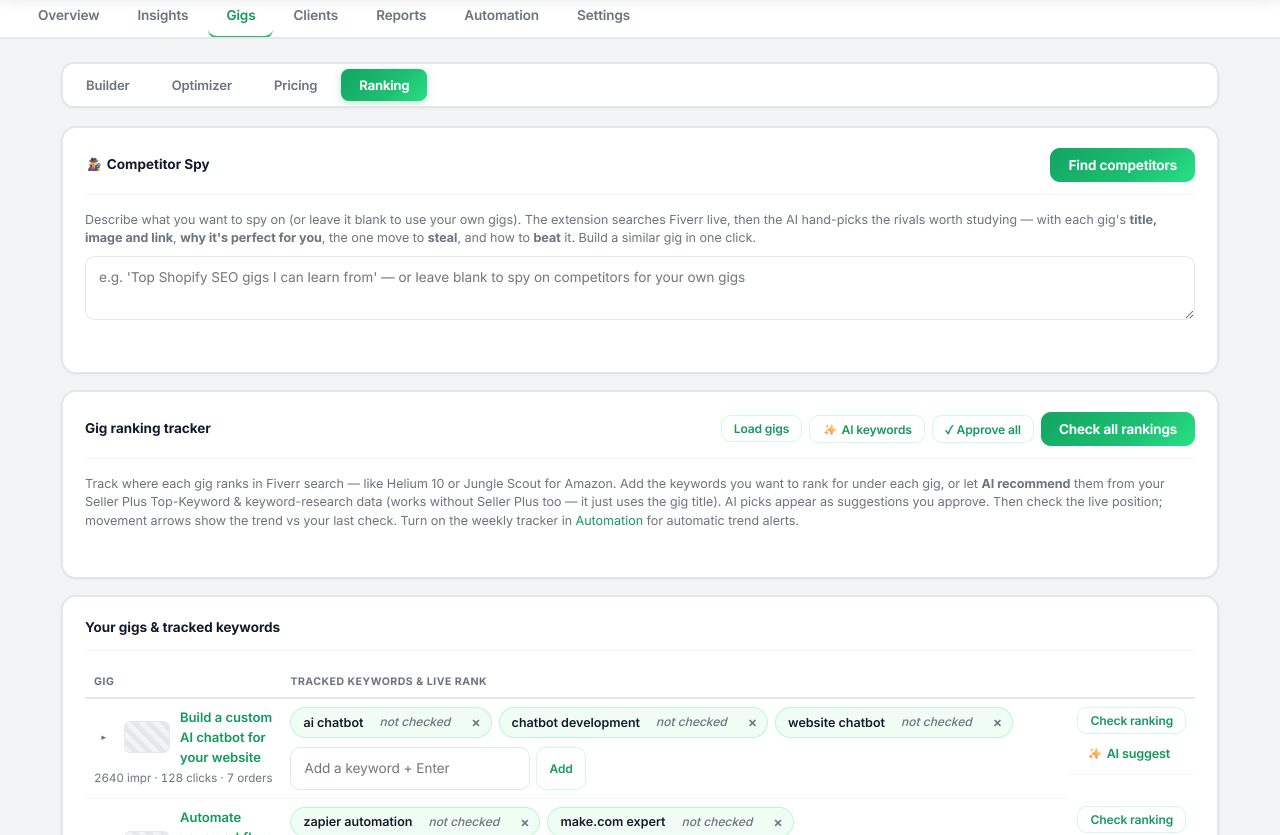
Seller OS does not edit your profile title; that field lives in Fiverr's editor. What it helps with is choosing the words: keyword research suggestions show phrases buyers actually search for, and rank tracking records where your gigs sit for those phrases over time, so the title you write can be anchored to demand rather than instinct.
The gig audit then reviews a live gig's copy and conversion signals against the gig's own performance data, the same write-observe-adjust loop this guide applies to a tagline. Everything is drafted and stored locally in Chrome, and no field is ever changed on Fiverr without you completing the final action.
Fiverr Professional Title questions
What is a professional title on Fiverr?
It is the short tagline shown with your name on your freelancer profile, not the title of a gig. Fiverr's profile article describes it as a short line that describes what you do, and it advises against descriptive words like expert, best, or Fiverr. Fiverr does not publish a character limit for the field.
Should my Fiverr title include keywords?
Include the words a buyer would recognize as your service, because that is what makes the title readable at a glance. What you should skip is keyword stuffing: a list of tools, platforms, and variations reads as noise. One service, one buyer, and one qualifier filter better than an inventory of everything you can do.
Can I use the word expert in my Fiverr title?
Fiverr's profile guidance says to avoid descriptive words like expert, best, or Fiverr in your title. Beyond the rule, the word filters nothing, since any seller can claim it. Replace it with something checkable, such as an industry, a format, a turnaround, or a platform, so the line points at work a buyer can recognize.
What is the difference between a Fiverr title and a gig title?
The professional title describes you and appears on your profile. A gig title describes one service and appears in search results; Fiverr pre-fills it with I will and advises against special characters like ampersands, slashes, quotes, and plus signs. Both lines are short, but they live on different surfaces and answer different questions.
Name the work you want more of.
Cut the list, name the buyer, keep one true qualifier, and reread it against your gigs.