 Seller OS
Fiverr profile vs gig: what's the difference
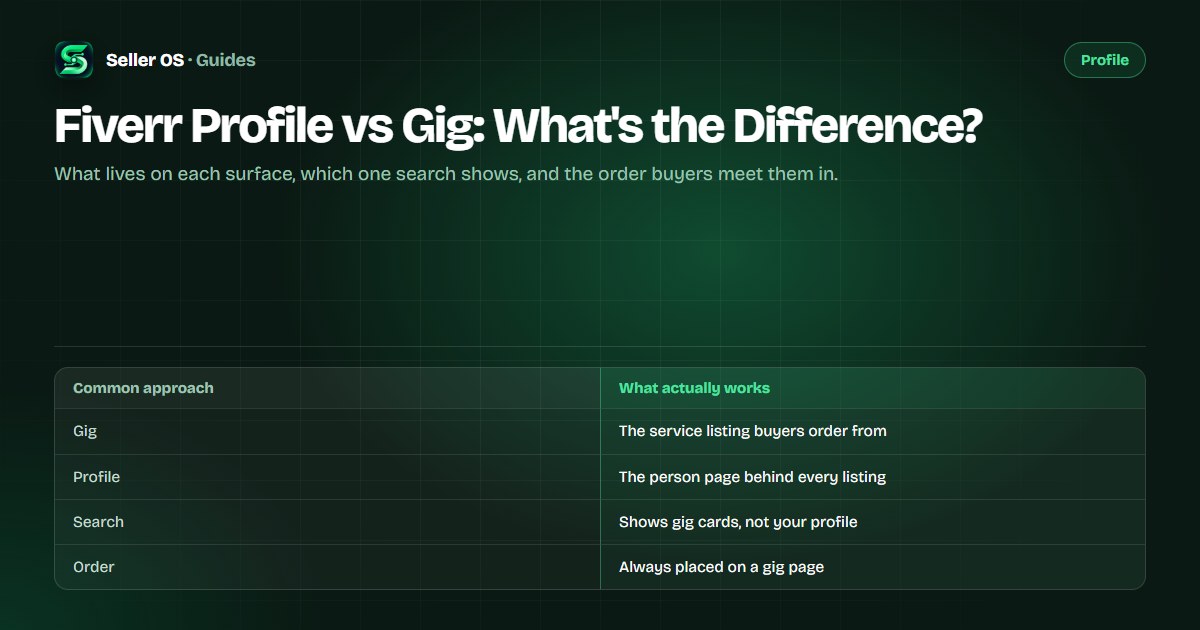
On Fiverr, the gig is the service you sell and the profile is the person selling it. Search results show gigs, and orders are placed on gig pages. The profile is what a buyer opens to learn who stands behind the listing, and it carries several of the same trust signals the gig page shows.
This guide defines both surfaces, maps what lives where, explains which one search actually shows, and walks through how they support each other. It is a roles-and-places guide, not an optimization checklist.
Free plan available. Local-first data. Human review on every change.
What a gig is and what a profile is
A gig is a service listing: a title, a description, a gallery, packages with prices and delivery times, extras, and an FAQ. It is the unit buyers order, and it is the unit search displays. Fiverr lets you run several active gigs at once, with the cap set by your seller level, so one account can sell more than one service.
A profile is the person page behind those listings. Fiverr's client guide describes it as location, languages, response times, bio, skills, and certifications. It also collects your portfolio, your reviews, and your level. Nothing on the profile is for sale by itself; its job is to make the gigs credible.
- Gig: packages, description, gallery, extras, requirements, and FAQs.
- Profile: display name, picture, tagline, About, skills, languages, certifications.
- Both: reviews, level, and portfolio pieces, arranged in different places.
Which surface Fiverr search actually shows
Search results are gig cards. Your profile does not appear as a result on its own; buyers reach it by clicking through from a gig, a review, or a portfolio piece. Fiverr says your level is visible on gig cards, gig pages, and your profile, and its article on search and recommendations notes that Pro status can influence ranking, so seller-level signals travel along with the listing.
That has a practical consequence for how you spend your time. A profile problem cannot be fixed by profile editing alone, because search never sees the profile first. Win the click with the gig, then make the profile worth the visit the gig earned.
Where buyers actually place the order
Orders happen on the gig page. The buyer selects a package, adds any extras, answers your requirements questions, and pays. The profile has no checkout; it is the trust check before the order, or the reassurance after it. This is why sellers who polish only the profile rarely see the change they expected.
A hypothetical walkthrough: a buyer searches for animated explainers, clicks a gig card, compares the packages, then opens the profile. If the portfolio pieces look like their project and the response time is workable, they go back and order. If the profile is thin or off-topic, they return to the results and try the next card instead.
Signals that appear on both surfaces
Reviews show on the gig page and the profile page, each as a star rating plus written feedback. Portfolio pieces show on your profile, your profession page, and your gig page below the description. The level badge travels with all three, and the response time is visible to clients wherever they look.
The overlap is why a mismatch stands out so clearly. A gig that promises one service and a profile that demonstrates another reads like two different sellers. Point the gig's promise and the profile's proof at the same work, and the two surfaces stop competing with each other.
One more shared element is the rating itself. Because the same reviews feed both pages, a strong review history lifts the profile and every gig at once, while a rough patch follows the listing everywhere a buyer looks.
| Question | Gig | Profile |
|---|---|---|
| Where does search show it? | In results, as a card | Not shown in results |
| Where is the order placed? | On the gig page | Never; no checkout exists |
| Where do reviews appear? | Gig page | Profile page |
| Where does portfolio show? | Below the gig description | Profile and profession pages |
| What does it define? | The service and its price | The seller and their credibility |
How the two surfaces support each other
The gig's job is to win the click and describe the offer precisely enough that the right buyer stops scrolling. The profile's job is to confirm that a capable person stands behind that offer. When both do their job, the profile visit ends in an order instead of another search.
Worked example, hypothetical: a seller's gig promises 60-second SaaS explainers at a fixed price. The profile's first two pinned projects are SaaS explainers, the About names software teams, and the skills list only the tools those projects use. The two surfaces tell one story without any extra decoration.
The failure case instructs just as much. Same gig, but the first pinned pieces are wedding videos and the About opens with a decade in broadcast television. The buyer has to translate the mismatch, and most will not bother. The portfolio guide and the professional title guide cover the profile side in depth, and the upload guide handles the mechanics.
Mistakes new sellers make with both
The first mistake is treating the profile like a resume, when the buyer is looking for a service. The second is expecting the profile to rank, when search shows gigs. The third is editing the gig to fix a profile problem, or rewriting the profile to fix a gig that never gets impressions.
Keep the diagnosis straight. Impressions and clicks are gig-level questions; the visit-to-order step is where the profile usually matters. Fiverr publishes no statement that profile fields change search ranking, so treat profile work as conversion work and gig work as visibility work. The profile audit is the right starting point once a gig earns visits.
- A profile with no gigs gives search nothing to show.
- A strong gig with a mismatched profile loses the visit it earned.
- Profile edits cannot rescue a gig that never gets impressions.
- Reorder the profile around the gig you want more of, using the profile audit.
Where Seller OS helps
Seller OS works on the gig side of this pair, because that is where the extension can help without pretending to be Fiverr. The gig builder turns a one-line idea or a competitor URL into a structured draft and fills the wizard for your review, and the gig optimizer reviews a live gig's copy, gallery, and conversion signals against the gig's own performance data.
The profile side stays yours, and that is deliberate. The extension does not edit your profile, your portfolio, or your title, and it never publishes anything on its own; it drafts, fills, and tracks locally, and a person completes every Save, Continue, or Publish action. Client records and order history stay in Chrome local storage.
Fiverr Profile vs Gig questions
What is the difference between a Fiverr profile and a gig?
A gig is a service listing: title, description, packages, prices, and extras, and it is what buyers order. A profile is the seller page behind it: picture, tagline, About, skills, languages, portfolio, and reviews. Search shows gigs, and the profile is what buyers open to check who they would be hiring.
Does Fiverr show my profile in search results?
Search results are gig cards, so your profile does not appear as a result on its own. Buyers reach it by clicking a gig, a review, or a portfolio piece. Fiverr says your level is visible on gig cards, gig pages, and your profile, one of the seller signals that travel with the listing.
Can I sell on Fiverr with a profile but no gigs?
No. Orders are placed from gig pages, so without a published gig there is nothing for a buyer to order and nothing for search to show. A complete profile still matters, but it supports the gig rather than replacing it. Build the profile and the first gig together, as one project.
Should I optimize my profile or my gig first?
Start with the gig, because that is where impressions and clicks are won. Once the gig earns visits, audit the profile in the order buyers read it: tagline, portfolio, proof, then About. Fiverr publishes no statement that profile fields change search ranking, so profile work is conversion work.
Know which surface does what.
Fix the gig for search, the profile for trust, and stop editing one to solve the other.