 Seller OS
How to optimize your Fiverr profile
Your gig wins the click; your profile decides whether the buyer keeps going. After a promising gig page, buyers open the profile to answer one question: is this person credible enough to hire? That answer comes from a handful of fields, read in a rough order.
This guide covers what buyers actually see, the scan order they follow, which fields to fix first, and a before-and-after audit. The bio gets its own guide; here it is one field among several.
Free plan available. Local-first data. Human review on every change.
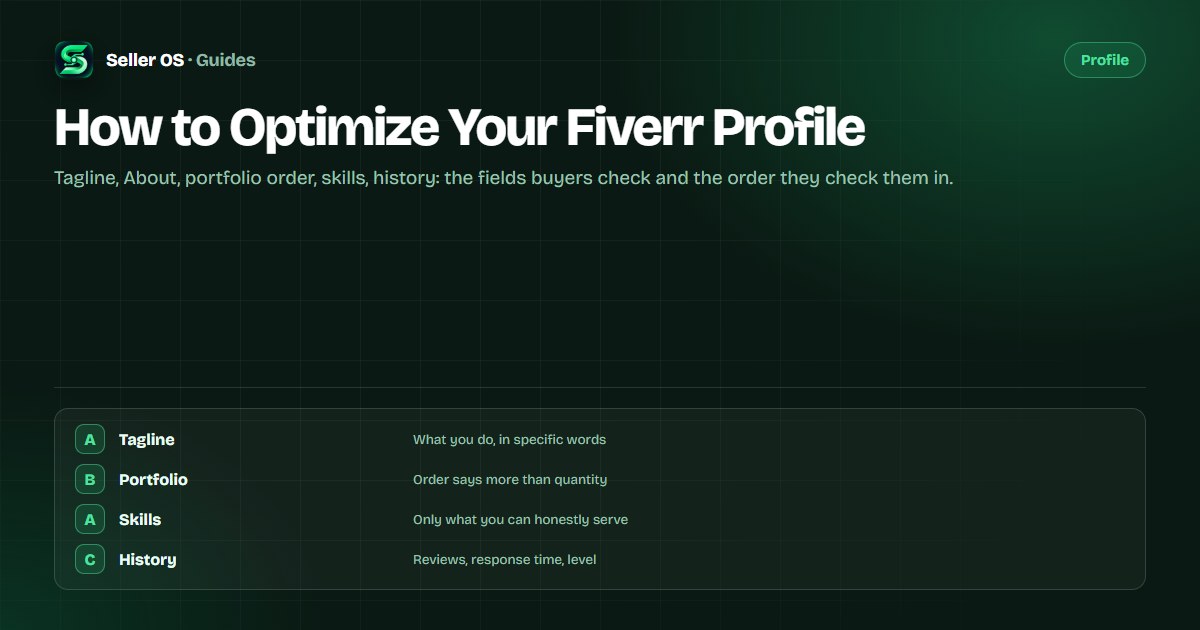
What buyers actually see on your profile
Fiverr's client guide lists what a profile includes: location, languages, response times, bio, skills, and certifications. Your level is visible on gig cards, gig pages, and the profile, and the response time is the one inbox metric clients see, since the response rate itself is private to you.
That list is your audit checklist. Everything a buyer sees is either proof, clarity, or friction. The tagline and About create clarity, the portfolio and reviews provide proof, and stale or padded fields add friction.
- Identity and trust: display name, profile picture, location, certifications.
- Clarity: tagline, About, skills, languages, professions.
- Proof: portfolio, reviews, level, response time.
The order buyers actually read you in
Profiles are not read top to bottom; they are scanned. The tagline gets a glance, the portfolio gets the longest look, the rating and level get a check, and the About section is read only if the first three survive. Optimize in that order, not in the order the editor lists fields.
That is also why a rewritten bio rarely moves anything on its own. If the portfolio does not answer the question the gig raised, better sentences upstairs will not rescue the visit.
The scan also explains why profile problems feel mysterious. Sellers rewrite the field they can see most easily, which is usually the About, when the visit actually died in the portfolio. Fix the visible order, not the comfortable one.
Tagline - does it say what you do and who for, in specific words?
Portfolio - do the first items match the service the buyer just looked at?
Proof - do the rating, level, and response time support the promise?
About - does it answer what happens next if they hire you?
Fix the tagline before anything else
Fiverr's profile guidance says to keep the title short, describe what you do, and avoid descriptive words like expert, best, or Fiverr itself. The practical version: name the service, the buyer, and one qualifier that is true and checkable.
Weak versus strong, hypothetical: Motion Designer with 7 Years of Experience becomes Animated explainers for B2B software companies. The first is a job title; the second is a service a buyer can recognize. The professional title guide covers naming in more depth.
“Stand out with a short tagline that describes what you do.”
— Fiverr Help Center, Creating and editing your freelancer profile, September 2026
The About section in one paragraph
Fiverr describes the About section as the place to introduce yourself to potential clients, and its profile help article lists the rules for it: be honest, write in English, be original, and leave out contact details, payment information, URLs, and company names.
Structurally, it has four jobs: who you help, what you deliver, how you have proven it, and the next step. If your About is long on biography and short on the fourth job, paste the same text into a document and rewrite the last three sentences first. The bio guide shows a full weak-to-strong rewrite.
One more element deserves attention while you are on this page. Fiverr shows your response time to clients and keeps the response rate private to you, so a fast, consistent inbox habit is itself profile copy that no rewrite can replace.
Portfolio order beats portfolio size
Your portfolio shows on your profile, your gig pages, and your profession page, and the display order is mostly automatic: your first two pinned projects, then the three most recent review files from deliveries, then your other manually added projects in the order you choose.
So the first two pins are the only real editorial choice on the profile. Pin the two pieces that match your best-selling gig, and treat the next three slots as a rolling showcase that new deliveries keep refreshing. A hypothetical example: a video editor pins the SaaS explainer and the product launch spot, then lets the newest review files carry the following slots.
| Slot | What fills it | Who controls it |
|---|---|---|
| 1-2 | Pinned projects | You choose |
| 3-5 | Three most recent delivery review files | Automatic |
| 6 onward | Other manual projects, up to 18 | You choose the order |
| Last | Delivery files, up to 17, newest first | Automatic |
Skills, languages, and the fields that filter
Skills, languages, and certifications are filters: buyers search or skim for words they recognize. List all the skills you can honestly serve and attach an experience level; the same goes for languages and proficiency. Fiverr does not publish a cap on skills or languages, so check the editor for what each field accepts.
The most common mistake is padding. Ten skills where three are real reads as noise, and the buyer cannot tell which service you actually want to be hired for. A profile is a storefront, not a resume: every line should point at something you sell.
While you are in the editor, check the display name rules as well: a real or business name, in English, with no special characters except a period or an apostrophe, and no level references. It is a small field, but it is visible to every client who opens your profile.
- Eligible freelancers can add up to three professions.
- Pro and Top Rated freelancers can connect their accounts to LinkedIn.
- Top clients and paid consultations unlock at Level 2 and Top Rated.
- Profile Strength is optional and skipping it does not affect your impressions or seller metrics.
Before and after: one profile audit
Hypothetical seller: a WordPress developer with five good projects and no orders. Before: a tagline that says Website Developer, skills padded with every CMS, the portfolio left in upload order, and an About that opens with a degree and a hobby. The gigs get clicks, the profile gets visited, and nothing converts.
After: the tagline names WordPress builds for membership sites, the portfolio pins the two membership builds, skills drop to the ones the gigs sell, and the About closes with the first step of a project. Nothing was invented and nothing new was produced; the same material was reordered around the buyer's question.
Audit your own profile in that same order and change one field at a time. Fiverr publishes no profile signal that flips results overnight, so the honest method is to fix the first thing a buyer sees, then the next.
Where Seller OS helps
Seller OS treats your gigs and profile as one surface. The gig audit reviews a live gig's copy and conversion signals against its own performance data, and the action queue turns the findings into a short list of changes, the same order-first discipline this guide applies to the profile.
The extension does not edit your Fiverr profile and does not publish anything; it prepares the audit and the drafts. Profile fields themselves stay in Fiverr's editor, where the limits and eligibility rules live.
How to Optimize Your Fiverr Profile questions
What should I put in my Fiverr profile to get more orders?
Start with the fields a buyer actually checks: a tagline that names the service and the buyer, a portfolio whose first items match your best gig, and the proof signals Fiverr shows, like your level and response time. Then write an About that ends with what happens next. Clarity first, biography last.
Does the order of my Fiverr portfolio matter?
Yes, and mostly through your two pinned projects. Fiverr shows the pinned items first, then the three most recent delivery review files, then your other manual projects in the order you choose. Pin the work that matches the gig a buyer just viewed, because that first impression is the one you control.
How many skills should I list on Fiverr?
Fiverr does not publish a cap on skills, so check what the profile editor accepts. The useful rule is honesty: list the skills you can actually deliver and attach a real experience level to each. Padding the list with adjacent tools makes every skill look less credible, especially the three that matter most.
Does my Fiverr profile affect my gig ranking?
Fiverr publishes no statement that profile fields like the About section or skills change search ranking, so treat profile optimization as conversion work rather than ranking work. The profile matters after a buyer clicks a gig: it helps the visit turn into an order. Search visibility is a gig-level job.
Audit the profile your gigs send traffic to.
Fix the tagline, reorder the pins, and cut every field that does not point at a service.