 Seller OS
Fiverr requirements that stop scope creep
Scope creep rarely starts with a demanding buyer. It starts with a polite request that sounds small, made after work has begun, when saying no feels awkward. The cheapest place to fix that is intake, before the order clock is running and while every boundary is still a question rather than a refusal.
This guide builds the requirements set that locks scope. It covers the questions worth asking, how each answer maps to a package or an extra, and how to handle incomplete answers so the boundary holds.
Free plan available. Local-first data. Human review on every change.
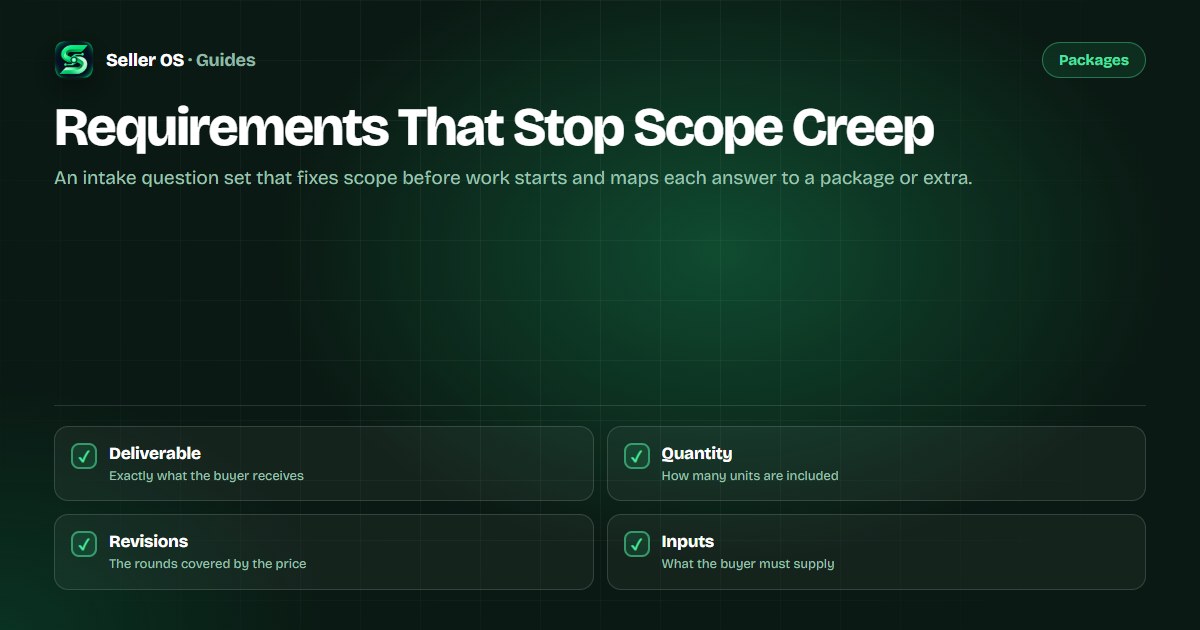
Why intake is where scope is won
Fiverr gigs can ask buyers a set of requirements questions when they order, and the Help Center explains that buyers provide these details before work begins (see Fiverr Help Center). The answers create the record of what was agreed, which is far easier to point to later than a chat message that arrived mid-order.
A requirement is not a formality. Each question either defines a boundary or leaves one open, and open boundaries are exactly what a small extra request later expands. Asking the right questions up front turns a potential negotiation into a settled fact.
The core intake question set
Five questions carry most of the load. They define the deliverable, the quantity, the revision allowance, the inputs the buyer supplies, and the deadline context. Every one of them can be answered in a sentence, which keeps intake fast.
Phrase each question so the answer is concrete. Ask for the number of items, not whether the buyer wants a lot. Ask which file format, not whether they care about format. Concrete answers are the ones that close scope.
- What is the single deliverable you are ordering?
- How many units or items are included at this tier?
- How many revision rounds does this price cover?
- What files, text, or access will you provide?
- When do you need it, and does that date need priority?
Map every answer to a package or an extra
A question without a consequence is just a survey. For scope control, each answer should lead somewhere: it either confirms the chosen package covers the request, or it points to a specific extra or the tier above. That mapping is what lets you respond to a later request with a price instead of a debate.
When a buyer's answer exceeds the package they selected, name the gap plainly and offer the upgrade or extra that covers it. Buyers rarely object to a price for more work; they object to a surprise, and mapping removes the surprise.
| Question | If the answer exceeds the package | Offer |
|---|---|---|
| Deliverable | Requests a second format or asset | Add the relevant extra |
| Quantity | Wants more units than the tier includes | Move up one tier |
| Revisions | Wants more rounds than covered | Add a revision-round extra |
| Inputs | Cannot supply needed material | Add a sourcing extra or decline |
| Deadline | Needs it faster than the clock allows | Add priority delivery |
What to do when answers come back incomplete
Buyers sometimes answer vaguely or leave fields thin. The wrong response is to guess and start, because every gap you fill with an assumption is a revision waiting to happen. Ask a single focused follow-up that names exactly what is missing and why you need it.
Keep the follow-up short and specific. One clear question gets a clear answer; a list of concerns reads like an interrogation. If the buyer still cannot specify the work, that is itself useful information about how the order will go.
Never begin production against an unclear brief just to protect the clock. The time you save at intake returns as rework later, and the record of the agreed scope is weaker for it.
Put the questions in the gig, not in chat
The strongest place for these questions is the gig's requirements field, because the answers attach to the order itself. A question asked in chat can be forgotten or reworded; a requirement the buyer must complete before work begins is part of the order record.
Write them once, review them against your packages, and update them whenever you change what a tier includes. Requirements and tiers should move together, so the questions always describe the offer you are actually selling.
Holding the line without souring the order
Even with strong requirements, a buyer will sometimes ask for something the answers did not cover. The request itself is rarely the problem; the way it is answered decides whether the order continues smoothly. Point back to what the intake established and describe the addition as exactly that, an addition.
A calm reply names the gap, gives the price or the upgrade that covers it, and leaves the choice with the buyer. That framing turns a possible argument into a simple decision, and it keeps the tone collaborative even while the boundary holds. The buyer is not being refused; they are being offered the work at its real scope.
If the request is genuinely small and inside the spirit of the original order, absorbing it is a fair call that builds goodwill. The point of requirements is not to charge for every minute; it is to make the boundary visible so both sides can see when a line is being crossed.
Record the outcome. When the buyer agrees to an extra or an upgrade, confirm it in the order thread so the agreed scope is written down. A short confirmation message is the difference between a settled change and a disagreement to revisit later.
- Point back to what the intake answers established.
- Present the addition as an addition, with its price.
- Absorb truly small extra work to build goodwill.
- Confirm any agreed change in the order thread.
Where Seller OS helps
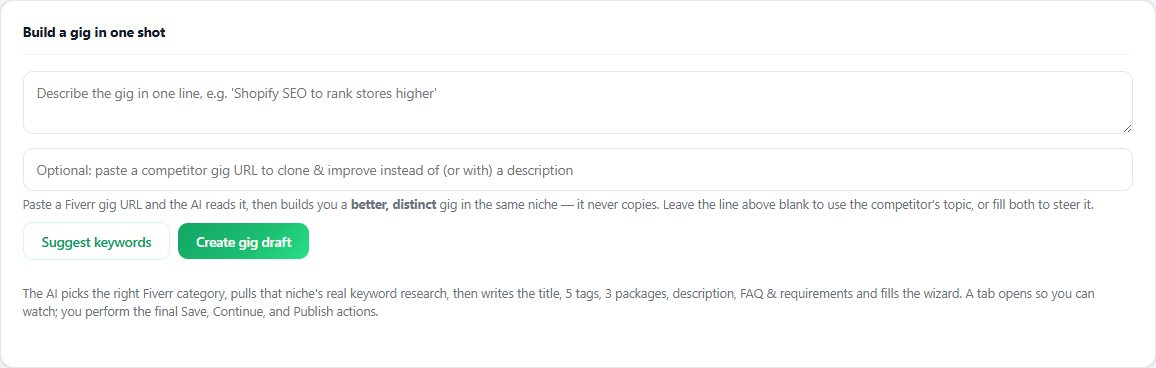
Seller OS treats the requirements set as part of the gig draft. When the gig builder assembles a listing, it prompts for the intake questions that match the tiers and extras you defined, so the boundaries and the offer stay in step instead of drifting apart.
The extension drafts and organizes; it does not send requirements to buyers or alter an order. You write the final wording, you set the fields, and everything stays in Chrome local storage on your machine.
Requirements That Stop Scope Creep questions
What should Fiverr gig requirements include?
At minimum: the single deliverable the buyer is ordering, how many units the chosen tier includes, how many revision rounds the price covers, what files or access the buyer will provide, and the deadline with any priority need. Each answer should either confirm the package or point to an extra.
Do Fiverr requirements prevent scope creep?
They help a great deal because they create a written record of what was agreed before work began. A later request that exceeds those answers is visibly an addition rather than a dispute. The requirements do the framing, and your clear response offering an upgrade or extra closes the loop.
What if the buyer leaves requirements blank?
Ask one focused follow-up that names exactly what is missing and why you need it. Do not start production against an unclear brief to save time; guessing fills the gaps with assumptions that return as rework. If the buyer still cannot specify the work, treat that as information about the order.
Should I ask requirements in chat or in the gig?
Put them in the gig's requirements field so the answers attach to the order record, and use chat only for a focused follow-up. A requirement the buyer completes before the order begins is stronger evidence of scope than a message that can be reworded or forgotten later.
Lock scope at intake.
Ask the five questions, tie each answer to a package or extra, and never start against an unclear brief.