 Seller OS
Fiverr buyer wants free extra work
A request for free extra work rarely arrives as a demand. It arrives as 'while you are in there' or 'one tiny thing', and it is easy to say yes in the moment. The problem is that yes is a pricing decision, and the right answer depends on what the extra actually costs you.
This guide sorts asks into three sizes, gives you a reply for each, and shows how to set the boundary in writing before the next order so this conversation stops repeating.
Free plan available. Local-first data. Human review on every change.
Why buyers ask for free extra work
Most buyers are not trying to exploit you. They do not see the line between what the package includes and what it does not, because nothing on the order page draws that line in the exact shape of their request. From their side, the extra is often one small errand inside a project they already paid for.
A few buyers do test the boundary, and the test is usually gentle: a vague ask that leaves room for a no. Your first reply sets the norm for the rest of the order, and a habit of quiet yeses becomes an expectation you can never bill.
- While you are in there, can you also add...
- It is just one more page, same style.
- This is almost right — could you also try a second version?
Classify the ask in three sizes
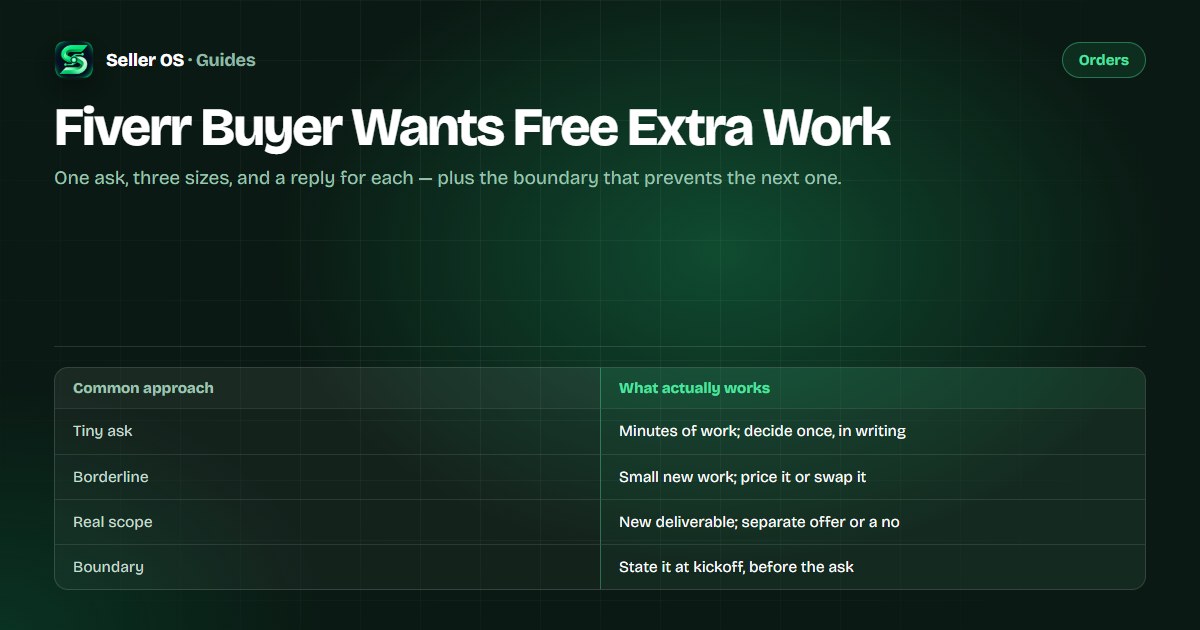
Before you answer, name the size. A tiny ask costs minutes and no new decisions: renaming files, exporting one more format, sending a link again. A borderline ask is small new work that still needs your judgment, such as another variation of the same asset or a version for a second platform.
Real scope is a new deliverable: a new page, a new video cut, a new language. The size matters because the reply changes with it, and because borderline requests left unclassified are how a two-hour order quietly becomes a two-day one.
- Tiny: minutes of work and no new decisions
- Borderline: small new work that still needs a price
- Real scope: a new deliverable that changes the order
Three response scripts for the three sizes
These scripts are examples to adapt, not magic words. Each one answers quickly, keeps the tone warm, and makes the boundary explicit — the buyer hears what the order covers and what a yes would cost, in the same breath.
For a real-scope request, name it and open the paid path: 'The pitch deck is a new deliverable, so I will send it as a separate offer with its own timeline. The current order stays on schedule either way.' The phrase doing the work is 'separate offer' — it moves the request onto the same footing as any other purchase.
| Ask size | Reply in one line | Why it works |
|---|---|---|
| Tiny | 'I can do this once, since it takes a minute — the package covers the rest.' | Gives help without setting a precedent |
| Borderline | 'That one is a small add-on at 20 dollars, or I can swap it for the included option.' | Prices the work or trades scope |
| Real scope | 'That is a new deliverable, so I will send it as a separate offer with its own timeline.' | Turns the ask into a normal purchase |
How to say no without losing the client
A clean no has three parts: acknowledge the request, state what the order covers, and offer a paid or smaller path. Skip the apology paragraph and the cost breakdown; both invite a negotiation you do not want. You are not rejecting the person, only a request that does not fit this order.
Then hold the line. The most common mistake is inventing a new justification every time the buyer pushes; a fresh reason invites a fresh counterargument, while the same sentence repeated ends the negotiation. If the asks refuse to stop and the buyer will not pay for the work they want, a professional exit beats an unpaid project — Fiverr's cancellation process exists for that exit, and the order cancellation guide walks through it.
Set the boundary before the next order
Boundaries set at kickoff feel like service, not defensiveness. One short message when the order starts does the job: 'Confirmed: two concepts, three revision rounds, final files in PNG and SVG. Anything outside that scope gets a quick quote before I start.' The buyer reads it as process, and you gain a written reference for the rest of the order.
Put the same line in your gig FAQ and package descriptions, where buyers look before ordering. State what is not included with the same specificity as what is: file formats, revision limits, platforms, and the revision window are the four places extra asks usually begin. The gig packages guide shows how to structure tiers with those lines visible before checkout.
- Confirm the scope in writing when the order starts
- Name exclusions in packages and FAQ, not just inclusions
- Ask requirements questions that force scope decisions early
When the free asks keep coming
One ask is a decision. A request every few days is a pattern with a different answer, and replying to each message in isolation hides the size of it. If the total is a new project, stop pricing the pieces and renegotiate the whole scope once, in writing: what is left, what each addition costs, and what the timeline becomes.
That pattern has stronger fixes than a single reply — package wording, revision design, and a checkpoint message that catches additions early. The scope creep guide covers those, and when the buyer wants money back instead of more work, the seller-side options live in the Resolution Center.
Where Seller OS helps
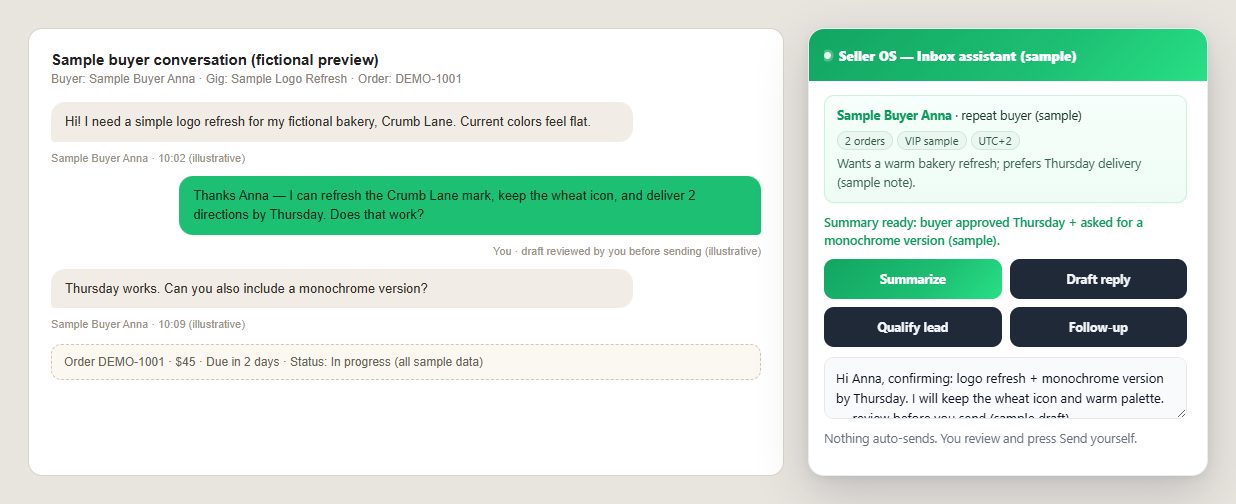
Seller OS helps before the reply goes out. The inbox assistant drafts a response to a scope request from the conversation context, and you edit the number, the tone, and the boundary in the draft before sending. Client records keep this buyer's order notes, so you can see whether the request is a first-time ask or the fourth this month.
The package pricing review can also test whether a small paid add-on is worth its time against your profit assumptions. It drafts and files; it does not quote, negotiate, or change an order on Fiverr, and every message leaves only when you send it.
Fiverr Buyer Wants Free Extra Work questions
Should I do small free extras to keep a Fiverr buyer happy?
Only as a deliberate one-time courtesy you can name out loud, never as a habit. A tiny request answered once with a clear note that it is a one-off costs little. The same yes repeated becomes the expected standard, and then a normal quote reads to the buyer as a surprise. Decide consciously, not by reflex.
How do I say no to a Fiverr buyer without a bad review?
Keep the reply fast, warm, and specific, and keep your own costs out of it. State what the order covers, offer the paid or smaller version, and repeat the same sentence if the buyer pushes again. Reviews reflect the whole experience, and a calm, useful reply usually reads better than a reluctant free yes.
Can a Fiverr buyer ask for extra work after delivery?
They can ask, and you can price it. Revisions depend on what your package includes or what was agreed for the order, and a standard order auto-completes three days after delivery if nobody acts. Work beyond the agreed scope is a fresh purchase: a custom offer or a new order. Where you draw that line is your call, made in writing.
Does refusing free extra work hurt my Fiverr completion rate?
No. Declining a request outside the order's scope is not an order outcome, so it does not touch completion metrics by itself. What counts is how the order ends: a cancellation you submit affects order completion, and a partial refund does not affect it whether the buyer accepts or declines. Keep the order moving and the math stays clean.
Answer once, clearly, in writing.
Classify the ask, send the matching reply, and note the boundary in the kickoff message.