 Seller OS
Fiverr revisions: how many should you offer?
Revisions are a promise you make in your package before you know the buyer. Offer too few and cautious buyers look elsewhere; offer too many, or leave the number undefined, and a single order can absorb weeks. The count you publish is a design decision, and it should match how subjective your deliverable is.
This guide covers what Fiverr's order flow does with a revision request, how to set counts tier by tier, how to separate a revision from new scope, and how to close a loop before the third round.
Free plan available. Local-first data. Human review on every change.
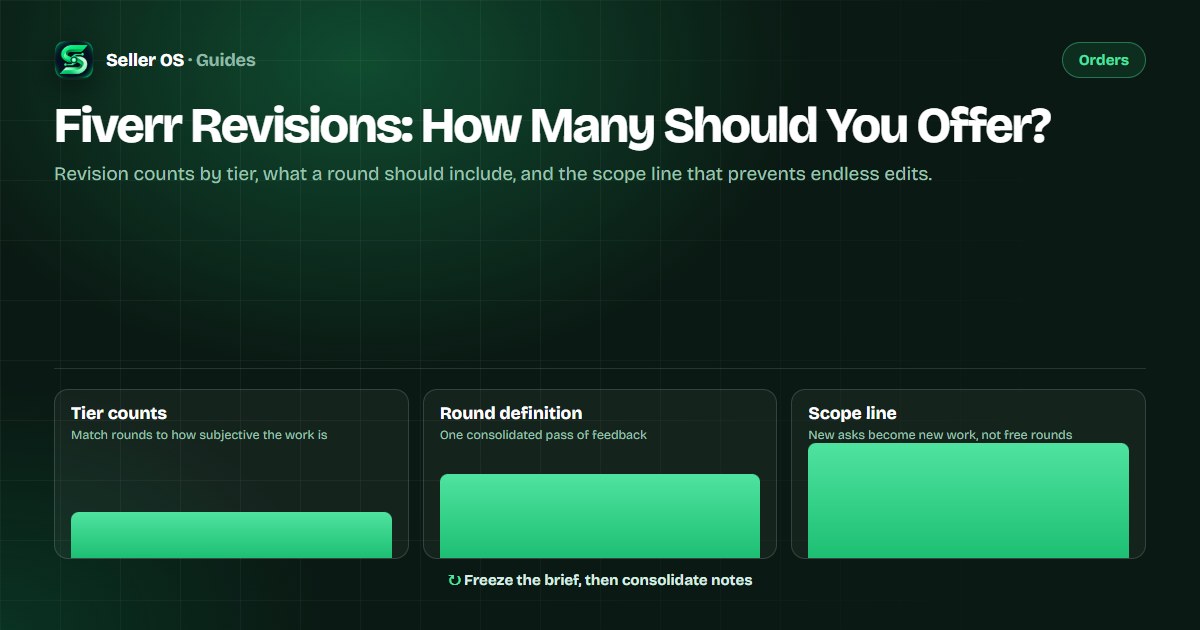
How revisions move through a Fiverr order
When a client is not satisfied with a delivery, they reject it and the order status becomes In Revision. You then re-deliver, and the work returns to the review flow. Fiverr does not run a separate revision counter on its side: the number a client can request depends on what your gig package includes or on the scope you agreed for that order.
The review clock matters as much as the count. Fiverr's client guide gives three days from a delivery to accept it, request revisions, or extend the review period, and an order auto-completes if nobody acts. A review extension of up to five days keeps the order in Delivered and is not a revision request. Fiverr's two current guides describe the status label after a re-delivery differently, so read the live order page rather than assuming a label.
“The number of revisions a client can request depends on what's included in your Gig package or agreed-upon order scope.”
— Fiverr Help Center, Managing your orders: A freelancer's guide, September 2026
How many revisions should each tier include?
Start from the nature of the work, not from what competitors show. Subjective deliverables — logo concepts, visual styles, tone of voice — attract feedback about taste, so a higher tier that includes several rounds matches how buyers judge them. Objective deliverables — a data cleanup, a translated document, a bug fix — have a finish line you can verify, and one round is often enough.
The example policy below is illustrative, not a platform rule. Use it as a sanity check against your own delivery times: every round costs you a pass, and a premium price can carry more of them.
Two platform facts shape the design. Custom offers let a seller set revisions between zero and 20, or choose Unlimited, so an order built through an offer can differ from your published package. Revisions are also a package requirement: Fiverr requires at least one revision option per package, so the count you publish is part of the offer a buyer sees before purchase.
| Tier | Example rounds | Why it fits |
|---|---|---|
| Basic | 1 round | One consolidated pass; keeps the entry price honest |
| Standard | 3 rounds | Room for taste-level changes on a visual deliverable |
| Premium | 5 rounds | Final polish plus stakeholder feedback on a larger scope |
A revision, or new scope? Draw the line early
A revision improves work that was already agreed: the logo direction stays and the shade changes; the article structure stays and a paragraph is rewritten. New scope changes what was promised: another page, another format, another stakeholder's fresh idea, a different message entirely. Both arrive in the same friendly sentence, so the classification has to happen before you start editing.
Scenario, hypothetical: a buyer approves the script for a 60-second explainer, then asks to swap the middle section for a product demo and add captions. The swap changes the approved scope, and the captions may be an add-on the package never included. The reply that keeps the order healthy names what is included, names what is new, and puts a number on the new part before any work begins.
The practical test: if the request can be satisfied by editing the approved deliverable, it is a revision; if it needs something that did not exist in the agreed scope, it is new work. Write that test into your gig FAQ so buyers classify their own requests before they send them.
The revision clock: three days, then what?
Every delivery enters the same decision window on the client's side: accept, request changes, or extend the review period by up to five days. If the client chooses revisions, you re-deliver and the work goes back for review. The order only completes when the client accepts or the clock runs out: three days for standard and hourly orders, eight for milestone orders, fourteen for gigs that require shipping.
That produces two practical rules. Reply to revision requests quickly, because the client's ability to keep the conversation moving depends on you; and never treat work in revision as finished business — it is not revenue and not a review yet. Fiverr adds one distinction that helps here: a draft is not a delivery, does not change the order status, and does not start the auto-completion clock, so showing an early draft can collect feedback without opening a formal review.
When a re-delivery goes unanswered, the same clock finishes the order for you; the unresponsive buyer guide covers what each silent stage does. If revisions are the reason a deadline is slipping, handle the time formally with the order extension mechanics.
Should you offer unlimited revisions?
Unlimited exists as an option: Fiverr's custom-offer FAQ says a seller can set revisions between zero and 20, or choose Unlimited. What unlimited concretely obligates is not spelled out in Fiverr's current live documentation, so define your own boundaries in the package or the offer: what a round includes, what resets the count, and when the window closes.
If the promise has marketing value for you, keep it and define the mechanics behind it: one revision round means one consolidated set of notes; new scope is quoted separately; and the free-revision window ends a set number of days after the final delivery. That last part is your policy, not a Fiverr rule, so it belongs in the gig description or FAQ where buyers see it before ordering.
How to prevent the revision loop
Most loops are born before the first delivery. A brief that leaves the audience, tone, or format open invites a taste debate; a kickoff message that confirms those three things in writing closes it. Ask for one consolidated set of notes per round rather than accepting feedback one message at a time, and repeat the notes back in your own words before you start.
Confirm the brief in writing
audience, deliverable, format, and what finished looks like.
Show a draft before the formal delivery
a draft does not start the review clock.
Collect one consolidated note set
ask the client to number the changes in a single message.
Repeat the changes back
confirm what you understood before editing begins.
Re-deliver with a note
name what changed and what stayed the same.
The revision mistakes that cost the most
The most common mistake is treating every message as a revision. A buyer who mentions three ideas for future videos, or asks for a file format your package never included, has produced new requests, not rounds. Answering them with free edits feels generous for a week and expensive for a month.
The second is revising past the point of value: a sixth round on a small logo rarely produces a better logo, and it delays the review and the revenue that follows it. The third is hiding the boundary until the disagreement. If the package says one round and the conversation implies many, the buyer is not being difficult — the terms were never stated.
Requests that arrive after the order completed are a different conversation entirely; the guide to post-completion requests explains how to sort them. Up to that point, say the count, the round, and the scope line up front, and revision conversations stay short.
Where Seller OS helps
Seller OS helps with the design side before a buyer ever requests a round. The Gig Builder turns a short idea into structured packages, including what each tier includes and how revisions are framed, and the package pricing review checks the numbers against your own cost and profit assumptions. You still write your own terms; the extension organizes them so the count, the round definition, and the scope line are visible before a buyer orders.
On the order side, the inbox assistant drafts a revision acknowledgment or a scope-boundary reply from the conversation context, and you edit and send everything yourself. There is no automatic editing, sending, or publishing; the human gate stays where it belongs.
Fiverr Revisions questions
How many revisions should I offer on Fiverr?
There is no platform-wide number. Fiverr states the number depends on your gig package or the scope agreed for the order, and custom offers can set zero to 20 or Unlimited. A practical starting point is one round on the entry tier and several on higher tiers, matched to how subjective the deliverable is.
What counts as a revision versus new work?
A revision edits what was already agreed; new work adds a deliverable the scope did not include. If the change can be made inside the approved piece, it is a revision. If it requires something new — another page, another format, a fresh concept — quote it as new scope, ideally before you start editing.
What happens if a buyer keeps requesting revisions?
Each delivery gives the buyer three days to accept, request changes, or extend review by up to five days. If requests continue, stop editing and re-open scope: ask for one consolidated note set, confirm what the package includes, and quote anything outside it as new work. Keep the whole conversation on the order page.
Do revisions affect my Success Score?
Fiverr lists revisions with delivery extensions and partial refunds as actions evaluated by their impact on client satisfaction, in the group it describes as enhancing the client experience rather than harming the score. That does not make extra rounds harmless: the real cost is your time, and scope confusion is what turns one round into five.
Decide the count before they ask.
Write the round, the scope line, and the limit into the package, then let the delivery speak.