 Seller OS
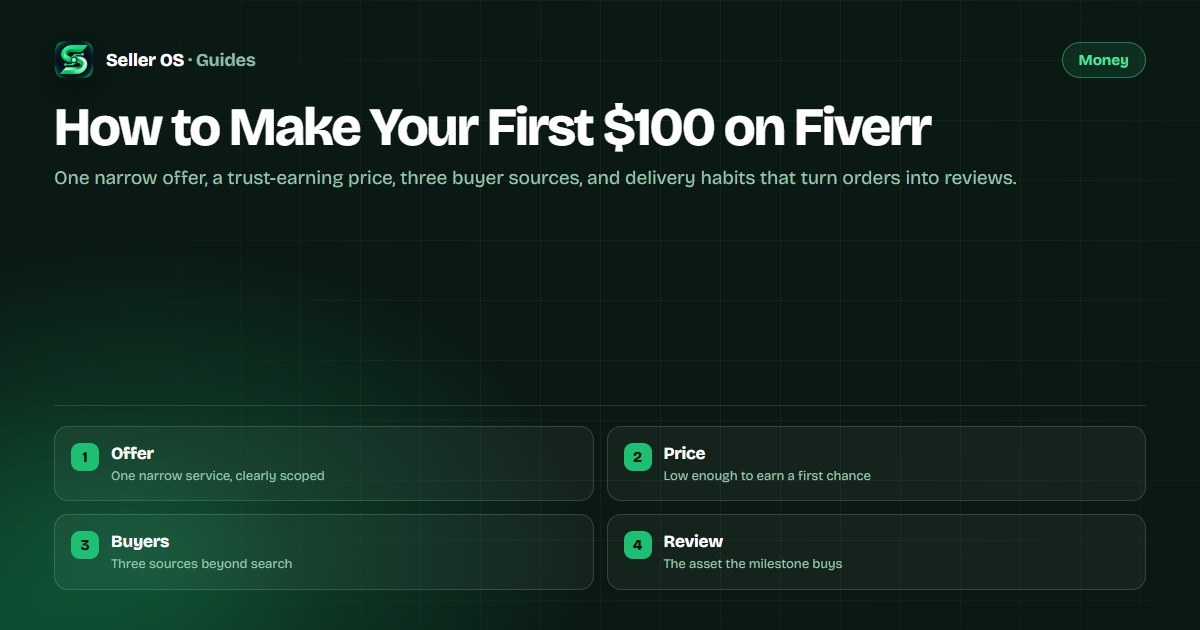
How to make your first $100 on Fiverr
Your first $100 on Fiverr is a proof milestone, not an income milestone. It means a stranger paid you, you delivered, and the platform recorded it. Everything after that gets easier, because buyers trust sellers with history.
This guide gives you a concrete plan: one narrow offer, a trust-earning price, three ways to find your first buyers, delivery habits that earn reviews, and the fee math on $10, $25, and $50 orders so you know exactly how many sales the milestone takes.
Free plan available. Local-first data. Human review on every change.
Pick one narrow offer
New sellers fail by offering everything. A gig titled for five services tells each buyer nothing, while a gig promising one specific outcome tells the right buyer everything. Choose the smallest service you can deliver excellently: not design, but podcast cover art; not writing, but product descriptions for skincare stores.
Scope it so delivery is boring and repeatable. A tight scope means fixed requirements, a short turnaround, and no surprises, which is exactly what earns a five-star review from a cautious first buyer. The low-competition method helps you check that the niche has demand before you commit.
- Name the buyer, the deliverable, and the use case in one line.
- Keep requirements to five questions or fewer.
- Set a delivery time you can beat, not one you must survive.
Price it to earn trust, then publish
Your opening price buys your first reviews, so set it where a skeptical buyer says yes. That usually means the lower-middle of your category: not the cheapest, which signals risk, but comfortably below established sellers. You can raise prices once proof exists, and the raise guide covers that sequence separately.
Publish with packages that make the middle tier the obvious pick, a gallery that shows the exact deliverable, and an FAQ that answers the two hesitations buyers always have: what you need from them and how fast they get it. The packages reference details the tier structure, and the pricing guide covers the foundations.
Source your first three buyers
Search will not send you buyers yet, so you source them. Three channels work for beginners, and you should run all three in parallel rather than waiting on any single one.
Keep every message specific to the buyer. A short note that names their project and offers the exact deliverable beats any template, and polite follow-up once is fine while repeated nudging is not.
Buyer requests and briefs
Answer open briefs in your niche daily with a reply that names the deliverable, your turnaround, and one relevant sample.
Your own network
Tell friends, former colleagues, and online communities what you now sell, and offer the same public price with the same public process.
Direct outreach
Message a few businesses whose need you can see, describe the specific improvement, and link the gig so ordering stays on Fiverr.
Deliver, then earn the review
Delivery is where the review is won. Confirm requirements before starting, deliver before the deadline, and include one small extra that costs you minutes: a checklist, a usage note, a quick variant. Buyers review the feeling of being looked after as much as the file itself.
Ask once, after acceptance, in plain words: mention that reviews from early buyers shape your new gig and that honest feedback is welcome. Most satisfied buyers comply when asked directly and never think of it otherwise. The first-order guide has more on this final stretch.
The fee math on $10, $25, and $50 orders
Fiverr states that sellers earn 80 percent of each completed order, per the Help Center, so $100 net needs $125 gross. At $10 orders that is thirteen sales, at $25 it is five, and at $50 it is three. Smaller tickets mean more reviews per milestone, which is a genuine advantage disguised as a grind.
Choose your row deliberately. Tiny orders build review count fast but consume weeks; larger first orders reach the milestone sooner but ask more trust from each buyer. Either path works, and the fee calculator lets you model your exact mix.
| Order value | You keep each | Orders for $100 | Reviews earned |
|---|---|---|---|
| $10 | $8.00 | 13 orders | 13 reviews |
| $25 | $20.00 | 5 orders | 5 reviews |
| $50 | $40.00 | 3 orders | 3 reviews |
Where Seller OS helps
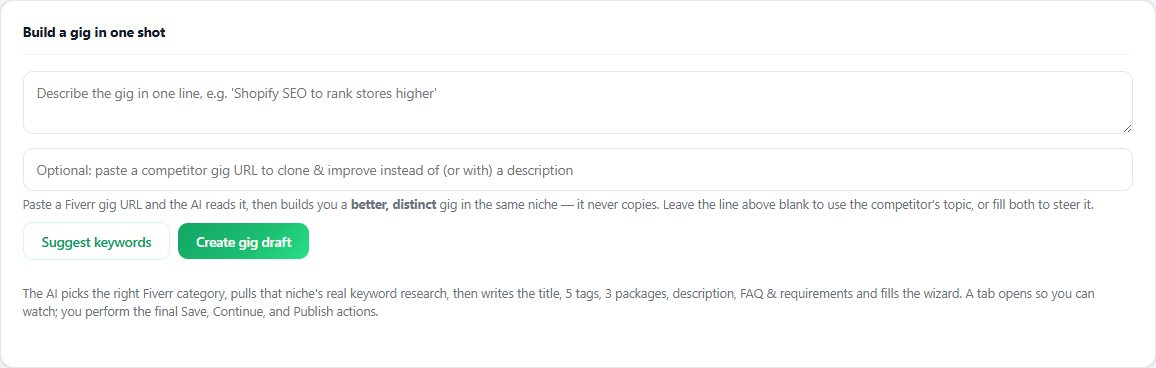
Seller OS shortens the setup half of this plan. The gig builder turns a one-line idea into a structured draft with packages and FAQ suggestions, and the brief-response tools help you answer early inquiries quickly while every message still goes through you.
Tracking stays on your machine in Chrome local storage. The extension drafts and organizes, you review and publish, and no order, message, or price ever moves without your click.
How to Make Your First $100 on Fiverr questions
How many orders does $100 on Fiverr take?
It depends on your order value, because you keep 80 percent of each sale. At $10 orders you need thirteen sales for $100 net, at $25 you need five, and at $50 you need three. Smaller orders build your review count faster per milestone, while larger ones reach the dollar figure sooner with fewer deliveries.
What is the fastest honest way to get first Fiverr sales?
Run three channels at once: answer buyer briefs daily, tell your own network what you sell, and message a few businesses with a specific offer. Pair that with one narrow gig priced for trust and fast replies. There is no shortcut that skips proof, but parallel sourcing plus a tight offer shortens the wait considerably.
Should my first Fiverr gig be cheap?
Price in the lower-middle of your category rather than at the bottom. Rock-bottom prices attract difficult buyers and signal risk, while lower-middle pricing lowers the trust barrier without branding you as the cheapest option. Once several good reviews exist, raise gradually toward the rate your work supports.
How do I get reviews on my first Fiverr orders?
Deliver early, add one small thoughtful extra, and ask once after the buyer accepts the work. A plain request works: early-buyer reviews shape your new gig and honest feedback is welcome. Most satisfied buyers leave a review when asked directly and never consider it otherwise, so the ask itself is the system.
Make the first hundred about proof.
One offer, trust pricing, three buyer channels, and delivery that earns the review.