 Seller OS
Fiverr keyword analytics: what the data shows
Keyword analytics on Fiverr answers one narrow question: which search terms buyers used to find your gig, and how each term performed. The catch is availability. Fiverr documents keyword-level data inside Seller Plus, so many sellers never see a keyword row at all, and no public Fiverr keyword tool exists.
This guide explains what the data contains, how to read each column without overreacting to small numbers, and what to do when you have no keyword rows. A manual substitute keeps your decisions grounded either way.
Free plan available. Local-first data. Human review on every change.
What keyword data Fiverr actually provides
Start with the boundary, because it shapes everything else. Fiverr's Analytics area lists six tabs, and its help center states that only Overview and Repeat business are standard. The other four, including Top Keywords and Keyword research, are Seller Plus tabs, and Fiverr says these are available exclusively to Seller Plus members. Fiverr's Advanced Analytics article describes the full set.
So there are two honest situations. If you have Seller Plus, you can read the search terms buyers used to find each gig. If you do not, Fiverr shows you no keyword-level data, and any keyword number you see elsewhere is somebody's estimate, not a measurement. Plan around the situation that is actually yours.
Why does Fiverr gate it? The Keyword research tab exposes marketplace-wide numbers, and Fiverr has chosen to keep that behind a paid program rather than publishing a public tool. That is a business decision, not an oversight, and it will not change because sellers ask. Build your workflow around the access you actually have.
How to read the columns in a keyword row
The Top Keywords tab lists which search terms clients used to find your gig, along with how each keyword performed across impressions, clicks, orders, and earnings. Each column answers a different question. Impressions show the term appeared in results; clicks show the card earned attention; orders show the traffic converted; earnings show what the orders were worth.
Two definitions deserve care because they differ from the standard dashboard. Fiverr defines keyword CTR as how often clients clicked after seeing your gig for that keyword, and keyword CR as how often clients placed an order after clicking it. The per-gig conversion rate on the standard dashboard instead divides orders by impressions. Use the definition that matches the screen you are on, and never mix the two in one comparison.
A concrete read, hypothetical: 800 impressions, 40 clicks, and 2 orders means the card earns attention and the page converts a small share of it. Compare that with 800 impressions, 6 clicks, and 0 orders, where the card is the bottleneck. The two rows point at different fixes, which is the entire reason to read the columns together.
The rank column is relative, not global
Fiverr's Top Keywords table includes a # icon that shows a keyword's ranking relative to your other keywords. That ordering is useful for prioritization: it ranks your own terms by performance without pretending to show where you sit in the marketplace.
Marketplace-level questions belong to the Keyword research tab, which Fiverr describes as showing how search terms perform across the broader Fiverr marketplace, not just for your gig. It lists Overall Rank, Search Volume, Average Order Price, Conversion Rate, and Competition, with lower competition described as better. Stop there: Fiverr does not publish how Overall Rank or Competition are calculated, how far back the data goes, or how many keywords exist beneath the visible rows.
Treat the ordering as a priority list rather than a scoreboard. If one term sits above another in your own table, it is telling you where buyers found the gig most often, not how good the term is in the abstract. The marketplace view, when you have access to it, is the other half of the picture.
“Give any new or updated keywords at least 30 days before reviewing their impact and analyzing their performance.”
— Fiverr's Advanced Analytics for Seller Plus help article, September 2026
When you have no keyword data at all
Most sellers are in this position. Without keyword rows, build your keyword picture from evidence you can still collect: the phrases buyers use in messages, the wording of the requirements they submit, the terms Fiverr suggests as you type in search, and the language on the gig cards that keep appearing above yours.
Then write the terms down with the fields they occupy. That record is what lets you compare later, because the point of keyword analytics is not the number itself; it is knowing whether a term is working better or worse than it did last month.
A hypothetical mapping for a resume writer: five recent messages mention ATS, autocomplete suggests ats resume, and three competitor cards phrase it as resume writing. The shortlist writes itself — ats resume for the title, the variants for keywords and tags, and a review date 30 days out.
Collect
note every phrase buyers use in messages and requirements.
Shortlist
keep the terms that describe what you actually deliver.
Map
assign each term to one gig and one field.
Sample
search your own terms in a private window, weekly.
Review
judge the set only after a full 30-day window.
Worked example: reading one keyword review
Suppose your monthly keyword review shows three rows. The numbers here are hypothetical; the reading logic is the point.
The third row is the interesting one. Low impressions do not disqualify a term. A healthy click and order rate on small traffic can justify more room in a field, while the high-impression, low-click row needs attention on the listing card rather than on the keyword itself.
Read the set, not the winner. A monthly keyword review should end with a small number of decisions: protect the terms with orders, fix attention on the terms with impressions, and give a field to the small terms that convert. Three decisions maximum, or the review turns into a rewrite.
| Keyword | Impressions | Clicks | Orders | Read |
|---|---|---|---|---|
| explainer video | 1,200 | 38 | 6 | Works end to end; protect it |
| saas explainer video | 410 | 4 | 0 | Card earns no attention; check title |
| 60 second explainer | 180 | 11 | 3 | Small but healthy; give it a field |
Mistakes keyword analytics invites
The first mistake is treating a small sample as a verdict. A term with thirty impressions can swing for reasons that have nothing to do with your gig, and Fiverr's guidance is to leave new or updated keywords for at least 30 days before judging them. The second is comparing a keyword CR against the per-gig conversion rate, or against a figure from a different window; the definitions and periods differ, and the comparison quietly becomes meaningless.
The third mistake is assuming more data exists somewhere. Fiverr does not publish a public keyword tool. If you are not in Seller Plus, the official keyword data does not exist for you yet, and planning around estimates while believing they are measurements is how sellers end up rewriting working gigs for no reason.
One habit prevents most of this: date every keyword change in the same note where you record the review. When a term moves, the note tells you whether your edit or the season gets the credit, and it keeps the 30-day rule from becoming a 30-day guess.
Where Seller OS helps
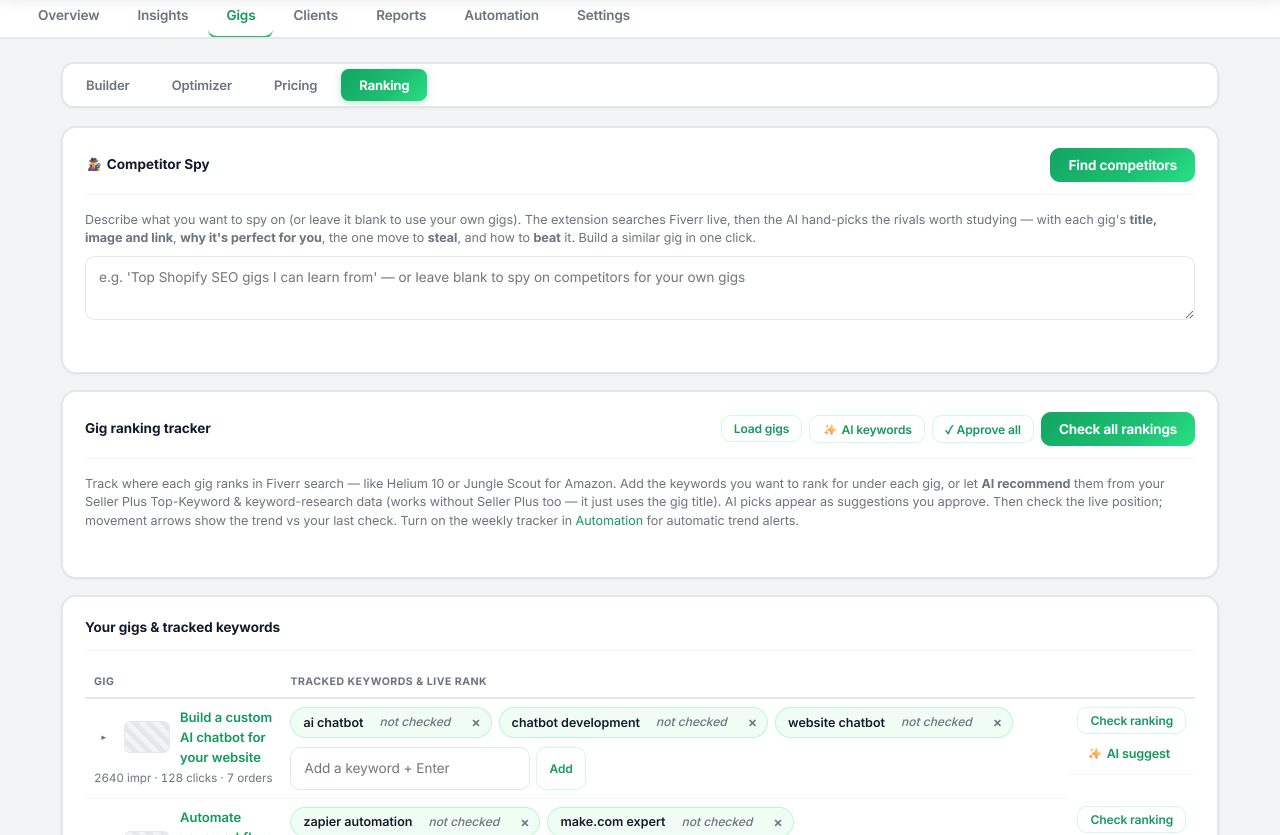
Seller OS keeps a keyword history locally, without pretending the gated data is available. The Keyword Rank tracker samples the terms you sell against on a schedule you choose and records positions and movement, so a keyword has a trend even when Fiverr shows you no keyword rows.
Keyword suggestions help when you map terms to fields, and the gig audit reads a gig's own performance data against its copy and gallery when something moves without explanation. Everything stays in Chrome local storage, and the extension never edits, publishes, or uploads anything on its own.
Fiverr Keyword Analytics Explained questions
Does Fiverr show keyword data without Seller Plus?
No. Fiverr's help center states the Top Keywords and Keyword research tabs are available exclusively to Seller Plus members, and the advanced analytics article adds that those tabs are web-only and not available on Kickstart or non-Seller Plus accounts. Standard analytics covers earnings, repeat business, and per-gig statistics, but not the search terms behind your traffic.
What do the keyword columns mean?
Top Keywords shows the search terms clients used to find your gig with impressions, clicks, orders, and earnings for each. Keyword CTR is how often clients clicked after seeing your gig for that term, and keyword CR is how often they ordered after clicking. The standard per-gig conversion rate is a different definition.
How long before I judge a keyword's performance?
Fiverr's guidance is to give new or updated keywords at least 30 days before reviewing their impact. Before that window closes, small samples dominate the picture and edits stack on top of each other. Change one field, note the date, and compare the next full period against the one before.
What should I use if I cannot see keyword data?
Build the picture from messages and requirements buyers send you, Fiverr's autocomplete suggestions, and the repeated phrasing on competitor gigs above yours. Map each phrase to a field, sample your own positions weekly in a private window, and keep the notes. That record substitutes for the missing rows.
Read the keyword rows honestly.
Add your terms to a local rank history and review them after a full 30-day window.