 Seller OS
Fiverr top keywords: how to find your best ones
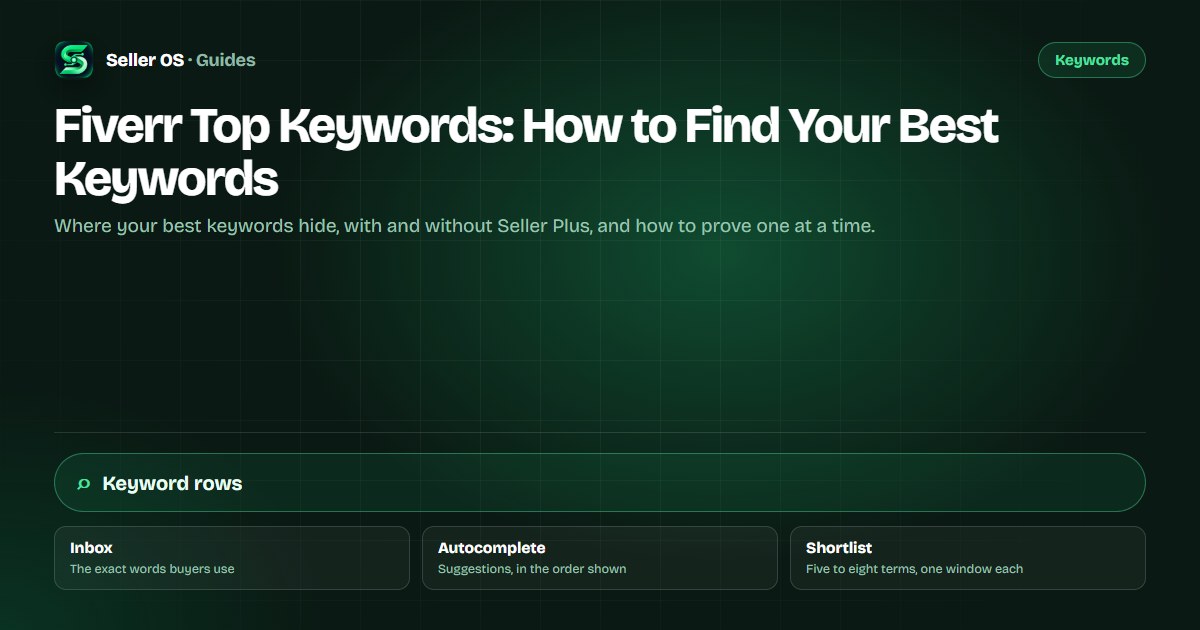
Your best Fiverr keywords are not the biggest phrases in your category. They are the terms that already bring you buyers, or the ones with real evidence that buyers search them. Finding them is a research job with one honest limit: Fiverr's own keyword data lives inside Seller Plus, so most sellers work from observable evidence instead.
This guide shows where to look in both situations, how to build a shortlist of five to eight terms, and how to keep testing them across 30-day windows. It is about keywords that fit your gig today, not chasing volume.
Free plan available. Local-first data. Human review on every change.
What makes a keyword your best keyword
A search term earns that label by bringing buyers, not traffic. Three qualities separate a working keyword from a busy one: it describes a service you actually deliver, it leads to conversations or orders, and you can place it in a field without distorting the sentence.
That definition changes what you look for. A term with modest impressions and a real order rate beats a broad phrase that never converts, and a phrase buyers use in their own messages beats both, because the language is already proven where it matters.
There is a second, quieter test: would you keep the term even if it brought no orders this month? A phrase that describes exactly what you sell still belongs in a field during a slow window, because its job is to keep the gig findable. A phrase that only looked impressive in a list can be dropped without regret.
- Fits the service: you can deliver what the phrase promises.
- Shows intent: the searcher is close to ordering, not browsing.
- Has evidence: a keyword row, a message, or an observed pattern.
- Fits a field: title, keywords, tags, or description, without stretching.
If you have Seller Plus, start with your own rows
The Top Keywords tab lists the search terms clients used to find each gig, with impressions, clicks, orders, and earnings per term. Sort by orders rather than impressions and your proven keywords are in front of you. The # icon orders terms relative to your other keywords rather than to the whole marketplace.
Two cautions. These rows are your history, not the market's, and Fiverr documents the tab as Seller Plus Standard and Premium only, web-only, and unavailable on Kickstart accounts. If your rows are thin, that is information too: the gig may be too new or too quiet for keyword data to accumulate yet.
Read rows by decision rather than by rank. A term with orders and earnings earns protection; a term with impressions and no clicks points at the card; a term with clicks and no orders points at the offer or the page. The # ordering only decides which row you open first.
Without Seller Plus: four honest sources
Fiverr does not publish a public keyword tool, so free research means reading signals instead of rows. Four sources are strong enough to build a shortlist from, and none of them requires software.
Your inbox
the exact phrases buyers use when describing the job.
Requirements
the wording clients attach when they place orders.
Autocomplete
type a head term and note the suggestions in order.
Competitor cards
phrases that keep reappearing above yours.
Turn the candidates into a shortlist
Collecting phrases is easy; choosing is the work. Build a shortlist of five to eight terms: one primary phrase for the title, three to five supporting phrases for the positive keywords field, and tags that split the difference between format, use case, and audience.
Then track them. Sampling your own positions weekly in a private window turns a list of hunches into a record you can compare, and Fiverr's guidance to allow at least 30 days before judging a keyword change sets the review rhythm.
The shortlist is a working document, not a final answer. Terms move between slots as evidence accumulates, and a phrase that fails as a title candidate can still work as a tag. Write the evidence beside each term so the next review does not relitigate a decision you already made.
| Phrase | Evidence | Proposed slot |
|---|---|---|
| podcast intro voice over | Six inbox mentions this quarter | Title |
| podcast intro | Repeated autocomplete suggestion | Positive keywords |
| audio branding | Two past orders used the phrase | Positive keywords |
| voice over intro for youtube | Competitor cards phrase it this way | Tag |
| female american voice over | Only if your profile matches | Tag or FAQ |
Prove a keyword before you promote it
The title is the most valuable field because Fiverr's stated matching order reads title text first, then the positive keywords field, then the description. That is exactly why a new phrase starts lower down: test it in a supporting slot, watch whether impressions arrive, and promote it only when the data agrees.
Worked example, hypothetical. A voice-over seller adds audio branding to the positive keywords field in March. Impressions rise during April while orders hold steady, and the phrase keeps appearing in messages. In May the seller moves it into the tag set and drafts a title variant — one field at a time, one window each.
If the phrase is already performing in a supporting slot, there is no prize for moving it. A title change is only worth the risk when the data says the phrase is the strongest description of the service and the current title is not carrying it.
Place the phrase in a supporting slot
keywords or tags, not the title.
Wait a full window
Fiverr names 30 days for keyword changes.
Read impressions first
visibility usually moves before orders.
Promote or drop
one decision per phrase per window.
Top-keyword mistakes that waste months
Assuming you are missing a tool is the first trap. Fiverr's marketplace keyword data is a Seller Plus feature, not a hidden public page, and no third-party number is measured from Fiverr's own data. Estimates can hint; they cannot prove.
The second trap is treating one search result as a strategy. Seeing your gig once for a phrase is an impression, not demand. The third is copying a competitor's terms wholesale; their history is not your history, and their phrase may describe work you do not want to sell. A fourth is judging a term before its 30-day window closes and swapping fields every week in response.
Where Seller OS helps
Seller OS keeps the shortlist alive. Keyword suggestions help you choose terms for each field when you build or optimize a gig, and the rank tracker samples the phrases you adopt on a schedule you set, storing positions and movement locally so a 30-day test has a before and an after.
On Pro, a background keyword monitor can refresh positions while Chrome is open and flag notable moves. It records and suggests; it never edits your gig, sends anything, or uploads your data.
Fiverr Top Keywords questions
How do I find my best Fiverr keywords?
Start with evidence you already have. Seller Plus members can read the Top Keywords tab, which lists the search terms clients used with impressions, clicks, orders, and earnings. Without it, collect phrases from your inbox, order requirements, Fiverr's autocomplete, and competitor cards, then shortlist five to eight terms and test them.
Does Fiverr have a top keywords tool?
Fiverr's Top Keywords tab exists inside Seller Plus and shows the search terms that found your gigs. There is no public Fiverr keyword tool, and the marketplace Keyword research tab is documented as Seller Plus-only as well. Free keyword numbers from third parties are estimates, not Fiverr data.
Should I put my best keyword in the gig title?
Only once it is proven. Fiverr states the matching order reads title text first, then the positive keywords field, then the description, so the title is your strongest slot and the riskiest to rewrite. Test a phrase in a supporting field for a full 30-day window before promoting it.
How many keywords should I track?
Five to eight is a working shortlist: one primary phrase, three to five supporting phrases, and the tags around them. Tracking forty words produces noise you will not act on. Map every term to one gig and review the set after each 30-day window.
Shortlist smart, then prove it.
Pick five to eight terms, test one per window, and keep the evidence in one local history.