 Seller OS
Fiverr brief proposal rewrite: generic to specific
Everyone knows a specific proposal beats a generic one. Seeing the two versions side by side, with each line annotated, is what makes the difference usable. This guide takes one brief response and rewrites it line by line, then tightens it again.
It is a companion to the proposal structure guide and the brief response guide, which cover the beats. Here the beats become a concrete before and after you can copy the logic from.
Free plan available. Local-first data. Human review on every change.
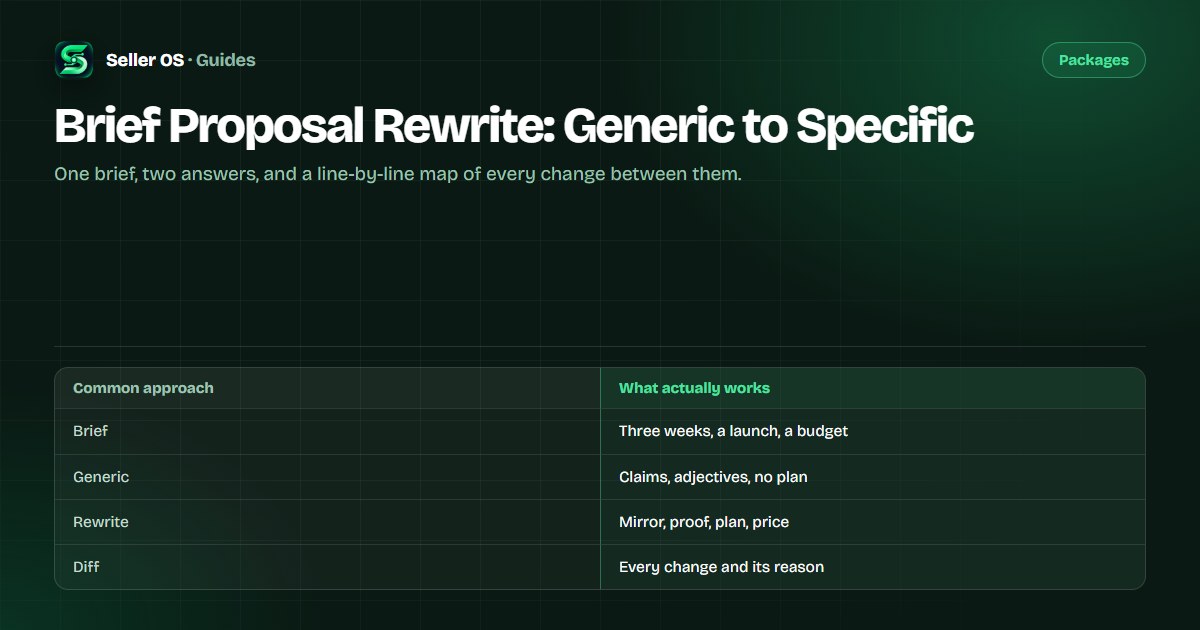
The brief we are answering
The brief is hypothetical but realistic: a B2B payroll startup writes to say it needs help with its LinkedIn presence before a funding announcement in three weeks. The budget is described as limited but flexible for the right person, and the company has two co-founders but no existing content calendar.
That is a good test case because it is short, time-boxed, and vague about budget, which is exactly where generic answers go to die. Fiverr's brief article tells recipients to consider creating a strong offer to stand out, and the window is short: briefs were answerable within 72 hours, and Fiverr says to answer Mira's first message within 24 hours so your response rate is not affected.
The generic version, line by line
Here is the kind of reply that gets skipped. Read it slowly and notice how little of it is about the buyer.
Generic: Hi, I saw your post and I would love to help with your LinkedIn presence. I am an experienced social media manager with many years of experience working with startups. I can definitely help grow your audience and create engaging content. I am available to start right away and my rates are flexible. Looking forward to hearing from you.
- The greeting mirrors nothing: it names LinkedIn, not their announcement.
- The experience claim is unfalsifiable: many years with startups says nothing they can check.
- The promise is vague: grow your audience is not a deliverable.
- The close asks for nothing: hearing from you gives no reason to reply.
The specific rewrite, line by line
Same request, same seller, one more pass. The rewrite mirrors the deadline, makes one proof point checkable, gives a plan with dates, prices with inclusions, and ends with a question about the launch.
Rewrite: Hi Dana, you need the LinkedIn presence ready before the funding announcement, with three weeks to build it and a freelance budget. I ran the same pre-announcement ramp for a seed-stage fintech last quarter: founder profile rewrite, a four-post launch sequence, and a comment playbook for the team, delivered in 11 days. My plan: audit your two founder profiles and current posts on Monday, draft the four-post sequence by Friday, revise the following week, live by the 18th, five days inside your announcement. The price is $900 and covers the profile rewrites, the four posts with visuals, and one review round; scheduling and employee advocacy are the part that needs your team. What is leading the announcement right now, investors, customers, or hiring?
What changed, and why
The rewrite is not longer because it is padded; it is longer because it answers questions the generic version left open. Every added line replaces a claim with something the buyer can verify or use.
| Beat | Generic | Rewrite | Why |
|---|---|---|---|
| Mirror | Help with your LinkedIn presence | Ready before the announcement, three weeks | Names their deadline |
| Proof | Many years with startups | The same ramp for a fintech last quarter | One checkable project |
| Plan | Available to start right away | Audit Monday, drafts Friday, live by the 18th | Dates they can hold you to |
| Price | Rates are flexible | $900 covering three named inclusions | The number has a shape |
| Question | Looking forward to hearing from you | What is leading the announcement? | Gives a reason to reply |
The tightening pass
The specific version can lose a third of its words and keep every beat. Short wins when the buyer is scanning, which is most of the time. Here is the same reply compressed.
Tight: Hi Dana, three weeks to the announcement and a freelance budget. I built the same pre-announcement ramp for a fintech last quarter in 11 days: profile rewrite, four-post sequence, team comment playbook. Plan: audit Monday, drafts by Friday, live the 18th. $900 covers the rewrites, the four posts, and one review round; scheduling stays with your team. What is leading the announcement, investors or customers?
What survived: the deadline, one proof point, a plan with dates, the price and its inclusions, the dependency, and the question. What left: the greeting, the adjective about experience, and every sentence that repeated a beat already made.
What the example teaches
The rewrite works because it answers the buyer's real question, which is not what you do but whether you understand what this launch requires. Specificity is just evidence that you read carefully and thought about their situation.
Two habits make the difference repeatable. First, borrow the buyer's own nouns so they recognize their project in your reply. Second, replace every claim with a countable detail, a date, a file, or a number, because countables are the only things a buyer can verify before they decide.
- Mirror the exact deadline and deliverable from the brief.
- One proof point, described without inflation.
- A plan with dates and a buffer inside the real deadline.
- A price with inclusions and the one dependency named.
- One closing question about their outcome, not your availability.
Where Seller OS helps
A rewrite is fastest when the first draft already exists. Seller OS drafts a brief response from the message, your gig details, and local client history, then hands it to you beside the original request, so the mirroring line is written from the buyer's own words. Reusable reply structures make the second version quicker than the first.
It is a drafting aid, not an autopilot. Nothing sends without your review, and the tool does not promise the project. You edit the proof, the dates, and the price until they are true, then send.
Brief Proposal Rewrite questions
What makes a Fiverr brief response specific?
It borrows the buyer's own nouns, names one proof point they can check, gives a plan with real dates, prices with inclusions, and ends with a question about their outcome. Specific means verifiable, not long. A sentence that only claims experience can be replaced by one countable detail.
How long should a Fiverr proposal be?
One screen, or about 70 to 120 words, is enough for most briefs. The example on this page keeps every beat in three sentences. Length reads as effort to the sender; the buyer is scanning for evidence you understood the request. Cut any sentence that does not mirror, prove, plan, price, or ask.
Can I reuse the same brief response every time?
Reuse the structure, never the content. The beats stay the same, but the mirroring line, the proof point, the dates, and the price must change for each brief. A visible copy-paste with the wrong project name costs more trust than a slower reply, and it wastes the match that put you in front of the buyer.
Should I attach a Fiverr custom offer to my brief reply?
Usually, once the scope is clear. A custom offer turns the conversation into a defined order with price, delivery, and revisions in fields, and Fiverr states the order starts automatically when the client accepts. Keep the numbers in the reply and the offer identical so the buyer does not have to reconcile two versions.
Rewrite one reply, see the difference.
Mirror the deadline, prove once, plan with dates, price with inclusions, and ask one real question.