 Seller OS
How to respond to a Fiverr brief
A good brief response does four things in a few lines: it shows you read the request, proves you have done this before, says exactly what you will deliver, and gives a reason the price makes sense. Speed matters because the window is short, but a fast generic pitch wastes the match that put you in front of the buyer.
This guide gives you the structure, a fill-in example you can adapt, guidance on attaching an offer, and the mistakes that turn a matched opportunity into silence. The thinking stays yours; the template only saves the blank page.
Free plan available. Local-first data. Human review on every change.
The clock: which window applies
Under the brief flow, each brief was available to answer within 72 hours, and the client side states that freelancers receive invites valid for 72 hours. Under Mira, the rule is tighter: Fiverr says to respond to Mira's first message within 24 hours to ensure your response rate is not affected, per Fiverr's Mira help article.
Notice what the Mira rule does and does not say. It protects your response rate, a first-reply metric measured over 90 days, but it is not a countdown to a closed deal. Send a real first response quickly, then take the time the scope actually needs before you quote.
If the message arrives while you are asleep or unavailable, respond as soon as you are back rather than skipping it. A late first reply still beats silence, and it gives the buyer a signal that the conversation is alive.
The four-part response structure
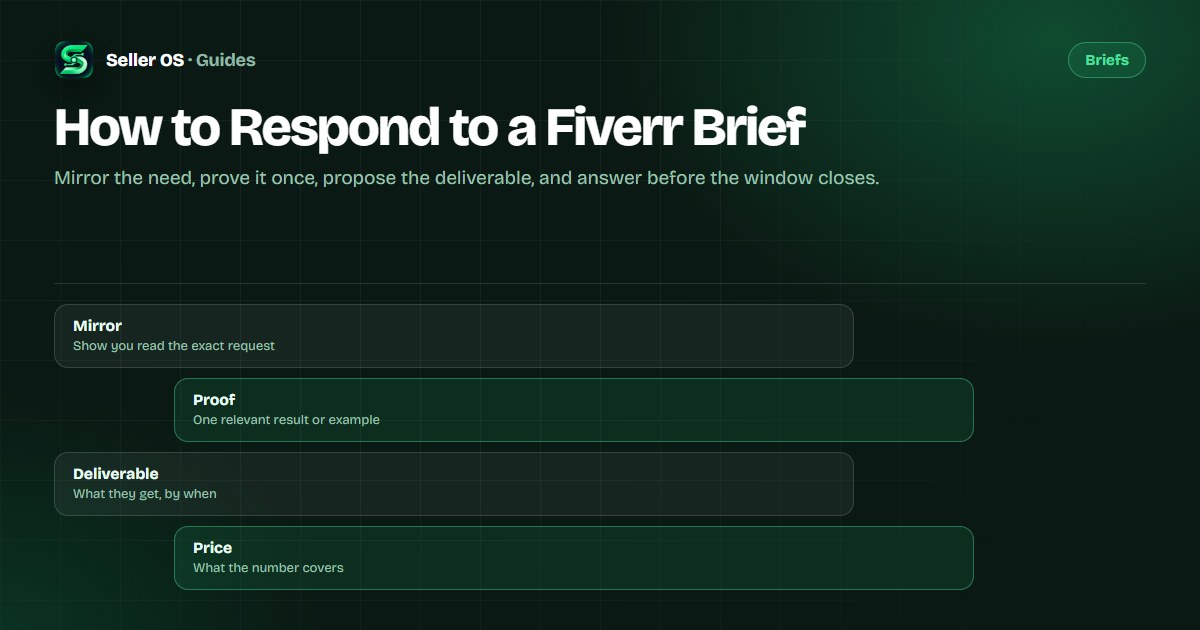
Structure beats length. Mirror the request in your own words so the buyer knows you read it. Add one proof point: a similar project, a relevant sample, or a result you can describe without exaggeration. Then state the deliverable and the timeline, and close with the price and what it covers.
Keep the whole thing to a short paragraph plus an offer. The buyer matched with you because of fit, so your job in the reply is to remove doubt, not to restate their request at length or list every service you offer.
Mirror
open with the specific thing they asked for, not a greeting.
Prove
one relevant project, sample, or outcome.
Propose
what you will deliver, the format, and the date.
Price
the number and what it includes; attach the offer.
A fill-in brief response example
Here is a labelled example. The project details are hypothetical; the structure is the point. A buyer writes: need a 90-second explainer video for a fintech app, script is ready, deadline in ten days.
The reply: Thanks for the detail on the 90-second fintech explainer. I did a similar 2D explainer for a payments app last quarter, delivered script to final in eight days. I can deliver yours in nine days: animated scenes from your script, voiceover, licensed music, and two revision rounds, for $650. The offer is attached, and I can adjust the scene count if your budget is fixed.
What makes this work is placement, not poetry. Every sentence is a beat from the structure, and the buyer can say yes without asking a follow-up question about scope. If the buyer has to ask what is included, the reply was too clever and too thin.
- It answers the exact request: 90 seconds, fintech, script ready
- One proof point, not a portfolio dump
- Deliverable, format, and deadline stated as commitments
- Price with scope, plus an opening to adjust
Attach the offer, do not just chat
The brief flow let sellers respond by creating an offer, asking questions, or marking not interested. The offer was the conversion path, and it still is: a custom offer defines the scope, price, timeline, and revisions, and the order starts automatically once the client accepts it.
Keep the offer matched to your reply: same scope, same deadline, same price. A reply that promises nine days and an offer that says twelve is the kind of mismatch that stalls a warm conversation. The Fiverr custom offers guide covers the fields and published limits that matter when you build one.
Questions and not-interested, used well
Not every opportunity deserves an offer. If the request is outside your services, vague, or badly matched, marking it not interested is the documented option, and Fiverr's brief FAQ states this will not hurt the process of the briefs you receive. You are not penalized for skipping bad fits.
If the request is close but missing details, ask before quoting. One or two sharp questions, such as whether they need original footage or edit-only, protect you from pricing the wrong scope. Ask the minimum, then answer fully once you have the answer.
Keeping AI drafts on a review leash
AI can turn a rough request into a first draft in seconds, which is exactly why it needs a review gate. The failure mode is a polished response that invents experience, promises a timeline you cannot hold, or answers a question the buyer never asked. Model output is a draft, not a commitment.
The workflow that works: generate a draft from the message, check every factual claim against your real history, edit the deliverable and date to match your calendar, then send it yourself. Never let a tool send to a client unreviewed, and never paste private client details into a service whose privacy terms you have not checked.
Mistakes that kill a matched opportunity
The most common mistake is a wall of text that arrives late. Length does not prove effort, and lateness counts against the response metric. The second is quoting before understanding scope, then renegotiating in public; it reads as bait and usually ends the conversation regardless of how good the work would have been.
The third is copying yesterday's reply into today's thread with the old project name still in it. Matching gave you one shot at relevance, and a visible copy-paste error spends it. Write to the brief in front of you, even when you reuse the structure.
The fourth is under-pricing to win the match. A brief answer that lands a project below your cost of delivery creates the kind of strain that shows up later in delivery time and client satisfaction, which are the areas your score actually measures.
Where Seller OS helps
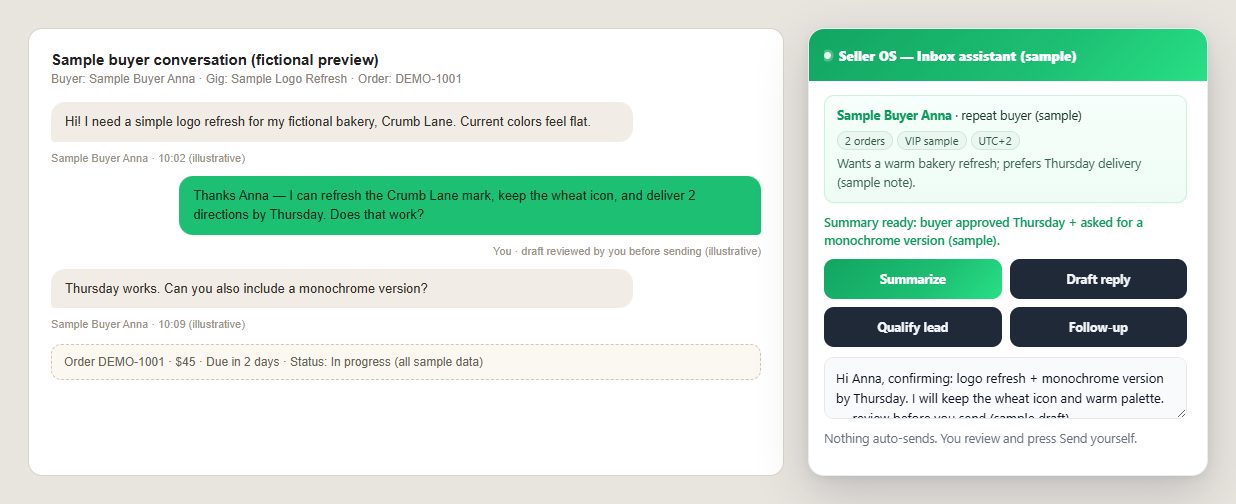
A brief or Mira message arrives with a deadline attached, and Seller OS is built for that moment: the inbox assistant drafts a reply from the message, your gig details, and your local client history, then hands you an editable draft with the original request beside it, so mirroring the need takes seconds instead of a blank page.
Reusable reply structures live in one place, which makes the four beats easier to keep when you are replying in a hurry. Nothing sends without your review, and nothing here guarantees that a response wins the project. It drafts; you decide.
How to Respond to a Fiverr Brief questions
How fast should I respond to a Fiverr brief?
Treat the first reply as urgent: Fiverr's Mira guidance says to respond to the first message within 24 hours to protect your response rate, and briefs were answerable within 72 hours. You do not need the complete answer immediately. A specific acknowledgment that names the request keeps the clock healthy while you prepare the offer.
Should I send an offer with my first reply?
Usually, if you already understand the scope. A custom offer is the documented way a brief conversation becomes an order, and Fiverr notes the order starts automatically once the client accepts. If key details are missing, ask one or two specific questions first, then attach the offer rather than quoting a scope you may need to renegotiate.
Can I use AI to write brief responses?
Yes, with a review step. Use it to structure the reply from the request, then verify every claim about your experience, adjust the timeline to your real capacity, and set the price yourself. Send it as you. Never send an unreviewed draft, and avoid pasting client details into any tool whose privacy terms you have not checked.
What if the brief is outside my services?
Mark it not interested if that option is present, or reply briefly that it is outside your scope. Fiverr's brief FAQ states that declining will not hurt the process of the briefs you receive, so there is no strategic reason to pitch work you cannot deliver well. A bad-fit order costs more than a skipped one.
Answer the brief in front of you
Mirror, prove, propose, price: the four beats, inside the window, every time.