 Seller OS
How to write a Fiverr proposal
On Fiverr, a proposal is not a document you attach; it is the structured message you send when a client project crosses your path, usually with an offer beside it. Its job is to turn a stated need into a conversation you are part of.
This guide covers the five beats a proposal needs, shows a generic version rewritten into a specific one, and explains the single question that keeps the thread alive. It stays separate from offer copy, which handles the transaction itself.
Free plan available. Local-first data. Human review on every change.
What counts as a proposal on Fiverr
There is no separate proposal tool. The channels that produce proposals are briefs, the Mira replacement that now sends matched projects into the Inbox, and inbound messages from buyers who found your gig. Fiverr's brief article captures the spirit when it tells recipients to consider creating a great offer to stand out.
One rule shapes where proposals can happen at all: freelancers cannot initiate contact with new clients, so a proposal is always an answer. You are replying to a brief, a Mira message, or a buyer who reached out first. Cold pitching in the Inbox is not part of the workflow.
“As one of only a few freelancers who receive these briefs, consider creating a great offer to help you stand out.”
— Fiverr's Help Center, Personalized offers (Briefs) for freelancers, September 2026
The five beats of a working proposal
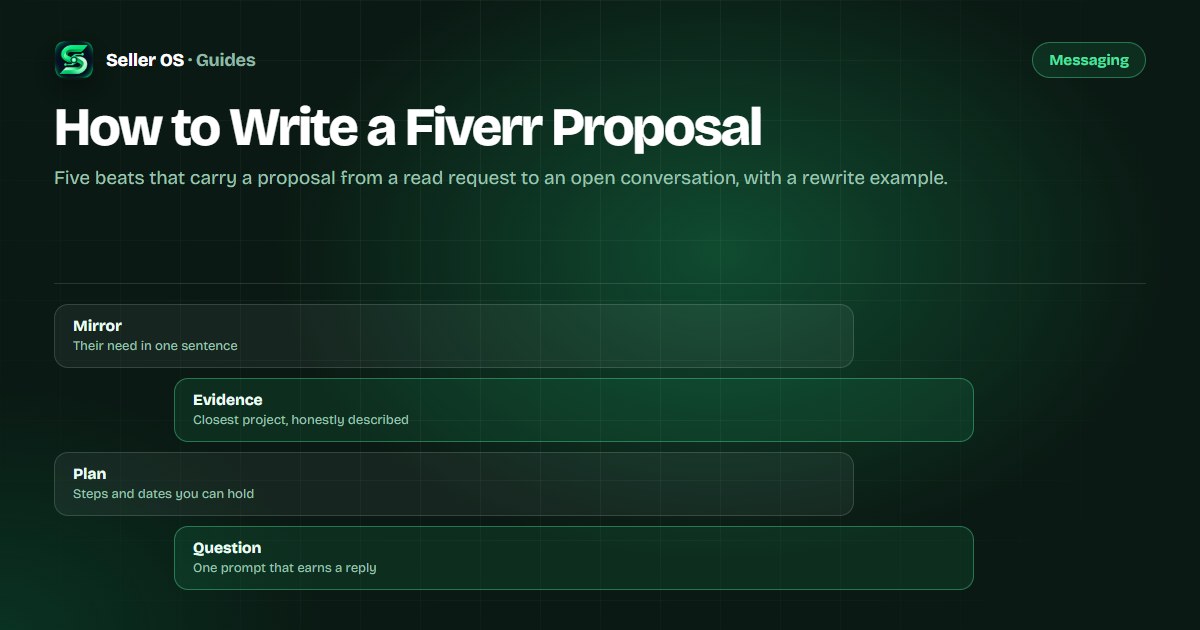
The beats give the buyer a reading order: they see themselves, then your evidence, then the plan, then the number, then a way to talk. Skip a beat and the buyer has to guess, and guessing is where proposals go quiet.
None of the beats needs more than a few lines. The whole proposal should fit one screen, because the buyer is scanning for evidence that you understood the request, not for a demonstration of stamina.
Mirror
restate the need in one sentence, in their own terms
Evidence
one relevant project, described without inflation
Plan
what you will do, in what order, by when
Price logic
what the number includes, and why it is that number
Question
one prompt that invites a reply, not applause
From generic pitch to specific proposal
The fastest way to see the difference is to compare. Both versions below answer the same request, hypothetical: a client needs email flows written for a store before a seasonal launch, and the brief mentions a small team and no existing sequences.
Generic version: 'Hi, I am an experienced email copywriter with many years in e-commerce. I can help with your email needs, and I am available to start soon. Looking forward to hearing from you.' It says nothing the buyer can use, and it mirrors nothing they wrote.
Specific version: 'You need the welcome, cart, and win-back flows written before the seasonal push. I built the same three-flow set for a supplements store recently, and I can show you the structure. My plan: audit your current sends on Monday, draft all three flows by Friday, revise the following week, live by the 21st. The price covers copy for all three flows plus subject-line variants; loading them into your platform is the one part I would need your help with. What is leading your revenue right now: repeat buyers or first-time orders?'
The difference is not eloquence. The specific version proves reading, offers a plan with dates, defines the scope behind the number, names the one dependency, and ends with a question that requires an answer.
| Beat | Generic version | Rewritten |
|---|---|---|
| Mirror | Your email needs | The three flows, before the seasonal push |
| Evidence | Many years in e-commerce | The same three-flow set for a supplements store |
| Plan | Available to start soon | Audit Monday, drafts Friday, live by the 21st |
| Price | Rates on request | Covers three flows plus subject-line variants |
| Question | Hearing from you | What leads revenue now: repeat or first-time buyers? |
Evidence without exaggeration or invention
One proof point beats five. Choose the project closest to the stated need, describe the deliverable and the outcome in plain numbers only when you have them, and link a sample the buyer can open in one click. If your closest work is a practice project, label it as practice; a labelled practice piece is credible, while a vague claim about a real client is not.
The failure mode is a portfolio dump. Three links to unrelated work reads as 'I have done things', not 'I have done this'. Cut until the evidence answers the specific fear in the brief, which is almost always: has this person solved my problem before?
- Closest project first; one sample, not five
- Name the deliverable and the outcome, without adjectives
- Label practice work as practice, plainly
- Link a sample the buyer can open in one click
Price logic inside the proposal
A proposal price needs a shape, not just a number: what the figure includes, what it assumes, and what would change it. Buyers compare numbers only when the scopes look equal, so the fastest way to win a comparison is to make your scope legible first.
Do not negotiate against yourself in the first message. If the brief signals a smaller budget, propose the smaller scope at a lower number instead of discounting the full one, and say what the smaller version excludes. That keeps the anchor honest and the work deliverable, and the price objection guide covers the conversation if they push back.
End with a question that opens dialogue
The last line decides whether the thread continues. A question about their project gives the buyer a reason to reply; 'let me know' gives them a reason to close the tab. Ask for information you would genuinely use to do the work better.
Good questions probe the outcome: what does success look like, which deadline is fixed, who reviews the work, what has already been tried. Weak questions ask for permission: 'does this work for you?' turns a conversation into a yes-or-no form, and silence becomes the default answer.
Worked example, hypothetical: a founder who needs landing page copy does not reply to pitches all week. The proposal that closes with 'what is the one thing visitors misunderstand about your product today?' earns a two-paragraph answer that becomes the positioning for the page. The question sold more than the pitch did.
Proposal mistakes that end the thread
The first mistake is retelling the brief. The buyer wrote it; they do not need it handed back. The second is arriving without a plan, which forces the buyer to imagine how you work, and most buyers will not do that imagining for you.
The third is hiding the price until asked. A proposal without a number is a teaser, and serious buyers read it as a delay. The fourth is sending the same proposal everywhere: it reads false immediately, because the mirror beat is wrong for everyone at once.
The last mistake is silence after sending. One well-reasoned follow-up is professional; a stream of check-ins is pressure. The follow-up guide covers that boundary; the proposal itself is the part you control.
Where Seller OS helps
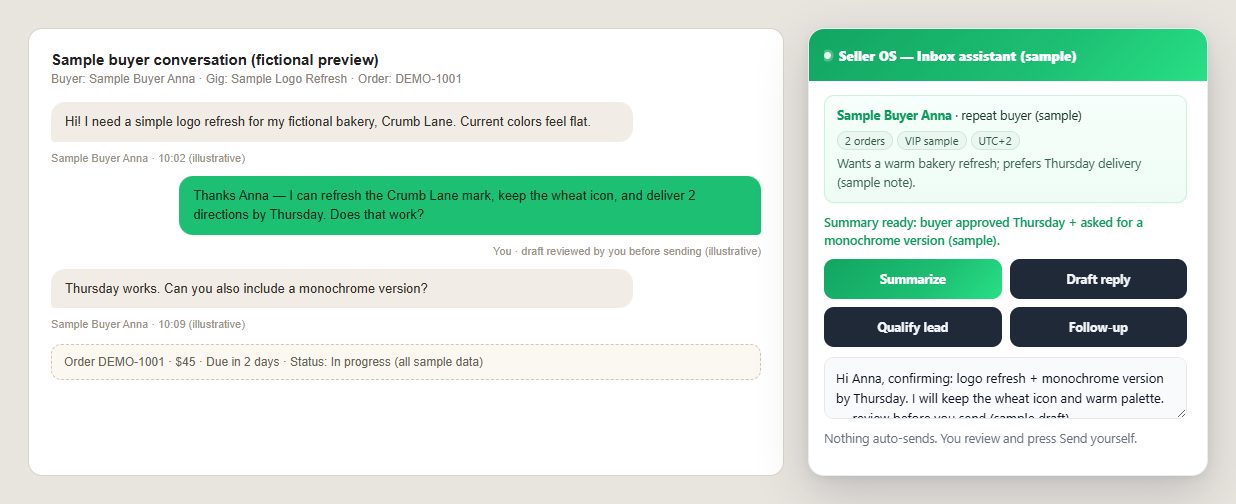
Proposals are writing under a clock, which is the situation Seller OS is built for. The inbox assistant drafts a proposal from the brief or Mira message, your gig details, and local client history, then hands it to you beside the original request so the mirroring line is written from the buyer's own words.
Reply structures and client notes stay in one place, so the second version of a proposal takes a fraction of the time the first one did. Nothing sends without you: every draft is editable and every final Send is a human action. The tool shortens the blank page; it does not promise the project.
How to Write a Fiverr Proposal questions
What is the difference between a Fiverr proposal and a custom offer?
The proposal is the message that argues your case: what you understood, what you have done, and how you would approach the work. The custom offer is the structured transaction Fiverr turns into an order, with price, delivery date, and revisions in fields. The strongest replies use both, with matching numbers.
How long should a Fiverr proposal be?
One screen: a mirroring line, one proof point, a short plan with dates, a sentence of price logic, and a closing question. Length reads as effort mainly to the sender. The buyer is scanning for evidence that you understood the request, and every sentence that does not carry evidence slows that scan down.
Can I send a proposal to a Fiverr buyer directly?
You cannot initiate contact with new clients on Fiverr; clients must reach out first. Proposals belong in the channels that already connect you: briefs, Mira conversations in your Inbox, and buyers who message you about your gig. Cold outreach inside Fiverr is against the rules.
Should I include the price in my proposal?
Yes, in one sentence with its logic attached. A proposal that hides the number invites the buyer to imagine a worse one, and it wastes the reply you will need later. State what the price includes, and if the budget is smaller, propose a smaller scope instead of discounting the full project.
Write proposals the buyer can answer
Mirror, prove, plan, price, and end with one question they actually want to answer.