 Seller OS
How to write a Fiverr custom offer
A custom offer is two things at once: the structured fields Fiverr turns into an order, and the message around them that makes a buyer comfortable accepting. The fields set price, date, and revisions; the copy explains what the buyer actually gets.
This guide is about that copy. It covers the scoping line, the deliverable list, timeline assumptions, the price sentence, and the closing step, with one complete example offer. Field mechanics and published limits live in their own guide.
Free plan available. Local-first data. Human review on every change.
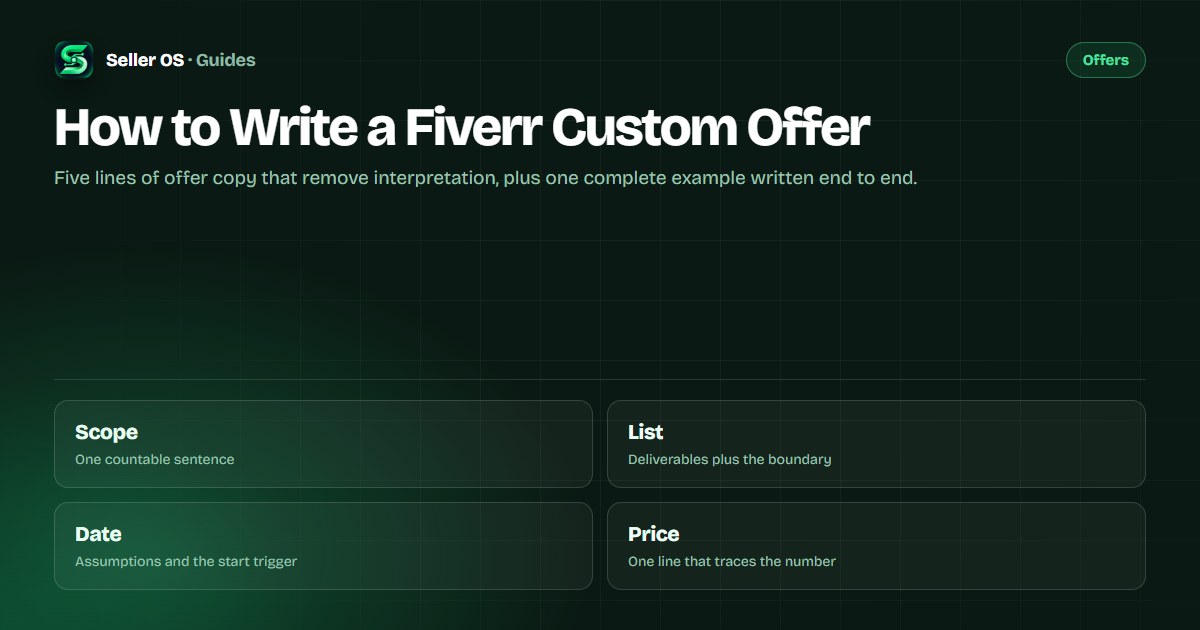
The fields do mechanics; the copy sells
Fiverr's custom offer help page describes offers as a tool for freelancers to provide tailored solutions that may not be covered by standard gigs. The offer travels through the Inbox, and once the client accepts, the order starts automatically, which means every sentence beside the fields becomes part of the commitment.
The fields carry the numbers, and the message carries the reasoning: what is included, what is not, when it arrives, and why the price is what it is. Buyers accept offers they understand, so the copy's job is to remove interpretation rather than to decorate.
“Custom offers are a tool for freelancers to provide tailored solutions that may not be covered by standard Gigs.”
— Fiverr's Help Center, Creating and managing custom offers, September 2026
Line one: the scoping sentence
Your first sentence should let the buyer picture the finished deliverable. It names the thing, the format, and the size in one breath, borrowing the nouns from the buyer's own request so they recognize their project in it.
Weak lines hide behind adjectives; strong lines are countable. The comparison below shows the same project written two ways, and the difference is not style but verifiability: a buyer can check a countable promise when the work arrives.
| Weak line | Strong line | Why it works |
|---|---|---|
| Professional content for your brand. | Five product page drafts for your store, ready to paste. | Countable deliverable, no adjectives |
| A complete design solution tailored to you. | One 10-page brand style guide in PDF and Figma. | Format, length, and artifact named |
| Quality work you will love. | Eight edited product photos at 2000px on white. | The buyer can check the result against the line |
The deliverable list and its boundary
After the scoping line, list what is included as short bullets: the files, the formats, the number of revision rounds, and anything the buyer would otherwise have to ask about. Four to six lines is enough; the list is a contract written in plain language.
The boundary line matters as much as the list. State what the price does not cover, once, without apology: source files, extra formats, additional pages, rush timing. A boundary stated before acceptance is professional scoping; the same boundary stated after delivery is an argument.
- Deliverable — files, format, and length
- Rounds — how many revision passes, and what counts as one
- Inputs — what you need from the buyer before starting
- Boundary — the two or three things the price excludes
- Usage — what the buyer may do with the finished work
Timeline, assumptions, and the date you keep
The delivery date is a field, but the assumptions behind it belong in the message: when the work starts, what you need first, and what happens if the inputs arrive late. Fiverr's fields allow delivery times from 1 to 90 days, so the number should come from your calendar rather than from optimism.
Build the date backward from real capacity. If the project needs three focused days, plan a buffer day on each side before entering the field number, and state the start trigger plainly: the clock begins on acceptance, or on receipt of the assets.
List the inputs you need before work can start
Estimate the focused days the scope actually takes
Add your buffer to the field number, not to the message
State the start trigger: acceptance or asset receipt
The price sentence, in one line
Explaining price is not defending it. One line that traces the number to something real, such as scope, hours, complexity, licensing, or rush, gives the buyer a reason they can repeat to their own boss. 'The price covers three full drafts, two revision rounds, and the extra research for your category' is a reason.
Do not open with a discount. If the budget is the real constraint, change the scope and re-price the smaller version, which is a different conversation from shaving the same work. The price objection guide covers that conversation in detail.
Worked example, hypothetical. A quote of '$600 for the landing page copy' invites haggling. The same money reads differently as '$600 across two milestones: $300 for the copy deck, $300 after the first revision round, with two calls included'. The buyer now sees what each part buys.
A full example offer, start to finish
The project, hypothetical: a buyer messages a copywriter after seeing a landing page gig. They run a scheduling tool, need the page rewritten before a launch in three weeks, and have analytics but no fresh positioning.
The offer message: 'I will rewrite your scheduling tool landing page: hero, three feature sections, a social proof block, and the pricing intro, delivered as a Google Doc with suggested headline variants. I start when you send the current page and any positioning notes, and I need them by Thursday, which puts delivery on the 14th, two days inside your launch buffer. That includes two revision rounds and one 30-minute walkthrough call. The price is $480 for the full page plus the pricing intro. Accept and I will send a short checklist so we start the same day.'
Why it works: one scoping line, a countable list, a start condition, a date with a reason, the revision count, the price, and a next step that happens on acceptance. The buyer can say yes without a single follow-up question, which is the standard to write toward.
Close with one decision, not a novel
End with the decision: accept and the order starts, or reply with a question. Fiverr's fields include an optional expiration date, and setting one creates a decision point; leaving it open means the client can accept whenever they want, which is fine for a warm lead and awkward for booked work. When the thread begins as a brief instead of a conversation, the proposal guide covers the message that comes first.
Short offers win. If the message needs scrolling on a phone, the buyer skims, and skimming is where opportunities go quiet. The most common mistake is writing the message like a sales page, with superlatives and urgency, when the buyer is only asking one thing: what exactly arrives, when, and for how much. Cut every sentence that does not answer it.
Where Seller OS helps
The blank page is the slow part of writing an offer, and Seller OS shortens it: the inbox assistant drafts the offer message from the conversation and your local client records, so the scoping line and the boundary start as an editable draft instead of an assembly job from memory.
The pricing review adds what memory gets wrong. Profit assumptions and a record of recently applied prices sit beside the draft, so the number you type is grounded in your own history. Every draft stops at review; a person presses Send, and a person sets the final price.
How to Write a Fiverr Custom Offer questions
What should a Fiverr custom offer include?
Fiverr's offer fields carry the price, delivery time, revisions, and order type. Your message should carry the rest: a scoping line, a short deliverable list with a boundary, the assumptions behind the timeline, one line of price reasoning, and what happens on acceptance. Fields alone rarely persuade anyone.
How long should the message with a custom offer be?
Short enough to read on a phone in one screen: a scoping line, three to five bullets, a timeline sentence, a price sentence, and the next step. The fields already hold the numbers, so the message does not need to repeat them all. It needs to make the numbers make sense.
Should I set an expiration date on a custom offer?
When the schedule matters, yes. Fiverr lets you set an expiry, and an offer without one can be accepted whenever the client wants, which is fine for a warm lead and awkward for booked work. An expiry creates a decision point, but never invent false urgency to force one.
Can I discount my custom offer?
You can change the price before sending or withdraw and re-issue the offer, but discounting the same scope trains buyers to wait for the next drop. If the budget is the blocker, re-scope the work and attach the lower price to a smaller deliverable. That keeps the number honest and the work deliverable.
Write offers buyers can accept at a glance
Scope it, list it, date it, price it with a reason, and end with one decision.