 Seller OS
Fiverr vs your own website in 2026
Fiverr supplies the parts most sellers struggle to build alone: buyer traffic, a checkout buyers already trust, payment handling, and a review record that follows every gig. Your own website supplies the parts Fiverr never gives you: full control of pricing and presentation, direct client relationships, and a list of past buyers you can reach without an algorithm in between.
This guide compares the two as a build-versus-borrow choice, not a loyalty test. It maps what each side supplies, what each side demands from you, how the cost math differs, and the hybrid setup most working sellers use. It updates the older starting-a-business page with a 2026 lens and stays out of daily client-finding tactics.
Free plan available. Local-first data. Human review on every change.
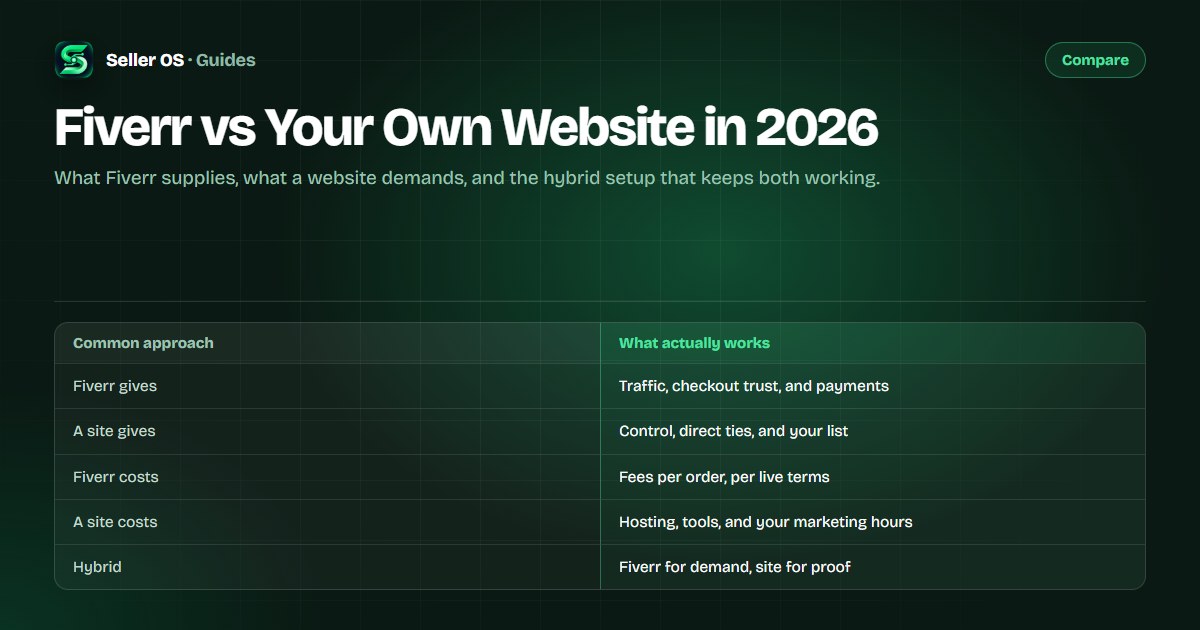
What Fiverr supplies that is hard to replace
Fiverr brings buyers who are already looking to hire. They arrive through search, category pages, and brief matching, compare a short list of gigs, and order inside a checkout they have used before. For a new seller, that intent is the scarcest input, and building it independently takes months of publishing and outreach before the first inquiry lands.
The marketplace also supplies trust infrastructure. Reviews sit next to every gig, payments move through Fiverr rather than invoices you chase, and order rules for delivery, revisions, and cancellations are written down. Fiverr's client guide describes how buyers order, pay, and review through the platform, which is the mechanism your own site would need to recreate.
- Demand: buyers arrive with a project and a budget in mind.
- Trust: reviews, levels, and order history sit beside the offer.
- Payments: checkout, holds, and payouts run through Fiverr systems.
- Rules: delivery, revision, and dispute paths are already defined.
What your own website requires from you
A website reverses the bargain. You keep the full price you set and present your work exactly as you want, but every visitor must be earned. That means one traffic habit you repeat weekly, such as search content, social proof posts, or direct outreach, plus a contact path that turns a visit into a reply within a day.
Operations also move onto your shoulders. You write the proposal, set payment terms, send invoices, follow up on late payments, and handle scope questions without a resolution desk behind you. Sellers who enjoy client work but dislike marketing often find this the heavier half, because the site only pays back after the habit compounds.
How the cost math actually differs
On Fiverr, cost arrives per order through service fees and withdrawal charges, with the exact figures set in the live terms. On your own site, cost arrives per month through hosting, a domain, invoicing tools, and any promotion you buy, plus the unpaid hours you spend finding buyers. One scales with sales and the other runs whether you sell or not.
Read the live fee and payout terms before you compare numbers, since Fiverr adjusts them over time. The fees guide walks through the seller-side deductions, and the older business comparison covers the independence argument this page updates.
| Item | Fiverr | Own website |
|---|---|---|
| Getting buyers | Marketplace search and matching | Your content, outreach, and referrals |
| Checkout trust | Included in the platform | You build with proof and process |
| Money movement | Platform checkout and payouts | Invoices and payment links you manage |
| Fixed monthly cost | Near zero without sales | Hosting and tools run regardless |
| Per-sale cost | Fees per order, per live terms | Processor cut on each invoice |
The hybrid setup most sellers use
Most sellers who add a site keep Fiverr as the demand engine and use the site as proof and backup. The site holds the portfolio, the service pages, and a contact form, and every Fiverr gig links outward only where Fiverr permits while the site links back to the gigs for buyers who prefer marketplace checkout. Neither side is asked to do the whole job.
A workable sequence runs in three passes. First, keep Fiverr as the primary checkout while the site earns its first proof. Then move repeat buyers to direct terms only when they ask and the relationship is steady. Finally, keep one channel that survives the other, so a paused gig or a quiet site month never zeroes your pipeline.
Anchor on Fiverr
keep gigs live while the site holds portfolio and proof
Route proof outward
send curious buyers to case pages, then back to order
Move repeats by request
offer direct terms only to steady return clients
Keep a backup channel
one live path when the other pauses or slows
Which one to start with in 2026
Start with Fiverr when you have no proof and no audience. The first ten reviews teach you what buyers pay for faster than any site analytics will, and the client-without-search guide covers demand you can reach before search notices you. Add the site once repeat questions appear, because those questions become your service pages.
Start with the site when you already bring demand: past clients, an audience, or referrals that ask where to hire you. Even then, a small Fiverr presence can catch overflow and price-sensitive buyers who would never fill a contact form. Revisit the split yearly, since buyer habits and your own capacity both move.
Where Seller OS helps
Seller OS fits the hybrid without taking sides. The gig optimizer reviews live gig copy and conversion signals, the ranking views show which gigs earn their visits, and local client records keep repeat-buyer history on your device so you know which relationships could support direct terms.
Nothing publishes on its own and nothing moves buyers off Fiverr for you. The extension drafts, fills, and tracks locally, and a person completes every Save, Continue, or Publish step. Client notes stay in Chrome local storage.
Fiverr vs Your Own Website in 2026 questions
Should I leave Fiverr for my own website?
Most sellers should not treat it as a switch. Fiverr supplies buyer intent, checkout trust, and payment handling, while a site supplies control and direct relationships at the cost of finding every visitor yourself. Keep Fiverr for demand and build the site as proof and backup, then move only steady repeat work to direct terms.
Which is cheaper, Fiverr fees or running a website?
They charge at different points. Fiverr takes per-order fees set in its live terms, so cost scales with sales. A site charges monthly for hosting, domain, and tools whether you sell or not, plus your marketing hours. Compare them with real numbers: read the live Fiverr terms and add up one year of site and tool costs first.
Can my website and Fiverr gigs help each other?
Yes, when each does its own job. Use the site for portfolio depth, case pages, and a contact path, and use the gigs for discovery and checkout. Link between them only where Fiverr permits, and keep messaging consistent so a buyer who sees both meets the same offer and the same proof twice.
When is the right time to build the site?
Build it once Fiverr starts teaching you something: repeat buyer questions, a service that outsells the rest, or requests for proof you cannot fit in a gig gallery. Those become your first service and case pages. Before that point, your hours usually earn more answering briefs and finishing orders than assembling pages.
Borrow demand, then own the record.
Keep Fiverr earning while your site collects the proof each order creates.