 Seller OS
How to get Fiverr clients without Fiverr search
Most sellers treat search as the whole business: rank the gig, wait for impressions, hope for orders. Search is one discovery channel, and it is not the only one you can build. Buyers also arrive through people who already know your work, referrals from past clients, and content that points back to your gigs.
This guide covers the channels outside search that respect Fiverr's published rules, what each channel actually asks of you, and how to sequence them over a month. It states the boundaries plainly too: promotion can happen anywhere, but the conversation and the order stay on the platform.
Free plan available. Local-first data. Human review on every change.
Why search should not be your only channel
Search positions are a sample of relevance and performance signals, and they shift with every buyer, category, and season. If every order you receive begins with a typed query, then a quiet ranking week becomes a quiet income week, and there is no second channel to fall back on.
This is not an argument against Fiverr's own tools. Gig quality, response habits, and delivered work all feed what buyers and matching see, and those stay the foundation. Building outside channels is about removing the single point of failure, not about ignoring the platform that hosts the order.
- One channel means one point of failure
- Referrals and content bring buyers who arrive with context
- Repeat work needs no discovery channel at all
The rules that shape every off-search channel
Fiverr's order guide is explicit about who starts a conversation: freelancers cannot initiate contact with new clients, and clients must reach out first, either by ordering directly or by sending a message. That single rule shapes every channel in this guide, because none of them may end with you pitching a stranger in the Inbox.
The payment boundary is equally firm. Fiverr's Terms of Service and Community Standards require that services arranged through the platform are ordered and paid for on the platform, so never suggest paying elsewhere and never move an order off it. Promoting a gig is welcome; taking the project offline is a risk to the account you are growing.
“Freelancers cannot initiate contact with new clients. Clients must reach out first, either by placing an order directly or by sending you a message.”
— Fiverr's Help Center, Managing your orders, September 2026
Channel one: people who already know your work
Former colleagues, past employers, classmates, and clients you served before Fiverr already trust your work. They do not need convincing about your ability; they need a link and a reason to act on a project they already have. Your job is to be visible when that project appears.
The boundary is the first message. You can promote a gig anywhere and invite anyone to look at it, but on Fiverr the buyer must open the conversation. Sharing a link is promotion; chasing contacts inside Fiverr's messaging is not allowed.
Write the list
twenty people from past jobs, clients, and classes who know your work
Share the link
send your gig where you already talk with them, with no pitch attached
Let them start
the buyer opens the conversation on Fiverr, and you answer it well
Log the source
note who came from where, so the next ask is easier than the first
Channel two: referrals from happy buyers
A referral is the cheapest lead you will ever get, because someone else did the persuading. The mechanics are unglamorous: deliver well, ask at the right moment, and make the introduction easy enough to forward.
Ask after the order is accepted and the work has proven itself, never mid-delivery. Hand the buyer words they can pass along: one line about who you help and what you deliver, plus your gig link. Hypothetical example: a seller asks a satisfied buyer to forward the gig to one colleague who runs a newsletter. One forwarded link is the entire ask.
Keep a record of who introduced whom. The people who have already referred once are the easiest to ask again, and the note takes ten seconds when it is written down at the moment it happens.
- Ask after acceptance, never mid-delivery
- Hand the buyer one sentence and a link to forward
- Log the source so you can thank and re-ask later
Channel three: content that points back to you
Content does not need an audience to start. A portfolio page, a short case study, or a post that shows one finished project can keep your gig link working while you sleep. The rule for every piece is the same: useful first, link second.
Keep the split clean. Fiverr-facing text such as a profile or gig description has its own content rules, so contact details and payment information stay out of it. Your website or social profile is where the link lives; the gig receives the buyer with nothing extra attached.
One finished example beats ten promises. Take a project you can describe honestly, state the problem and what you delivered, and close with a single line pointing at the service. People share content that taught them something, not content that advertised at them.
- A portfolio page you own and keep current
- One case study per service, with the result stated plainly
- Short posts that answer questions your buyers ask
A four-week sequence for non-search channels
Channels fail when you try all of them in one frantic afternoon. Sequence them instead: one focus per week, with a concrete check at the end of each. Four weeks is enough to see which channel produces a conversation, and which one deserves the next month.
Treat the table as an example to adapt, not a schedule that matches every category. A seller with deep past-teams contacts starts with the network; a seller with strong visual work may start with the case study.
| Week | Focus | End-of-week check |
|---|---|---|
| 1 | List and contact people who know your work | Messages sent and replies received |
| 2 | Ask two recent buyers for one introduction each | Introductions promised |
| 3 | Publish one case study with your gig link | Visits or questions it produced |
| 4 | Join two communities and answer questions | Conversations started, not links posted |
Mistakes that break the rules or waste the week
The expensive mistake is treating a channel as a permission slip. Asking a Fiverr contact to pay you directly, hinting at a discount for working off-platform, or sending unsolicited pitches to buyers are all ways to damage the account you are trying to grow.
The quieter mistakes cost time rather than safety. Mass-posting your link in communities that never asked for it, counting likes on a post as demand, and asking for a referral before the work has proven itself all create motion without conversations.
Leave one habit for last: never promise a specific result to earn an introduction. A referral built on an exaggeration creates an order you cannot satisfy, and the trust you spent does not come back.
Where Seller OS helps
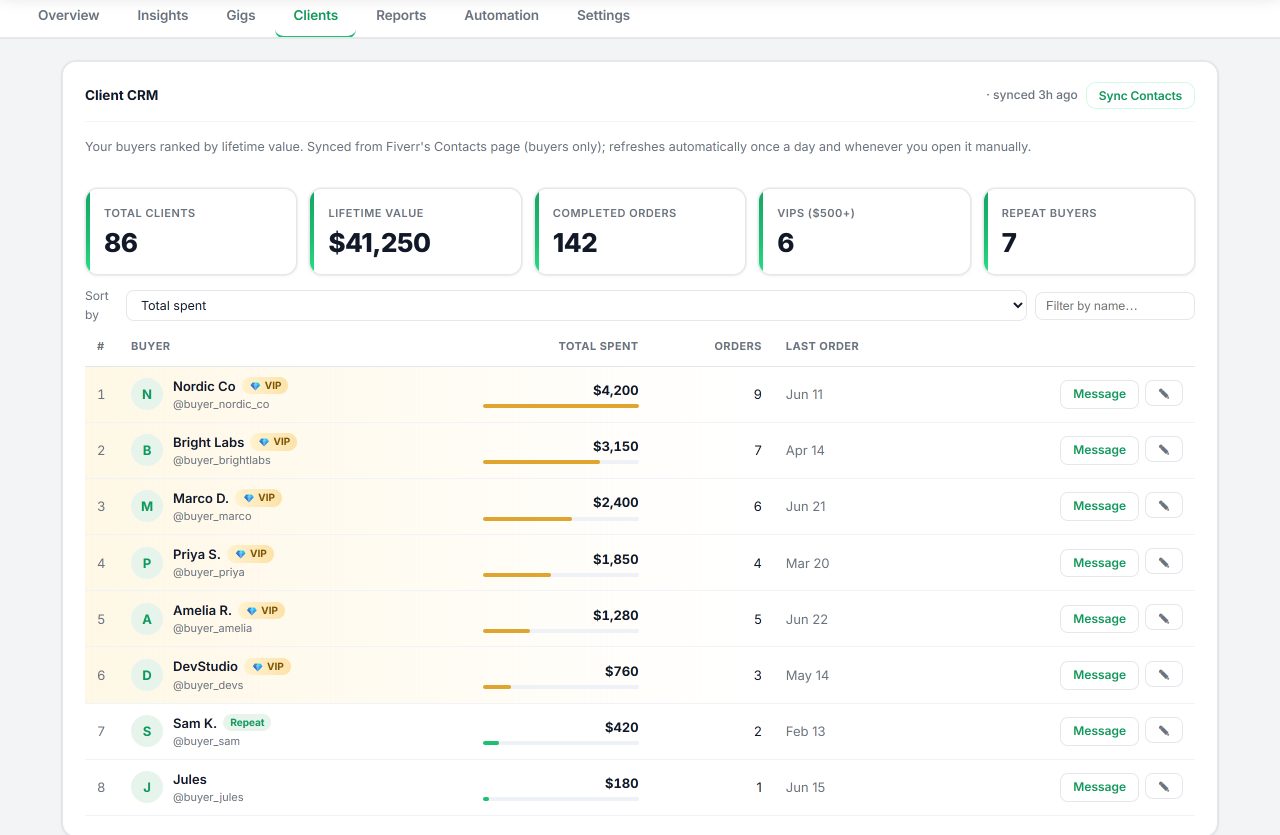
The channels above all depend on the same asset: your client history. Seller OS keeps local client records with notes and history, so the people who already know your work become a list you can see instead of a memory you have to trust. Re-engagement drafts help you write to a dormant buyer without starting from a blank message.
When a referred buyer does arrive, the inbox assistant drafts a reply from the message and your records, and you review and edit every draft before sending. It does not send messages, post for you, or make anyone reach out; it keeps the record and shortens the blank page. Everything stays in Chrome local storage.
How to Get Fiverr Clients Without Fiverr Search questions
Can I message people on Fiverr to offer my services?
No. Fiverr's order guide states that freelancers cannot initiate contact with new clients and that clients must reach out first, either by ordering or by sending a message. Sharing your gig link where you already talk with people is different from pitching strangers in Fiverr's inbox, which the rules do not permit.
Can I work with a client outside Fiverr?
No. Fiverr's terms require that services arranged through the platform are ordered and paid for on the platform, and moving an order off it puts your account at risk. Promote your gig wherever you like, but once a buyer arrives, the order belongs on Fiverr.
How do I bring clients I already have onto Fiverr?
Share your gig link where you already talk with them, describe the service in one line, and let them open the order page themselves. Buyers who reach out through Fiverr start the relationship correctly, and their completed orders count toward your history like any other.
How long does it take for off-search channels to produce orders?
There is no honest timeline to promise, and no channel guarantees an order. Some referrals convert in days because trust already exists; content and communities usually take longer. Measure conversations, not clicks, and give each channel a month of consistent effort before deciding whether it works for you.
Bring buyers in, keep the order here
Promote where trust already exists, then let buyers start the conversation on Fiverr.