 Seller OS
How to turn a one-time Fiverr client into a repeat client
Repeat clients are rarely won by a campaign. They are won in the hours around one order: the delivery message that frames the result, the close-out question that finds the next need, the specific next step you name, and a single follow-up that does not nag.
This guide walks that sequence with a worked message example and a cadence table you can adapt. It stays on the message side of the work; subscription and coupon mechanics live in their own guide.
Free plan available. Local-first data. Human review on every change.
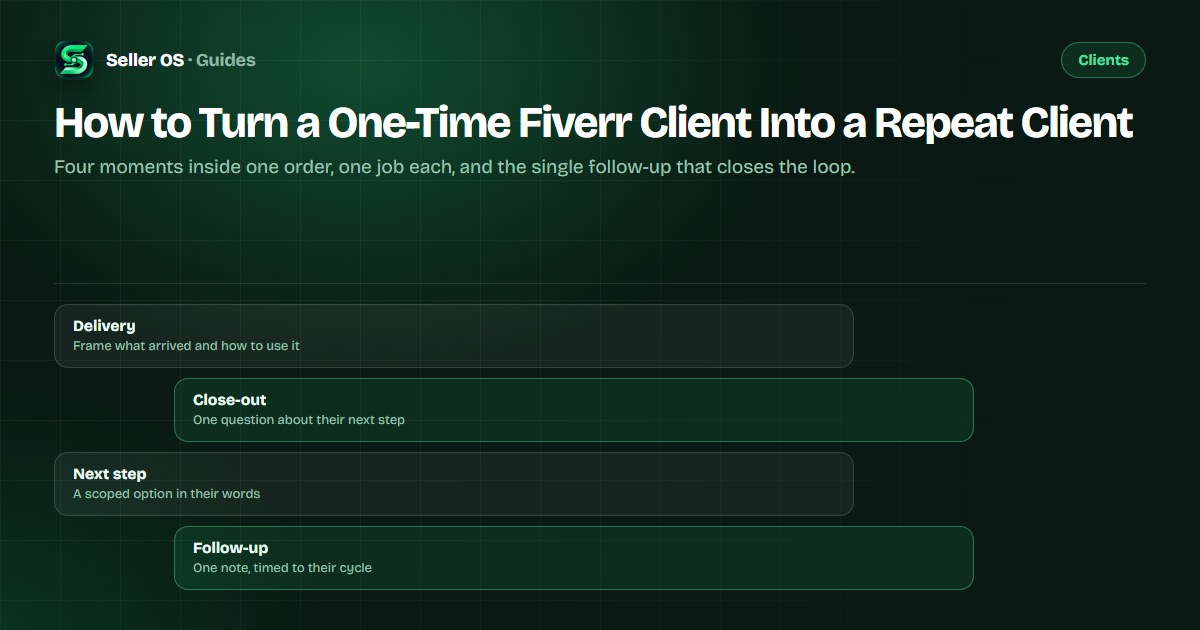
Where repeat business is decided
Trust peaks twice in an order: when the delivery lands and the buyer sees the work, and when the order is accepted and the transaction closes cleanly. Those two moments are worth more than any month-later discount message, because the buyer's attention is already on the project.
The playbook covers four moments inside and just after one order. Each has a single job, and none of them is to sell a subscription or a coupon; those are structures for later. Here the job is to make the next conversation natural, without pressure and without a funnel.
| Moment | What you send | What it must not do |
|---|---|---|
| Delivery | What is inside and how to use it | Ask for anything yet |
| Close-out | One question about what comes next | Pitch a full package |
| Next-step offer | A scoped option tied to their answer | Discount the first price |
| Follow-up | One short note, weeks later | Repeat the same ask twice |
The delivery message that sets it up
A delivery message is documentation, not a pitch. Name the files, the formats, and how to use them, plus the one detail you changed based on their feedback. Keep it short enough to read on a phone before opening the attachment.
Worked example, hypothetical. Instead of a bare 'here is the final version', the message reads: 'Your three social clips are attached as MP4 files with captions burned in. I kept the opening two seconds from your original footage as you asked, and clip two now ends on the product shot. Everything is ready to post.' The buyer knows what arrived and what to check.
Nothing in that message asks for another order. The ask belongs to the moments that follow, once the buyer confirms the work is right, and a delivery note that mixes in a sales line dilutes both jobs at once.
The close-out question that finds the need
Once the order is accepted, the buyer is at their most satisfied and most clear about what the work is for. A single question can surface the next project without sounding like a funnel.
Ask about their plan, not your availability. 'What is the next piece you are publishing with these clips?' earns a real answer you can act on. 'Let me know if you need anything else' earns a polite nothing, because it hands the buyer the work of inventing the request.
- Ask about the next step in their project, not your calendar
- One question per message, and never inside the delivery note
- Write the answer down, in their words, where you record clients
- If the answer is not yet, stop and schedule the follow-up
The next-step offer tied to their answer
A repeat client buys the next version of the same result, so the offer should name that result in their language. If the clips are for a product launch, the next step might be a launch-week batch or a longer cut; if the answer mentioned a monthly series, the next step is a monthly scope.
Worked example, hypothetical: the buyer says they post every month. The reply names one recurring unit, 'four clips a month from your existing footage, captions included, delivered in the first week', with a price for the unit and no discount. It is a small, legible commitment rather than an open-ended retainer.
When the answer calls for a genuine one-off, send a custom offer and keep the same shape: scope, date, price. The custom offer guide covers that copy; the point here is that a repeat client should never have to design the repeat scope for you.
One follow-up, timed to their cycle
If the close-out answer was 'not yet', or there was no answer at all, exactly one follow-up earns its place. Send it when it can be useful: tied to their season, their launch, or a time they named themselves.
The cadence below is an example, not a rule. The discipline is what matters: one follow-up, a real reason to send it, and a full stop if it goes unanswered. A second and third nudge do not add information; they subtract from the relationship you are trying to build.
| When | What you send | If there is no reply |
|---|---|---|
| Day 0 | Delivery message with usage notes | Wait for acceptance |
| Day 1 to 3 | Close-out question about their next step | Keep working on other orders |
| Same week | Next-step offer when they name a need | Let the offer stand |
| Three to six weeks later | One note tied to their cycle or season | Stop; do not send again |
Make the sequence sound like you
The sequence fails when it reads like a sequence. Use the buyer's own words from the brief and the order messages, mention the actual file names, and reference the specific feedback they gave. Personal detail is the difference between a follow-up and a form letter.
Match your energy to theirs. A short, warm thread stays short and warm; a formal corporate buyer gets complete sentences and no exclamation marks. Mirroring tone is not manipulation; it is the same professional courtesy as spelling their name correctly.
One more habit keeps the sequence honest: if the work did not go well, fix that before you ask for more. A repeat order offered while a revision is still open reads as opportunism, and the note in the delivery message should resolve the problem first.
Mistakes that turn clients into one-timers
The first mistake is bundling asks. A delivery message that also requests a review, a referral, and the next order reads like a checkout aisle and gets ignored. One moment, one ask, every time.
The second is offering a discount before the buyer has shown any hesitation. It prices the repeat work below the first order and teaches the buyer that patience pays. The third is following up forever; after one unanswered note, silence is the professional move, and your records keep the door open.
The fourth is assuming silence means disinterest. Many buyers return months later with the same project need, and the seller who kept clean notes and stayed out of the Inbox is the one who gets the message when the budget appears.
Where Seller OS helps
All four moments depend on remembering what was said. Seller OS keeps local client records with notes and history, so the answer to your close-out question is saved with the order, not buried in a message thread you have to re-read months later.
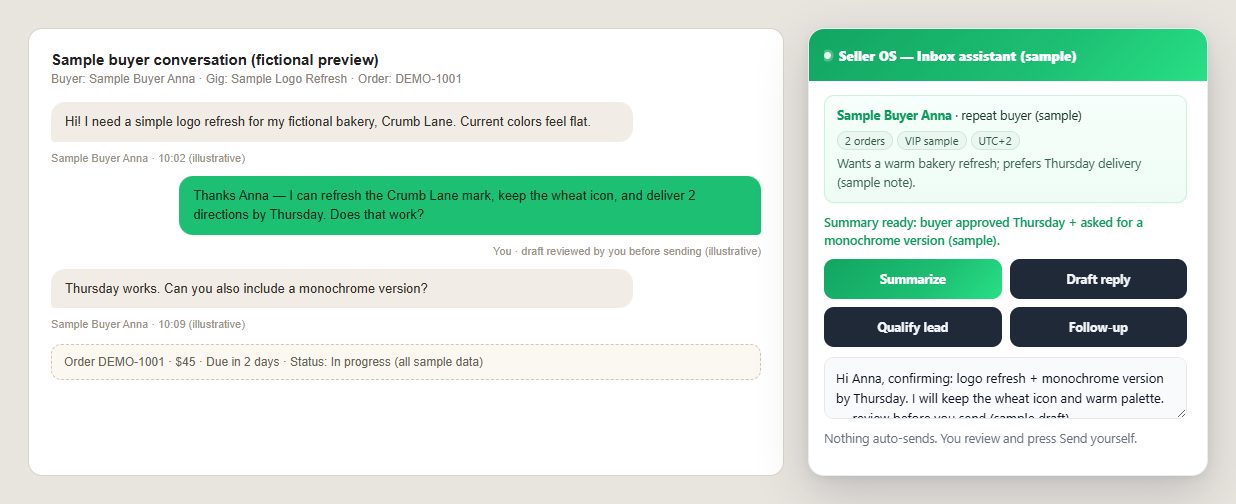
The inbox assistant drafts the delivery note and the follow-up from that history, and you edit the wording before pressing Send yourself. Re-engagement drafts are the same sequence for dormant buyers. Nothing here guarantees a return order, and nothing sends on its own.
How to Turn a One-Time Fiverr Client Into a Repeat Client questions
When should I ask a Fiverr client to order again?
After the order is accepted and the buyer has confirmed the work, not during delivery. That is when their confidence is highest and their next step is clearest. If the answer they give is not yet, a single follow-up weeks later, tied to their own cycle, is the professional limit.
How many follow-ups are too many?
One unanswered follow-up is the practical limit, unless the buyer named a specific time to return. More than that turns a client relationship into an interruption, and messages sent after silence rarely change the outcome. Keep the notes instead, and stay ready for the day the project comes back.
Should I offer a returning Fiverr client a discount?
Only when it buys a decision you actually want. A discount on the repeat order prices the second project below the first and can become the expectation. If you use one, make it time-bound and treat it as a decision tool rather than a thank-you note.
What if the buyer never replies?
Most silence is timing, not rejection. Deliver the order well, send the single follow-up if it has a real reason, and then stop. Keep their brief, their preferences, and the delivered files in your records so that when they return, the next order starts faster than the first one did.
Win the next order at delivery
Use the delivery note, the close-out question, and one careful follow-up to make the repeat decision easy.