 Seller OS
How to get more orders on Fiverr
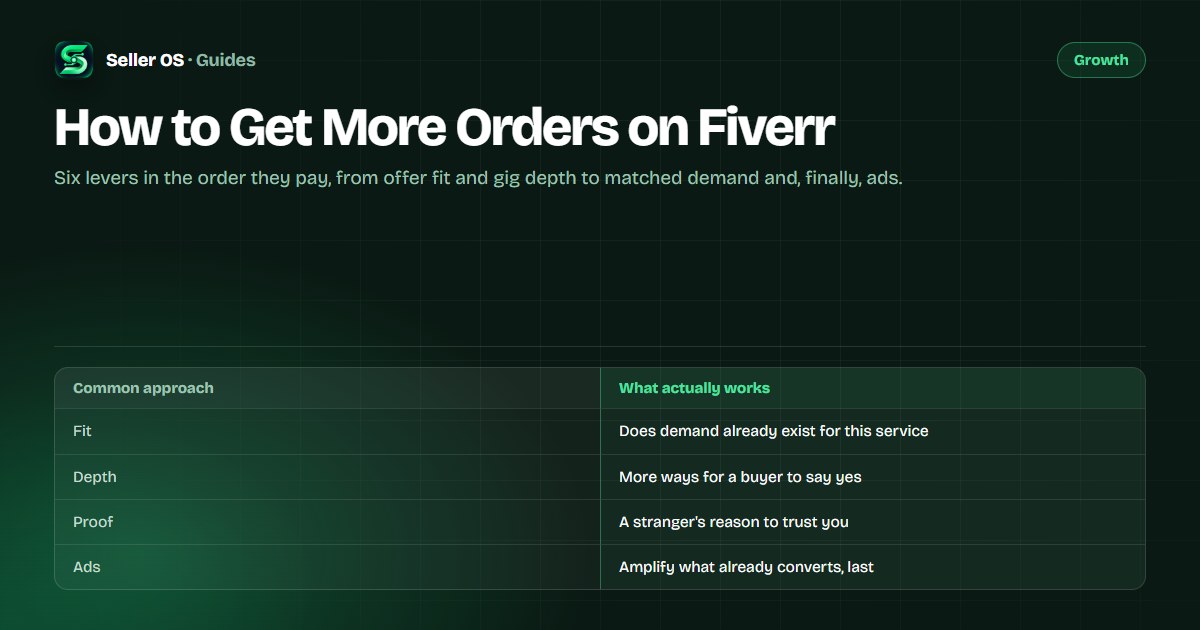
More orders rarely come from one change. They come from a stack of levers, and the order you pull them decides whether each one pays. The first levers make your offer worth finding; the last lever buys attention for an offer that already works.
This guide walks the stack in priority order with concrete examples: offer-market fit, gig depth, proof, briefs and offers, repeat business, and Fiverr Ads last. No guarantees, and no backwards order.
Free plan available. Local-first data. Human review on every change.
Why the order of your growth levers matters
A lever is anything that can change how many buyers find you and how many of them order. They are not equal: some change whether the offer fits the market, and some only change how many people see it. Pulling visibility levers before fit levers pays to advertise a gig buyers do not want.
The sequence below runs from the most fundamental to the most expendable. Work down the list, and when a lever needs time to show its effect, give it that time instead of jumping ahead to the next one.
| Lever | What it changes | Pull it when |
|---|---|---|
| Offer-market fit | Whether anyone wants this service from you | Any gig is quiet for weeks |
| Gig depth | How many ways buyers can say yes | One package carries all the work |
| Proof | How risky you look to a stranger | Clicks arrive but orders do not |
| Briefs and offers | Whether matched demand converts | Conversations stall before checkout |
| Repeat work | How much demand you replace monthly | Every month starts from zero |
| Fiverr Ads | How many buyers see what works | Conversions are stable and margin allows |
Lever one: make the offer fit the market
Fit means three things line up: buyers search for the service, you can deliver it well, and the price sits inside the range that demand already pays. A gig can be excellent and still sell nothing when it answers a question few buyers in your category ask.
The fix is usually narrowing, not adding. Worked example, hypothetical: a seller offers generic video editing and stays quiet, then rewrites the gig around talking-head YouTube editing with captions for ten to twenty minute videos. That is a service buyers search for by name and a scope the seller can price with confidence. Same skills, a legible offer.
- Name the service the way buyers type it
- Match the format and length buyers already ask for
- Price inside the range that demand pays
- Keep the scope narrow enough to deliver reliably
Lever two: give each gig more depth
One package at one price asks every buyer to accept the same scope. Depth means more than a price ladder: it is the set of ways a buyer can start, from a small first order to a full project, plus extras that cover the requests you already answer in messages.
Fiverr's published level table caps active gigs at 4 for a New freelancer and 10 at Levels 1 and 2, so adding more gigs has a ceiling. Depth inside a gig does not. Three clear tiers beat five overlapping ones, and extras should come from real requests rather than imagination.
Tier one
the smallest useful version of the service, priced so a cautious buyer can start
Tier two
the common case, complete enough to need one revision round
Tier three
the full scope, with the extra files and rounds buyers ask about
Extras
the two or three repeated requests from your inbox, priced once and clearly
Lever three: build proof a stranger believes
Proof answers one question: has this seller done this before, with results a buyer can see? Reviews help, but you cannot manufacture them, and inventing them breaks both the rules and the trust you are building. What you control is the work you show and how plainly you describe it.
If your order history is thin, build proof from process: a sample deliverable in the buyer's format, a before-and-after with the reasoning, a short walkthrough of a practice project. Label practice work as practice. Buyers forgive a new seller; they do not forgive a vague one.
Keep each piece close to the sale. Proof that matches the package being sold reduces the specific risk the buyer is weighing, while an unrelated showreel only proves that you own software.
- Samples that match the package being sold
- Before and after, with the decision that caused the change
- Process notes that show how you work, not just what you made
- Honest labels: practice work is practice work
Lever four: convert matched demand
Some demand is handed to you. Fiverr's brief flow was replaced by Mira for sellers, and both exist to match client projects with relevant freelancers. Whatever arrives through matching still has to be converted with a fast, specific response instead of a generic pitch.
The second half of this lever is the custom offer. Fiverr describes custom offers as a way to provide tailored solutions that standard gigs do not cover, and the order starts automatically once a client accepts. A matched message without a scoped offer is a conversation with no path to checkout.
Response timing belongs to this lever, not to a separate habit. Fiverr says to answer a Mira first message within 24 hours, and response rate is measured as first replies within 24 hours across 90 days, with level thresholds of 80% and 90%.
Lever five: keep the buyers you earn
Every repeat order is a sale you do not have to find again. A buyer who already trusts your work costs nothing to re-acquire, and their next order counts in your history and metrics exactly like a new one.
The mechanisms that produce repeat orders have their own guides, because the details matter more than the sentiment: subscriptions for recurring scopes in eligible categories, package design for work that renews, and one careful follow-up after delivery. Treat repeat work as the fifth growth lever, not the first thing to fix on a quiet week.
- Subscriptions fit work that renews on a schedule
- Packages should describe the repeating unit, not just the one-off
- One well-timed follow-up beats a monthly newsletter of nudges
Lever six: Fiverr Ads, last and never first
Fiverr Ads is an auction product: Fiverr's Fiverr Ads article describes a first-price auction where placement depends on ad quality and your bid, and you pay per click rather than per impression. Only active gigs are eligible, Fiverr lists Level 1, Level 2, Top Rated, and Pro sellers as eligible accounts, and some financial and legal consulting services are excluded.
That mechanics set tells you when ads pay: when a gig already converts and the margin covers the clicks. Ads cannot fix a fit problem, and they multiply whatever the page does, including a weak conversion rate. The most common mistake is switching ads on before the earlier levers are stable, then reading the spend as proof that ads do not work.
Worked example, hypothetical. A gig receives 300 impressions and converts two orders a month from steady search traffic. A seller turns on ads and buys 200 extra clicks. If the page converts, orders rise roughly with spend; if it does not, those clicks were rent. The pre-check is one question: are people who already see the gig ordering?
“With Fiverr Ads, you can push your services to prime locations in Fiverr's search results, category pages, and other pages across the platform.”
— Fiverr's Help Center, Fiverr Ads, September 2026
Where Seller OS helps
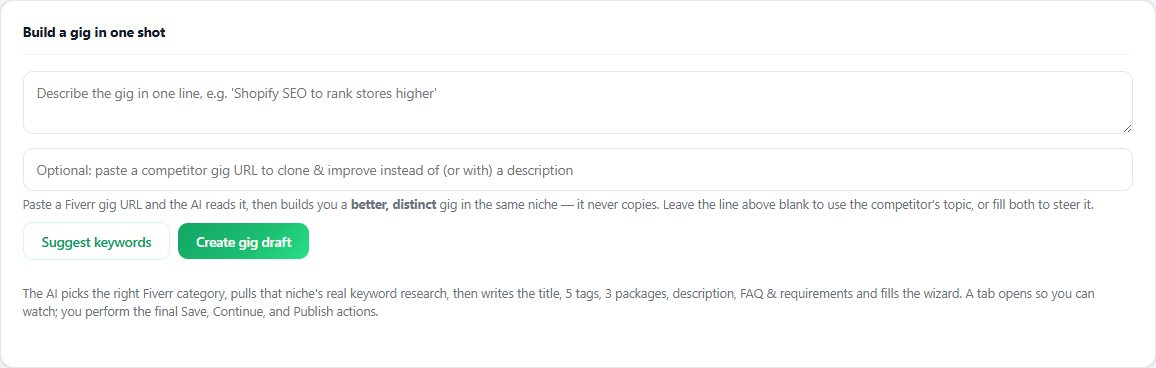
The stack above is mostly editing work, and Seller OS shortens the blank-page part. The Gig Builder turns a one-line service idea into a structured gig with a description, packages, and extras, and fills the Fiverr wizard, while you keep control: a person performs every Save, Continue, and Publish.
The Gig Performance Optimizer reviews a live gig's copy, gallery, and conversion signals against its own performance data and proposes changes, which is how you work the fit and depth levers without guessing. It does not buy ads, change prices silently, or promise orders; it drafts and proposes, and you decide.
How to Get More Orders on Fiverr questions
What is the fastest way to get more Fiverr orders?
There is no single switch, but fit moves first: make sure buyers search for the service, that you can deliver it well, and that the price sits in the range demand pays. Visibility tools like ads amplify whatever your gig already does, so they pay last, not first.
Should I lower my prices to get orders?
A lower price can win an order and lose the margin that keeps you delivering well, so treat it as a scope decision instead. Offer a smaller tier at a lower price rather than discounting the same work, and judge the change on earnings over time, not on order count alone.
Do Fiverr Ads bring more orders?
They can, within published mechanics: an auction where you pay per click and placement depends on ad quality and your bid. Ads work best when a gig already converts, because the click is rented and the sale is not. Fiverr does not publish an average cost per click or a guaranteed result.
How many gigs should I have?
Fiverr's published limits allow 4 active gigs for a New freelancer and 10 at Levels 1 and 2. The useful number is usually smaller: each gig should have a distinct service and its own packages. Three deep gigs beat ten thin ones, and depth inside one gig has no ceiling.
Work the stack from the bottom
Fix fit and depth first, convert matched demand next, keep the buyers you earn, and only then buy attention.