 Seller OS
Fiverr Ads vs organic search: which one should you run?
Fiverr Ads and organic search deliver the same thing through different economics. One is an auction you pay for per click; the other is placement earned through Fiverr's search and recommendation system. Neither is a promise of orders, and the useful question is which one your gig needs next.
This guide gives each channel its honest job: what it buys, what it cannot guarantee, the margin math on a hypothetical example, and the scenarios that point to paid placement versus the ones where fixing the organic listing wins first.
Free plan available. Local-first data. Human review on every change.
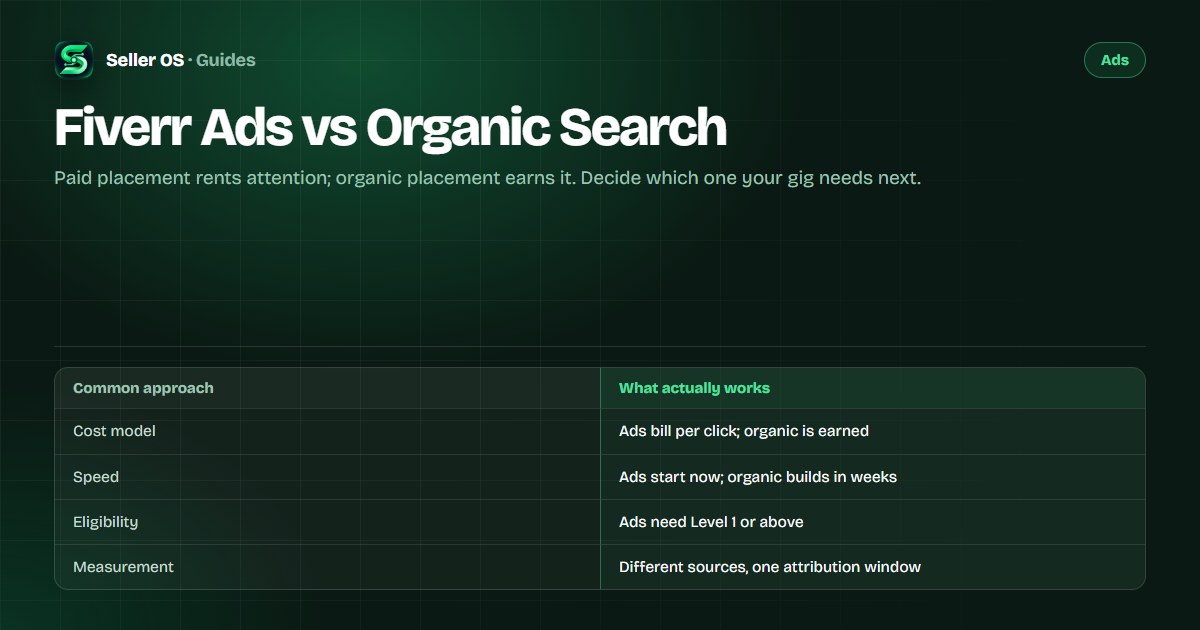
What each channel actually buys you
Fiverr Ads buys placement. An auction decides where your gig appears, based on ad quality and your bid, and you are charged only when someone clicks, as Fiverr's Help Center explains in its ads article. Organic search buys nothing directly; your position is earned inside Fiverr's search and recommendation system, and it changes with every search.
The table below is the short version. Read the eligibility row first, because it decides whether this comparison is even available to you: Fiverr lists ad eligibility as Level 1, Level 2, Top Rated, and Pro freelancers, with only active gigs eligible to advertise.
| Question | Fiverr Ads | Organic search |
|---|---|---|
| How you get it | Auction: ad quality plus bid | Earned in Fiverr's search system |
| What it costs | Per click, billed monthly | Time, relevance, and quality |
| Who qualifies | Level 1 and above, active gigs | Every published gig |
| Speed | Placement starts when you launch | Builds over weeks |
| Promises | Placement while you pay | No placement promise at all |
Scenario: when ads are the right spend
Ads are a multiplier, so they make sense when there is something worth multiplying: a listing that already converts, a demand spike you want to meet now, or a package you need to test with real buyers. Note the eligibility catch — a seller below Level 1 cannot advertise, so a brand-new account builds organically first by necessity, not preference.
Scenario, hypothetical: a Level 2 seller has a gig converting steadily but sitting on page two for its main phrase. Organic work is underway, and the seller wants orders this month. A small budget buys visibility now while the organic effort compounds — two tracks, two different jobs, one listing.
The pattern behind all three uses is the same: the listing already works, and the budget simply widens the doorway it stands in. That is the test to apply before any spend: if the gig could not convert a warm visitor, paid traffic will only make the failure more expensive.
- A converting listing with weak visibility: ads buy attention the card can already use.
- A seasonal window: demand arrives on a calendar, and ads can arrive with it.
- A new package on an established gig: paid traffic tests the offer before organic fields change.
The margin math, explained with an example
Ads only pay when an order earns more than the clicks that produced it. Fiverr pays sellers 80 percent of the purchase amount, including gig extras and tips, so a $60 order puts $48 into your earnings before your own costs. If the click path to that order cost $12, the order contributed $36; at $40, it contributed $8.
Those numbers are hypothetical, and deliberately so: Fiverr publishes no average cost per click and no typical conversion figures, and any benchmark you read elsewhere is someone else's arithmetic. Your ceiling for cost per order comes from your own margin, and the work is finding out whether the auction can meet it.
Scenario: when fixing organic wins first
If the listing does not convert, ads fund a leak. Paying per click to send buyers to a card that cannot close them turns a conversion problem into a conversion problem with a bill attached. Fix the card — image, title, price shown, package clarity — and prove the fix with organic clicks before buying more.
Organic also wins when the constraint is relevance rather than attention. If the gig never appears for the phrases it should own, no ad budget repairs that; the fields, tags, and description need work first, and there is a full guide for ranking a Fiverr gig. Ads amplify a working listing; they do not fix a broken one.
Running both without fooling yourself
Attribution is where channel comparisons go wrong. Fiverr attributes an order to an ad within a 30-day window from the last click, using a user-level model, which means a click on one gig and an order on another can still be attributed together. Multiple clicks from the same user count once, so the window is wider than the click count suggests.
Keep experiments separate. Change organic fields and launch an ad in the same week, and no result belongs to either decision. If you have Seller Plus, the Orders breakdown tab lists order sources — organic traffic, Fiverr Ads, coupons, briefs, Fiverr's Choice, and Pro — with a funnel view for organic and ad traffic; the Fiverr analytics guide maps that tab in context.
Five questions before you spend a cent
Run this checklist before committing a budget. It takes five minutes and prevents the most expensive mistake in this comparison: paying for traffic that a listing cannot turn into orders, which makes every later number harder to read.
Does the gig convert?
if clicks rarely become orders, fix the listing first.
Are you eligible?
Fiverr Ads open at Level 1 and above, on active gigs.
Can you afford a full test?
two weeks of a daily limit you will not miss.
What is one order worth?
derive a maximum cost per order from your margin.
What will you leave alone?
name the fields and settings the test will not touch.
Mistakes that blur the comparison
The first mistake is treating ads as an organic rank boost. Fiverr does not publish a link between ad performance and organic ranking, and the ad itself is labeled. The second is judging ads on clicks: clicks are the middle of the funnel, and a cheap click that never orders is the most expensive thing you can buy.
The third is stopping ads and rewriting fields in the same week, which produces two changes and zero conclusions. The fourth is assuming organic is free; it costs time, tests, and patience, and it is the only channel that keeps working after the budget stops.
If you want the operating loop for the paid side, How to optimize Fiverr Ads covers window planning, kill rules, and scaling without invented benchmarks.
Where Seller OS helps
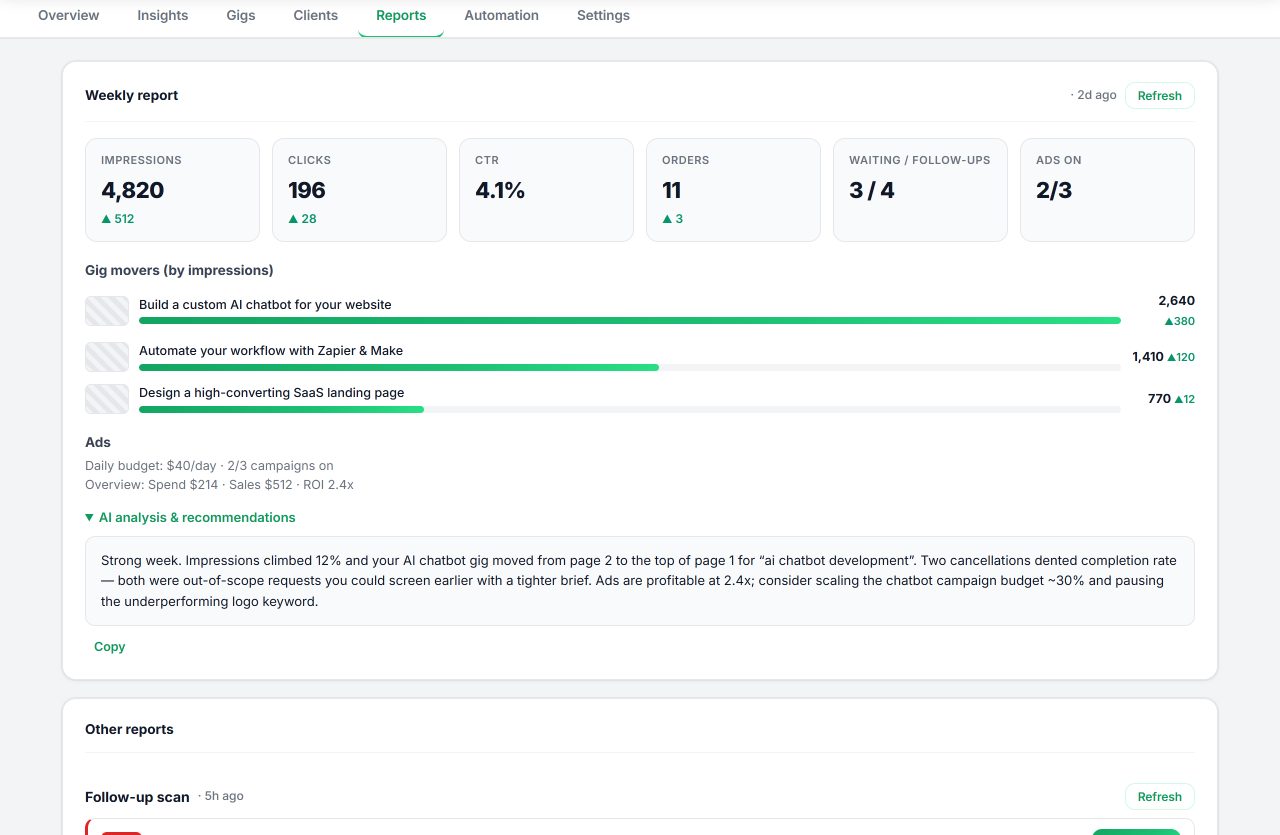
Seller OS does not run your ads; it keeps the comparison honest. Tracked gig numbers and reports assemble your own readings into periods, so the week ads ran and the week you changed a title stop blurring into memory, while the rank tracker follows organic positions for the phrases you care about.
The limit is deliberate: it cannot see Fiverr's ad platform or your ad spend, it manages no bids or budgets, and it never changes anything on Fiverr. It records what you did and when, locally in Chrome, so channel decisions rest on evidence you kept rather than the last number you happened to look at.
Fiverr Ads vs Organic Search questions
Are Fiverr Ads worth it?
They can be, when the listing converts and the cost per order fits the order's margin. Ads buy placement and clicks, not orders, and Fiverr publishes no benchmarks to compare against. If the gig is not converting organically, the honest order of operations is to fix the listing first, then start ads once the card proves it can close.
Do Fiverr Ads help organic ranking?
Fiverr does not publish that ad performance affects organic ranking, and promoted listings are marked with an ad badge. One related statement is official: Fiverr says that when clients hide an ad they find irrelevant, hiding it will not affect your organic rating. Treat ads and organic as separate channels with separate results.
Should I run Fiverr Ads on a brand-new gig?
You cannot if you are below Level 1, because Fiverr lists ad eligibility as Level 1, Level 2, Top Rated, and Pro freelancers. Even once eligible, a new listing usually benefits more from organic work first, because ads amplify conversion rather than create it. Prove the gig can close buyers, then buy attention.
How do I know whether an order came from ads or organic search?
Fiverr attributes orders to ads within a 30-day window from the last click, and Seller Plus members can see order sources in the Orders breakdown tab. Without Seller Plus, keep a dated log of when ads ran and compare the same window's order count with your non-ad weeks.
Rent attention, or earn it — decide with numbers.
Check the gig's conversion first, set a cost per order from your margin, then choose the channel.