 Seller OS
Fiverr Promotions explained for sellers
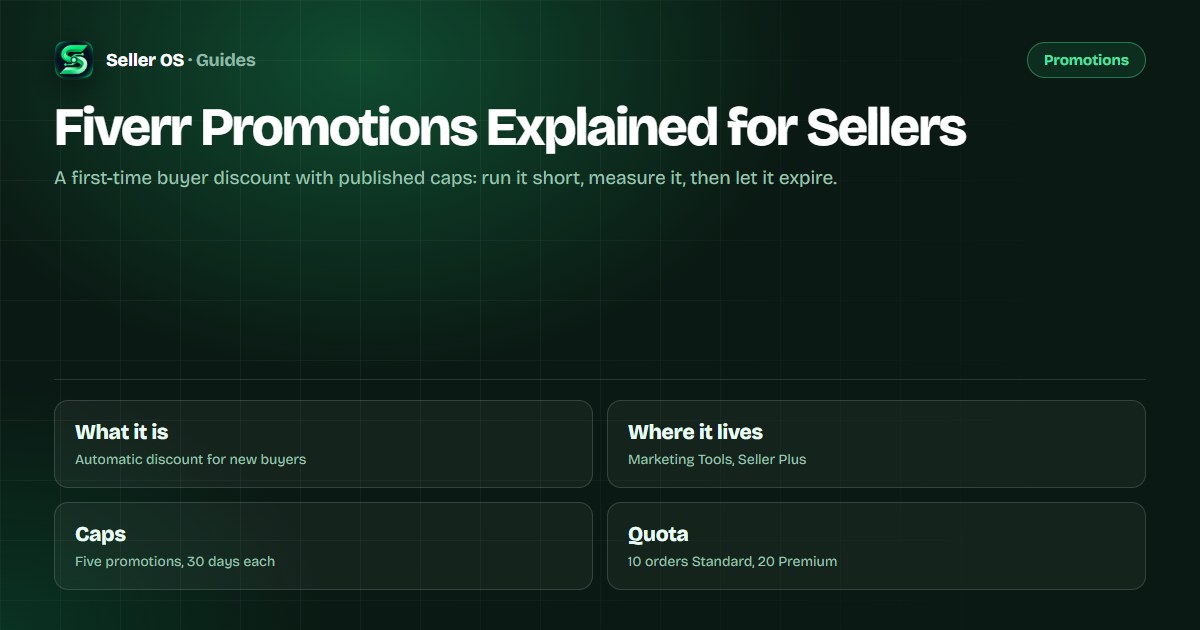
Fiverr Promotions is the first-time client discount tool: an automatic discount for buyers who have never ordered from you. Fiverr's help center describes it that way and publishes real limits, including five active promotions, a 30-day maximum run, and a monthly order quota that depends on your Seller Plus tier.
This guide covers the published rules, where the tool lives, how to run a promotion without teaching buyers to wait for discounts, and how to measure whether the discount paid. It also untangles the name from Promoted Gigs.
Free plan available. Local-first data. Human review on every change.
What the Promotions feature actually is
Promotions is Fiverr's first-time client discount tool. Fiverr's help center describes it as an automatic discount offered to clients who have never ordered from you before. You select an eligible gig, set the discount and the run window, and the discount applies at purchase for buyers who qualify, with no code for them to enter.
The name needs a warning label. Promoted Gigs is the old name for Fiverr's advertising product, now called Fiverr Ads. Promotions is a discount tool, not an ad placement: it does not buy visibility. If your goal is attention, start with that guide; if your goal is converting a hesitant first-time buyer, keep reading.
Scope matters too. Fiverr says promotions apply only to the active gigs you select from the gig page, not to custom offers. The discount lives on the listing itself.
The published rules, caps, and quotas
Fiverr publishes more of the mechanics than sellers expect. The table below reflects the current help pages; check the live page before you plan around a number, because Fiverr updates these pages.
The quota is the rule that surprises sellers most. Fiverr states that if the monthly order quota is reached, all active and scheduled promotions for the current month end automatically. That ceiling works in your favor: the tool cannot keep discounting past the cap you were given.
| Rule | Published limit | What it means in practice |
|---|---|---|
| Active promotions | 5 active or scheduled | Few enough to track each one |
| Run window | 30 days maximum | A campaign, not a permanent price |
| Per gig | One promotion per gig | No double discounts on one listing |
| Eligible gigs | Active gigs priced $15 or more | Low-priced gigs are out |
| Order quota | 10 per month, or 20 on Premium | The cap ends the month's promotions |
| Scope | Selected gigs only, not custom offers | The discount stays on the listing |
How to set up a promotion that ends
Setup is short, and the discipline lives in the decisions you make before clicking: which gig, how deep the discount, and what result would justify running it again. Fiverr's page shows the discount choices available in your account, so confirm the current options there rather than assuming a range.
Pick the gig
only active gigs priced at $15 or more are eligible.
Check your quota
Standard runs 10 discounted orders a month, Premium 20.
Set the discount
choose from the percentage options shown in your account.
Set the end date
30 days is the maximum, so a shorter test window is allowed.
Write down the goal
the number of first-time orders that makes repeating it worthwhile.
When a first-time promotion is worth it
A gig with traffic and no first orders. If your analytics show steady clicks but orders come only from repeat buyers, the page is earning attention and losing new buyers at the decision. A time-boxed promotion gives that hesitation a reason to resolve now, and the window keeps your price normal afterward.
A seasonal window you can name. When your service has a natural buying moment, a promotion tied to that moment reads as a reason rather than a permanent discount. Run it for the weeks that matter and let it expire on schedule.
A new package that needs its first orders. The first handful of orders on a new listing build the completed-order history and reviews that later buyers read. Use the discount to buy that evidence, then let the promotion end.
How to tell whether the promotion paid
A promotion is a spend, even though no invoice arrives. The cost is the discount given up on orders that might have happened anyway; the return is the first-time orders and whatever those buyers do next. Judge the tool on both.
Measure in three passes. Before it starts, write down your baseline: first-time orders in a normal month and their average order value. During the window, track discounted orders and the average discount granted. After it ends, check whether those first-time buyers return at full price.
Example (hypothetical, and your numbers will differ): a $100 package runs a 30-day promotion that produces six first-time orders. Assume, for the math only, that the discount you ran was 20 percent; the choices available to you appear on the setup screen. You gave up $20 per order, or $120 across the six, before any fee. If two of those buyers return later at full price, the verdict changes. A discount is only a loss when nothing comes back.
Mistakes that make promotions a habit
The first mistake is running one continuously. A promotion with no end date is a price cut with extra steps, and the automatic part means new buyers learn the discounted number as your price. Use the 30-day maximum as a fence, not a target.
The second is forgetting the rules around the edges: gigs under $15 cannot run promotions, and Fiverr says clients cannot combine the promotional discount with seller coupons or other special rates. If both tools fit a buyer, pick one.
The third is reading the order count during the window instead of the repeat rate after it. First-time orders are the easy number. The harder question is whether those buyers return at full price.
One honest note: Fiverr does not publish whether promotions affect Success Score or search rank. Treat any promise of a ranking boost as unverified, and judge the tool on the orders and repeat behavior you can observe.
Where Seller OS helps
Seller OS helps you decide and measure. The pricing review keeps margin assumptions and recently applied prices visible, so the discount you are about to approve does not push a package below your floor. Local client records show who bought at full price and who arrived through a discount.
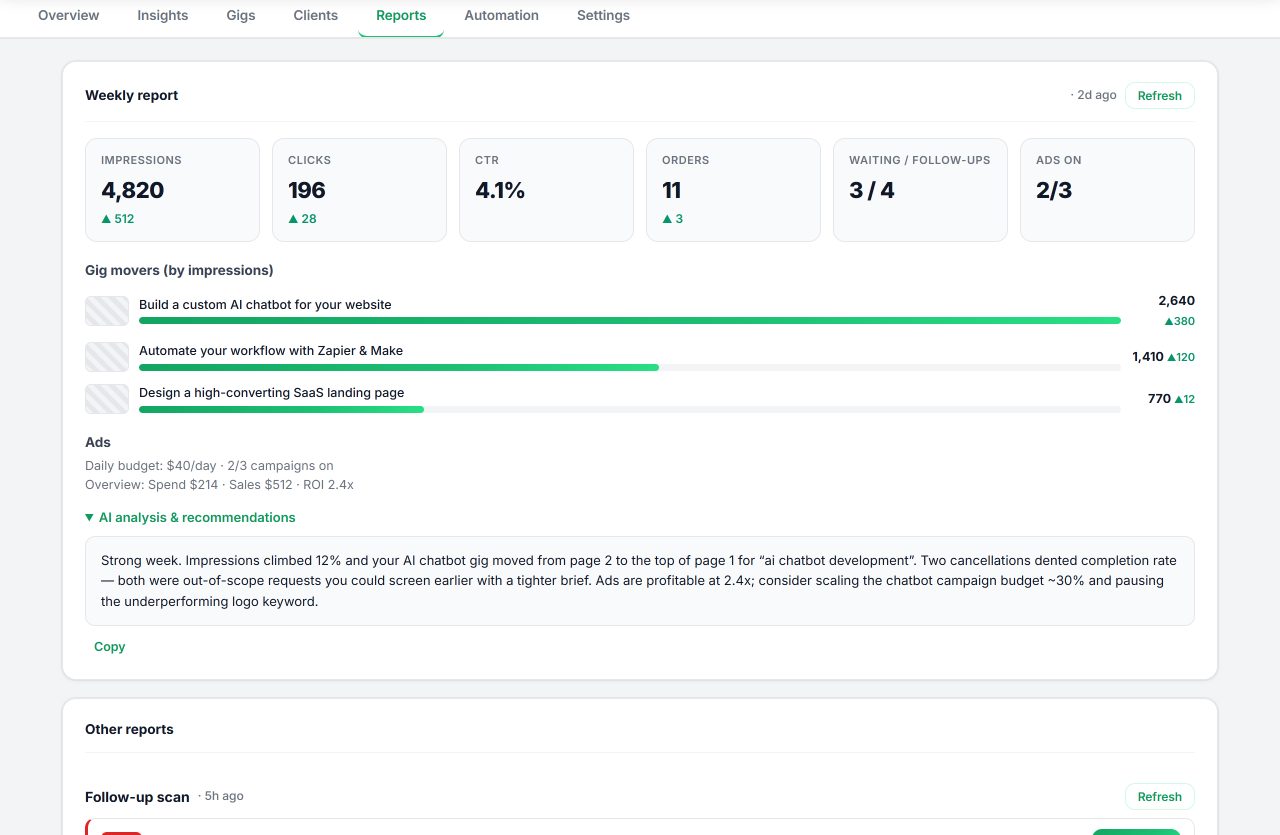
Reports and the action queue keep the read simple: first-time orders, repeat behavior, and the gigs that carry each promotion, all in one place you check after the window closes. The limit is worth repeating: Seller OS does not touch Fiverr's promotion settings, and nothing is published or sent without your review.
Fiverr Promotions Explained for Sellers questions
What are Fiverr Promotions for sellers?
Fiverr's first-time client promotions tool offers an automatic discount to buyers who have never ordered from you. It runs inside Seller Plus under Growth and Marketing, applies only to the gigs you select, and comes with published limits: five active or scheduled promotions, 30 days each, and a monthly order quota.
How many promotions can I run at once?
Fiverr allows five active or scheduled promotions at a time, with only one promotion per gig. The run window is a maximum of 30 days, and the discount applies automatically to qualifying first-time buyers on the gigs you selected. Plan each one as a campaign with a start and an end.
Do Fiverr Promotions stack with seller coupons?
No. Fiverr states clients cannot combine the promotional discount with seller coupons or other special rates. The two tools also interact on your side: orders placed with seller coupons you sent do not count toward your promotion quota. Pick the tool that matches the buyer, coupons for known clients and promotions for new ones.
Are Fiverr Promotions the same as Promoted Gigs?
No. Promoted Gigs is the old name for Fiverr's ads product, now called Fiverr Ads, while Promotions is a first-time client discount tool. Fiverr's legacy marketing pages still use the old name, which keeps the confusion alive. Ads buy placement; promotions reduce the price for eligible new buyers.
Run promotions like campaigns, not prices
Pick one gig, set an end date, and judge it on whether first-time buyers come back.