 Seller OS
Did AI kill UI/UX designers?
No, but generation moved the starting line. A plausible first screen is quick to produce, so teams pay less for a blank-canvas mockup and more for research, flow decisions, accessibility, design systems, and a handoff that survives a real build. The work shifted from drawing screens to deciding what the screens should do.
Free plan available. Local-first data. Human review on every change.
Did AI kill UI/UX design work?
No. It made the first draft nearly free and left the decisions expensive. Anyone can now generate a login screen or a settings page that looks reasonable, which removes the value of drawing those screens and raises the value of knowing whether they solve the right problem.
According to Fiverr's second-quarter 2026 results, published July 29, 2026, the company revised full-year 2026 revenue guidance to $356–372 million (down 17%–14% year over year) and cited “AI-related demand and traffic headwinds” and “persistent weakness across categories most exposed to AI automation.”
Fiverr also said that quarter reflected a strategic shift toward higher-value work, with a proprietary Knowledge Graph deployed live. Product design sits on the higher-value side when the deliverable is a decision or an outcome rather than a picture of a screen.
“While AI absorbs high-volume, low-value, transactional tasks, it is also unlocking the need for longer duration projects where AI tools enhance human expertise, workflow management, and accountability.”
— Micha Kaufman, founder and CEO of Fiverr, second-quarter 2026 results
What AI made fast
First-pass screens, placeholder copy, and the obvious patterns are fast now. Generation is strongest where convention already exists: a pricing table, a settings list, a signup form, a dashboard card. Those screens were never the hard part of product work; they were the visible part.
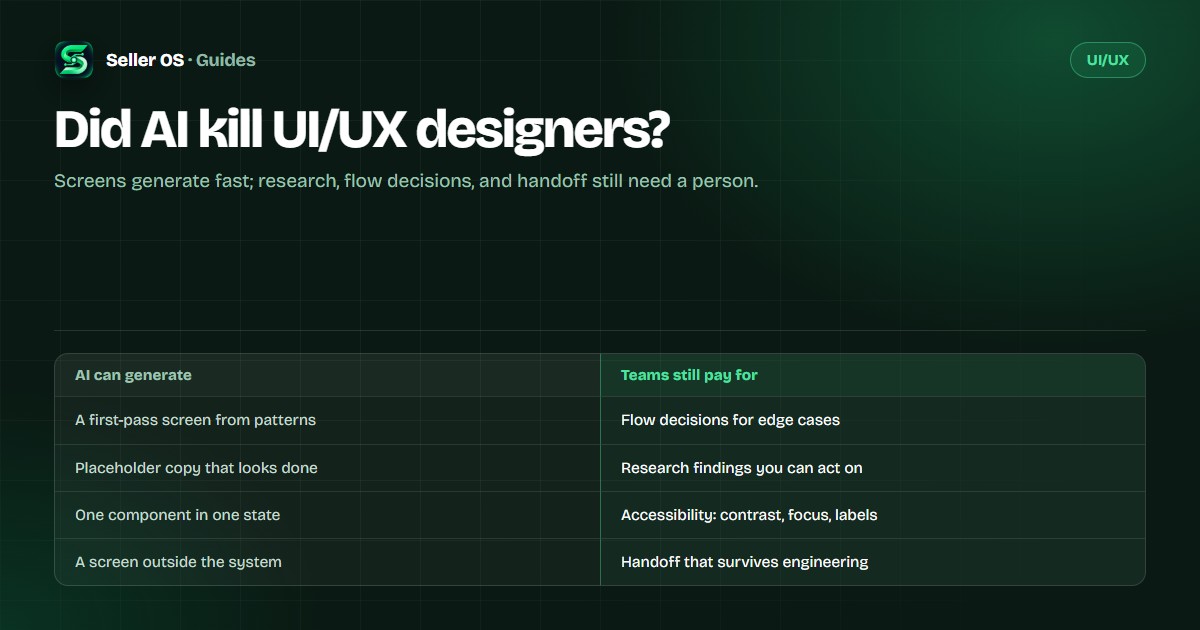
The commodity you are competing with is a screenshot that looks finished. The table below sorts what generation covers from what a product team still hires for.
| AI can generate | Teams still pay for |
|---|---|
| A first-pass screen that follows common patterns | Flow decisions that account for edge cases and failure states |
| Placeholder copy that looks finished | Research with real users and findings you can act on |
| One component that looks right in a single state | Accessibility work: contrast, focus order, labels, and keyboard paths |
| A screen that lives outside the design system | A handoff that fits the system and survives engineering |
What product teams still pay for
Research, flow and edge-case decisions, accessibility, design systems, handoff, and iteration from real usage still get budget. Every item on that list needs someone who can defend a choice after users touch the product.
Accessibility is a clear example. Contrast, focus order, labels, and keyboard paths are requirements rather than decoration, and a generated screen usually misses them. Design systems work the same way: a component that looks right in one state still has to behave in loading, error, and empty states.
Fiverr services that still sell
UX audits, landing-page critiques, design-system setup, file cleanup, and prototype-to-handoff packages still sell, because each one ends in decisions a team can act on.
Picture a buyer who sends a generated screen and writes: “Make it better.” The weak reply is a new screenshot. The strong reply turns the request into a decision: “I will audit the signup flow, list the three points where users drop, and deliver annotated screens plus a prioritized fix list.” That reply names the outcome, the artifact, and the order of work.
If the audit is priced at $300, the 20% Fiverr fee leaves $240. Price the decision work on its own line instead of folding it into a screen-redesign package, and the number stops looking expensive next to a generated mockup.
Position the gig around decisions
Write the promise as a decision or an outcome, not an artifact. Buyers searching for a screen can generate one; buyers searching for fewer signup drop-offs need a person who can find and fix them.
That changes the gig title, the packages, and the proof. A title like “I will run a UX audit of your web app flow and deliver a prioritized fix list” sets a scope you can price, and before-and-after notes from real projects show the reasoning that a generated screen cannot demonstrate.
Working with AI output honestly
Use generation for exploration, then put human review between the output and the delivery. Generated flow suggestions need a check against real constraints: platform conventions, input states, errors, and the way the team builds.
Keep client-confidential material out of third-party tools, verify the rights and terms for anything you ship, and disclose generated elements when the client's rules call for it. For a specific project with unclear rights, consult a qualified professional.
The honest limit
Some screen work is permanently cheaper now, and no repositioning changes that. Teams decide what they need, and a buyer who wants a quick visual for an internal discussion may not pay for a research-backed flow.
Fiverr controls search and ranking, so a sharper gig still competes for attention, and nothing here guarantees orders. Review any AI output before it reaches a client; the responsibility for what ships stays with you.
Where Seller OS helps
The Gig Builder turns an idea you describe or a competitor URL you point it at into a full gig draft: title, tags, description, packages, and FAQ fields, written into the wizard for you. For a UX offer, edit the draft so the promise names the decision you make, not the screen you draw.
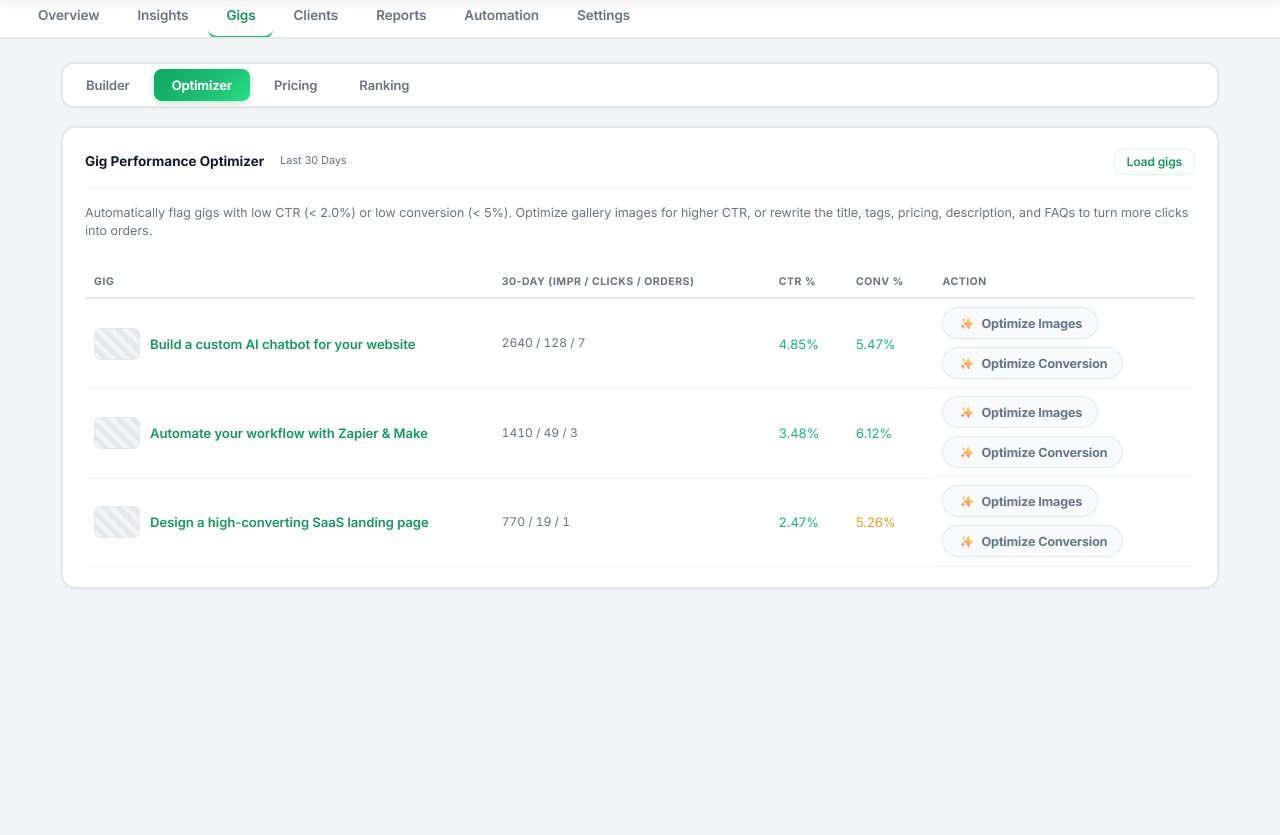
The Gig Performance Optimizer then audits a live gig against its own impressions, clicks, and conversions, so the new positioning gets measured instead of assumed. Seller OS drafts and fills; you perform Save, Continue, and Publish. Nothing runs automatically, and monitors run only while Chrome is open.
Sources
The market figures and the executive quotation on this page come from Fiverr's own reporting.
- Fiverr second-quarter 2026 results — published July 29, 2026.
The 20% seller fee mentioned above is Fiverr's published platform fee; confirm the current terms in your dashboard and in Fiverr's help center.
UI/UX design and AI questions
Did AI make UI and UX designers obsolete?
No, it changed the starting point. A plausible first screen is cheap to produce, so the paid work moved to research, flow and edge-case decisions, accessibility, design systems, and handoff that holds up in a real build.
What UI and UX services still sell on Fiverr?
Audits, landing-page critiques, design-system setup, file cleanup, and prototype-to-handoff packages. Each one ends in decisions a team can act on, which is what a generated screen cannot provide on its own.
How do I describe AI skills without sounding like every other gig?
Describe the decisions you make, not the tools you open. A promise like “I will audit your signup flow, find where users drop, and deliver a prioritized fix list” tells a buyer what changes after they hire you.
Who owns the copyright of an AI-generated screen?
Ownership rules vary by tool terms, jurisdiction, and how much human work went into the result. Check the terms for the assets you ship, keep confidential client material out of third-party tools, and consult a qualified professional for a specific project.
Sell decisions, not screenshots.
Draft the offer, keep the human handoff, and publish it yourself.