 Seller OS
Did AI kill graphic designers?
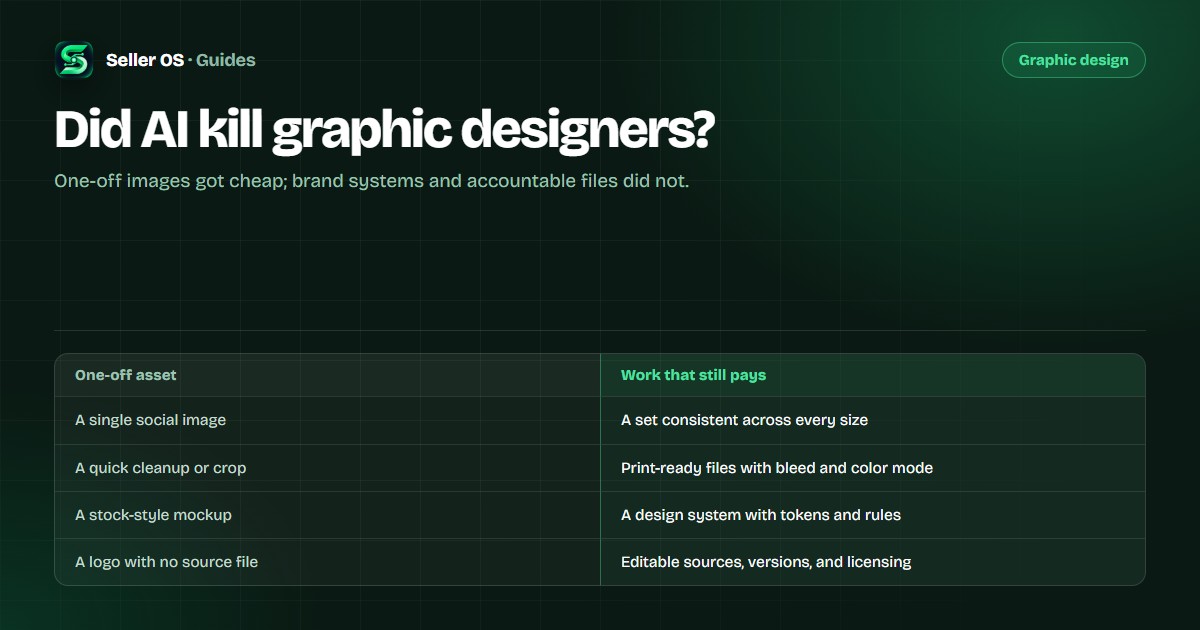
No, but it repriced the work. Generation made single images and quick edits cheap, while brand systems, print-ready files, typography decisions, and accountability stayed human. Sellers who still quote one image at a time compete with the cheapest layer of the market; sellers who sell consistency do not.
Free plan available. Local-first data. Human review on every change.
Did AI kill graphic design work?
No. It repriced the work by collapsing the cost of a single image and leaving the system around that image untouched. A logo, a layout, or a mockup can now be generated in seconds, which shows that the file alone was never the valuable part of a good design job.
According to Fiverr's second-quarter 2026 results, published July 29, 2026, the company revised full-year 2026 revenue guidance to $356–372 million (down 17%–14% year over year) and cited “AI-related demand and traffic headwinds” and “persistent weakness across categories most exposed to AI automation.”
Fiverr also said that quarter reflected a strategic shift toward higher-value work, with a proprietary Knowledge Graph deployed live. For designers, the practical reading is that buyers still pay for decisions and production, and increasingly not for a standalone picture.
“While AI absorbs high-volume, low-value, transactional tasks, it is also unlocking the need for longer duration projects where AI tools enhance human expertise, workflow management, and accountability.”
— Micha Kaufman, founder and CEO of Fiverr, second-quarter 2026 results
What became commodity work
Single assets and quick edits are the commodity layer: one social image, a simple mockup, a background cleanup, a logo exported with no source file. Buyers can generate or approximate those without hiring, and the price they expect reflects it.
Sort your service menu with the same question a buyer asks: is this one file, or a set of rules that has to stay consistent? The table below maps the split.
| One-off asset | Design work that still pays |
|---|---|
| A single social image with no brand file | A set that keeps a campaign consistent across sizes |
| A quick background cleanup or crop | Print-ready files with bleed, crop marks, and the right color mode |
| A stock-style mockup for a pitch | A design system with a type scale, color tokens, and usage rules |
| A logo exported with no source file | Editable source files, versions, and licensing the client can use |
What clients still pay designers for
Brand systems and consistency, print-ready and source files, typography and accessibility, revisions, licensing, and art direction over generated output all still get paid for. Each one includes a decision that has to survive contact with the real world.
Compare two offers. “One social image” is a file. “A launch kit: three post sizes, one story set, editable source files, and a one-page usage sheet” is a system, and the second offer gives the buyer something to reuse after the launch.
Price the reusable parts. If the kit is priced at $400, the 20% Fiverr fee leaves $320; if you bundle a single image into the same order for free, you have discounted the part that still competes on judgment rather than speed.
How to reposition your gig
Sell systems and audits instead of single images. An audit that checks a brand for consistency across ten touchpoints, a file cleanup that standardizes print production, or a template system a small team can maintain all answer a problem generation cannot name on its own.
Write the promise as the change the buyer gets. “I will design a small brand system with logo files, a type scale, and social templates” is a different sale from “I will make you a logo,” and it gives the packages room for discovery, production, and revisions.
Rules for an AI-assisted design workflow
Use AI where it speeds up exploration and keep the accountability human. That one rule covers most of the workflow questions designers ask.
Verify the rights on every asset you ship, and check the terms for the account you used. Never upload client-confidential material to a third-party tool, and disclose generated elements when the client's rules call for it. Before delivery, inspect the file at full size, in the final color mode, and with the fonts actually embedded; an image that looks right in a preview can fail in print. For license questions, ask a qualified professional.
The honest limit
Some one-off work is permanently cheaper now, and no repackaging brings that price back. Clients decide what they need, and a buyer who wants a single image for a personal post may not value a system at all.
Fiverr controls search and ranking, so a better-positioned gig still competes for attention, and nothing here guarantees orders. Review any AI output before it leaves your hands; the responsibility for what ships stays with you.
Where Seller OS helps
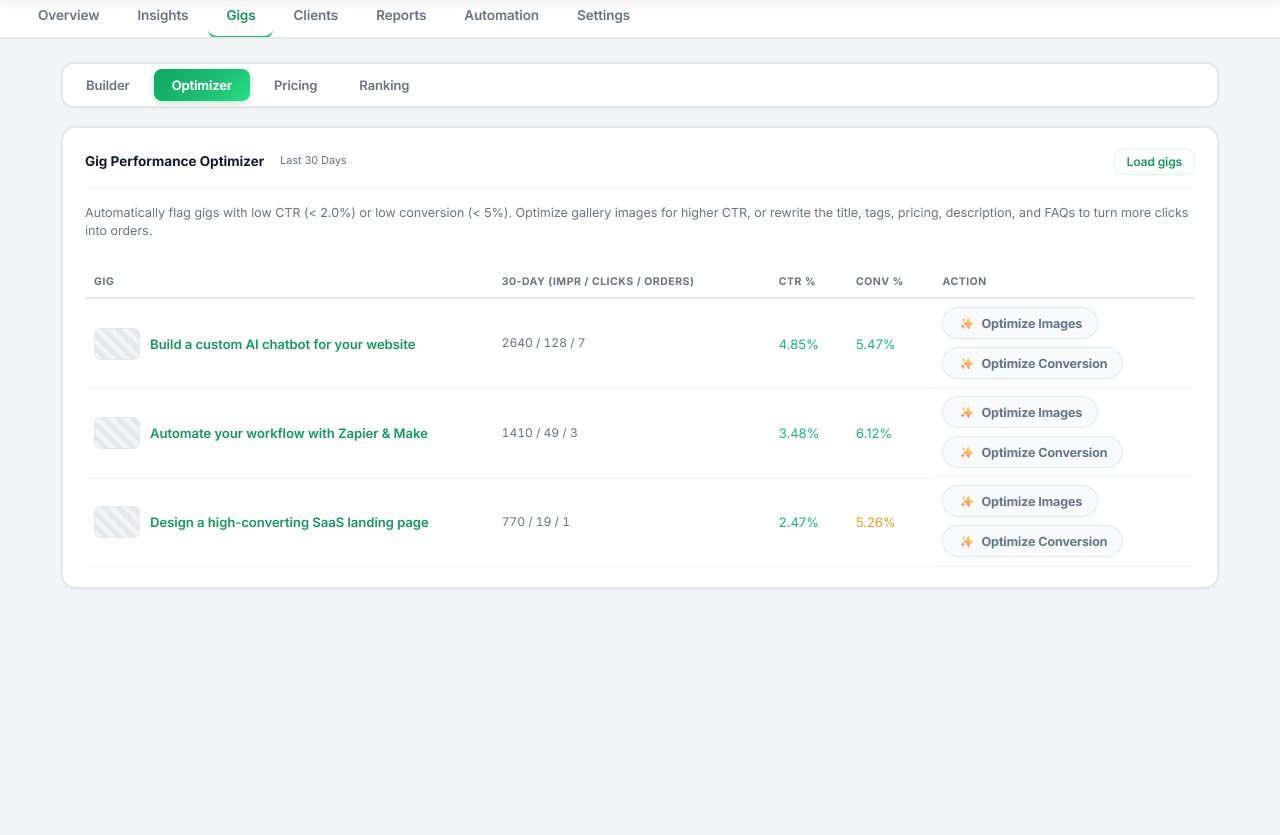
The Gig Performance Optimizer audits a live gig against its own impressions, clicks, and conversions, shows which stage is losing buyers, and keeps a history of the changes you applied. For a service menu being repriced around systems, that history is how you learn whether the new promise lands.
Seller OS drafts and fills; you perform Save, Continue, and Publish. Nothing publishes on its own, monitors run only while Chrome is open, and the pricing review adds profit guardrails with a recent-price write guard when you rebuild packages.
Sources
The market figures and the executive quotation on this page come from Fiverr's own reporting.
- Fiverr second-quarter 2026 results — published July 29, 2026.
The 20% seller fee mentioned above is Fiverr's published platform fee; confirm the current terms in your dashboard and in Fiverr's help center.
Graphic design and AI questions
Is graphic design still worth offering on Fiverr in 2026?
Yes, when the offer covers a system rather than a single asset. Brand kits, print production, template sets, and design audits still sell because they need decisions, files, and a person accountable for the outcome.
Should I tell clients when I use AI in a design project?
Follow the client's rules and the platform's requirements, and never present generated assets as something you drew by hand. If AI helps you explore options, tell the buyer what you used, and keep the final direction, type, and production work your own.
How do I price a brand system instead of a single image?
Price the scope: discovery, direction, file production, and revisions. The client is paying for rules they can reuse, so count the reusable parts rather than the number of exported images. Check the net amount after the 20% Fiverr fee before publishing the package.
Can I use AI-generated images in client work?
Rights depend on the tool's terms, the client's requirements, and the law where you and the client operate, so check the license for every asset you ship. Keep client-confidential material out of third-party tools, and ask a qualified professional when the rights are unclear.
Sell the system, not the single file.
Audit the gig, rewrite the promise, and publish the change yourself.