 Seller OS
Did AI kill voice over?
No, but the work split in two. Synthetic voices absorbed short, generic, unattended reads, while directed performance, brand tone, character work, and licensed usage still get hired. The commodity end is cheap now; the licensed, directed end still pays.
Free plan available. Local-first data. Human review on every change.
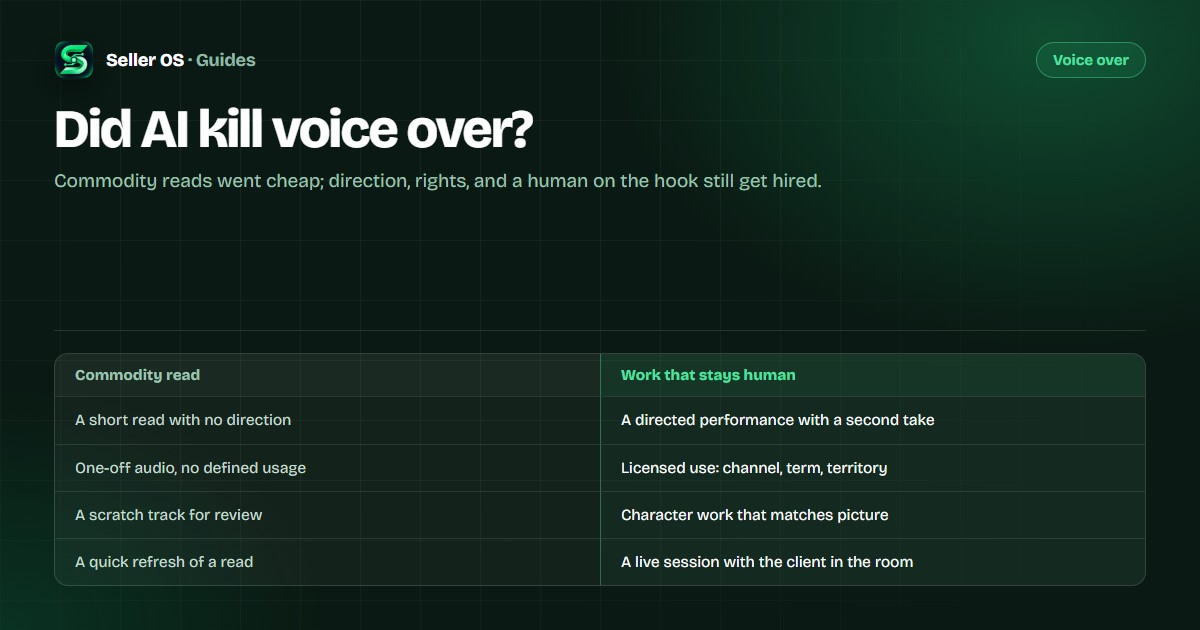
Did AI kill voice over work?
No. It split the work into two markets that share one job title. A short, generic read that a buyer can generate in seconds is a commodity, while a directed performance tied to a brand, a character, or a paid campaign is still a service that people pay for.
According to Fiverr's second-quarter 2026 results, published July 29, 2026, the company revised full-year 2026 revenue guidance to $356–372 million (down 17%–14% year over year) and cited “AI-related demand and traffic headwinds” and “persistent weakness across categories most exposed to AI automation.”
Fiverr also said that quarter reflected a strategic shift toward higher-value work, with a proprietary Knowledge Graph deployed live. The direction of travel matters more than any single category: transactional volume weakens, and longer, more accountable projects hold.
“While AI absorbs high-volume, low-value, transactional tasks, it is also unlocking the need for longer duration projects where AI tools enhance human expertise, workflow management, and accountability.”
— Micha Kaufman, founder and CEO of Fiverr, second-quarter 2026 results
What AI made cheap
Short, generic, unattended reads became commodity work. If the script is plain, the usage is unclear, and nobody will direct a second take, a synthetic voice often serves the buyer's purpose, and the job stops being a job.
That is not a reason to claim the audio is bad. The honest move is to stop competing for work that no longer needs a performer and to name the work that does. The table below is a useful sorting exercise for a service menu.
| Commodity read | Work that stays human |
|---|---|
| A short, generic read with no direction | A directed performance with tone notes and a second take |
| One-off audio with no defined usage | Licensed use with named channels, term, and territory |
| A placeholder scratch track for internal review | Character and animation work that has to match picture and pacing |
| A quick refresh of a read you already own | A live or directed session with the client in the room |
What still gets hired
Directed performance, brand tone, character and animation work, revisions, licensed usage, and live or directed sessions still hire humans. Each one needs a person who can take a brief, adjust on notes, and carry responsibility for the result.
A buyer writes: “We need a warm, confident read for a 90-second product film, and we will run it on paid social for six months.” That message asks for two things a generator cannot sign off on: a performance that matches a brand, and a usage grant with a channel and a term.
Treat the read and the rights as separate lines. If the base recording is priced at $200 and the paid-social tier adds another $150, the 20% Fiverr fee leaves $280 on a $350 order. Run that arithmetic before you quote, because the gross number is not the number you keep.
Where the money moved
The money moved from raw audio toward rights and direction. Buyers can generate a voice; what they cannot generate is a clear license, a second take that fixes a pronunciation, or an artist who joins a session and takes notes.
When you quote, separate the performance from the usage. Define channels, term, and territory inside the package. A tier that grants paid media for a year is a different product from an organic-only read, and pricing them the same gives away the part that still holds value.
What to change in your gigs
Rewrite the gig so a buyer sees direction, rights, and proof before they message you. The service is the decision layer, and the packages should read that way.
Lead with an outcome instead of a voice type. “I will record a directed explainer voice over with commercial usage options” tells a buyer what they get and starts the licensing conversation early. Then show range with three short samples that demonstrate tone shifts, not three readings of the same sentence.
Ask for what you need in the requirements: the script, pronunciation notes, the intended channel, and the campaign length. Repeat clients will send all four without being asked, and those are the buyers who make the directed end of the market worth serving.
The honest limit
Some reads are permanently cheaper now, and no repositioning changes that. Buyers decide what they need, and a client with a plain script and no usage requirements may choose a generated voice every time.
Fiverr controls search and ranking, so nothing here guarantees orders, and any AI output you use in your own workflow needs a human check before delivery. Repositioning improves the odds of being considered; it does not promise a result.
Where Seller OS helps
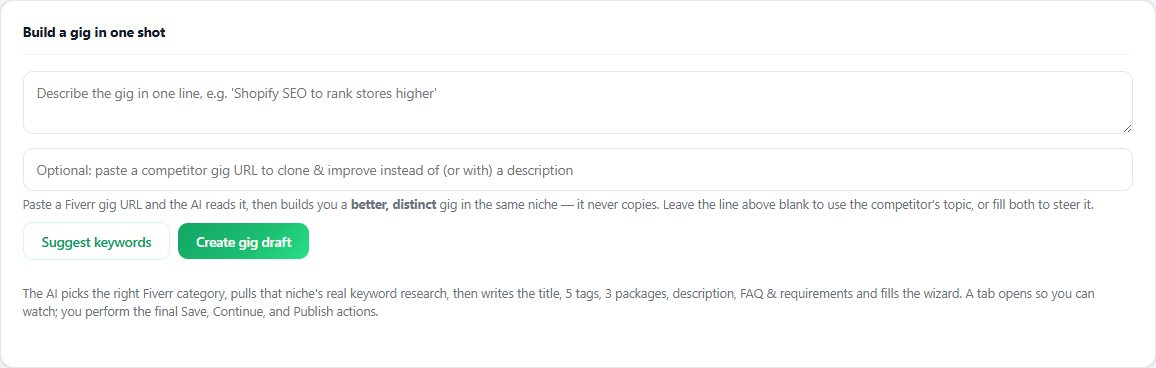
The Gig Builder turns an idea you describe or a competitor URL you point it at into a full gig draft: title, tags, description, packages, and FAQ fields, written into the wizard for you. That makes repricing around usage tiers a deliberate edit instead of a fresh start.
Seller OS drafts and fills; you perform Save, Continue, and Publish. Nothing runs automatically, monitors run only while Chrome is open, and the pricing review keeps a profit guardrail with a recent-price write guard, which matters when you rebuild packages around rights.
Sources
The market figures and the executive quotation on this page come from Fiverr's own reporting.
- Fiverr second-quarter 2026 results — published July 29, 2026.
The 20% seller fee mentioned above is Fiverr's published platform fee; confirm the current terms in your dashboard and in Fiverr's help center.
Voice over and AI questions
Will AI voices replace voice over artists?
They already replaced short, generic, unattended reads, and those jobs are unlikely to return at the old price. Directed performance, brand voice, character work, and licensed commercial usage still need a person who can be briefed, take notes, and carry responsibility for the result.
Do I need to disclose that I use AI in my workflow?
Ask what the client expects before you deliver. If the order is a human performance, keep the performance human and use AI only for tasks that do not change it, such as tidying a rough edit. If a buyer's rules require disclosure, say plainly what you used and where.
How should I price usage rights on a voice over gig?
Separate the recording from the license. Define the channel, the term, and the territory in the package, price each tier in the same order, and run the total through the 20% Fiverr fee so you are agreeing to the net amount rather than the headline price.
Can I win voice over work without a professional studio?
A treated room and a consistent setup carry many directed reads, and buyers can hear the difference between a clean take and a noisy one. What no setup replaces is the person who takes direction, fixes a mispronunciation, and stands behind the delivery.
Sell the work AI cannot sign off on.
Draft a gig around direction and rights, then publish it yourself.