 Seller OS
Follow-up timing rules for Fiverr buyers
Most follow-ups fail on timing, not wording. A message one hour after a quote reads as pressure; the same message two business days later reads as attention. The difference is not effort, it is the clock, and the clock can be set in advance.
This guide gives timing rules for the three moments that matter, a template for each, and the stop rules that decide when to stop. It is a companion to the buyer follow-up guide, which covers what to say at each moment; this page covers when.
Free plan available. Local-first data. Human review on every change.
Timing is the variable you control
You cannot control whether a buyer replies, but you control when you send. That makes timing the one lever worth optimizing. The rule that covers most cases: one follow-up per moment, and every follow-up carries something new, a date, a file, an option, or a reason to decide.
Decide the stop rule before you send the first message, not after the third. A stop rule is a number and a condition, such as two messages after a quote or one nudge after delivery. Once it is reached, you close the loop in your own records and leave the thread open.
- One follow-up per moment unless something genuinely changed.
- Business days, not calendar days, when you count a wait.
- A new piece of information in every message.
- A stop rule you chose before you started.
Before an order: question today, quote in two days
There are two pre-order moments. If the buyer asked you a question, your reply is the follow-up and it should go out the same day, ideally with one question back to move the project forward. If you sent a custom offer, give it room: two or three business days is the natural window, because a quote is a decision, not a task.
Count in the buyer's working hours, not yours. A nudge that lands at 2 a.m. their time waits until morning anyway, so line it up with when they are likely to read it. One reminder only, and make it useful: availability, a smaller option, or a deadline that matters to their project.
There is one hard limit on this moment. You cannot initiate contact with new clients, so a follow-up only fits inside a conversation the buyer already started. Replying to a quote that went quiet is fine; messaging a stranger is not.
After delivery: confirm on day one
Delivery is not the end of the conversation. Send one short message the day you deliver: confirm where the files are and ask whether anything needs a small fix before use. Keep it about the work, not the rating, because a check on quality is service and a request for stars is a chase.
The platform then runs its own clock. On a standard or hourly order the client has a short review period before the order completes automatically, with longer periods for milestone and shipping orders. Silence is not a problem here; the order finishes on its own, so there is no reason to keep messaging.
Review nudges: once, and near the close
A review nudge is the most overused follow-up, and the easiest to get wrong. The buyer can leave a review within a set window after delivery, and that window is finite. If you are going to nudge at all, do it once, and do it as the window is closing rather than the hour after delivery.
Frame it as a last touch, not a request. A short line that the window is closing and that a note helps other buyers decide is honest and low-pressure. Never tie a review to a discount, a refund, or a future favor, and never send a second nudge if the first is ignored.
There is a real strategic reason for restraint. Reviews are voluntary and the orders without reviews guide explains how to earn one without chasing it, while one awkward nudge can cost the repeat order a good first order would have earned.
Three templates with the timing built in
Templates work best when the clock is part of the copy. These are labeled hypothetical; the structure is the lesson.
Pre-order, sent two business days after a quote: A quick note on the offer I sent Tuesday. I have a slot open next week, so approving by Thursday keeps the first draft in seven days. If budget is the sticking point, reply and I will send a smaller version.
Review nudge, sent near the window close: Thanks again for the project. If you have a moment before the review window closes, a short note helps other buyers know what to expect. No pressure either way.
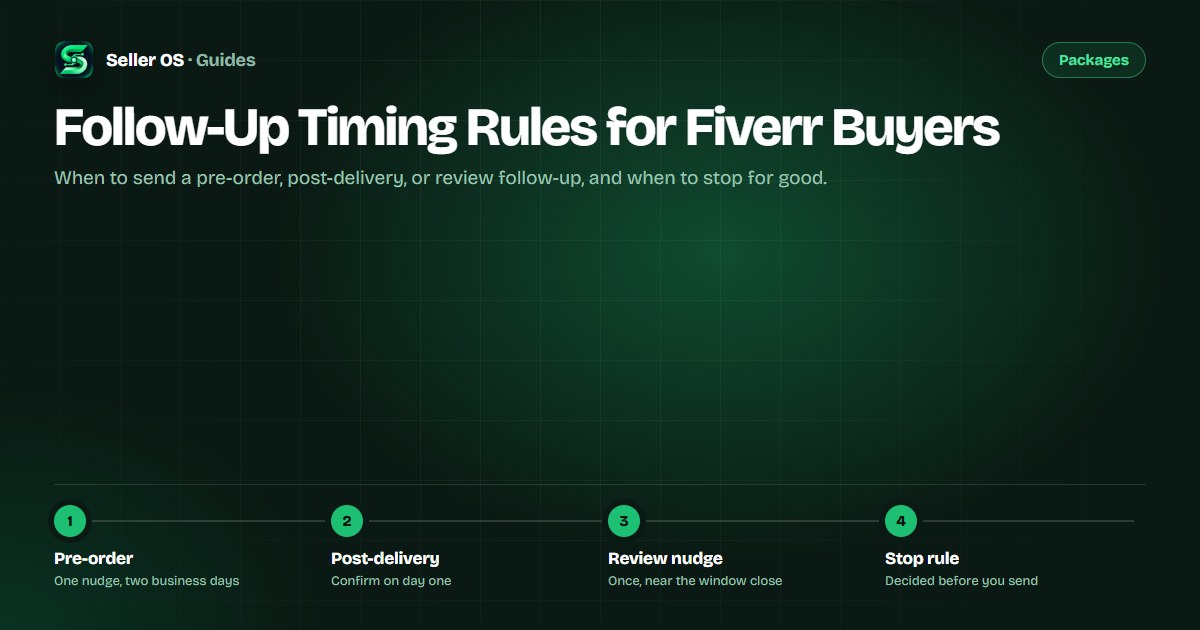
Pre-order
two business days after a quote, with a new reason.
Post-delivery
day one, a confirmation and a fix question.
Review nudge
once, as the window closes, framed as a last touch.
The stop rules, and why they help
A stop rule is not a defeat; it is what separates follow-up from chasing. When you reach it, the next message from you should carry a new reason, not a repeat of the last one. That keeps the relationship intact for the repeat client effort later.
The table below is practical guidance, not a platform rule. Adapt the numbers to your category and to the buyer's own cycle, then hold to them.
| Moment | Wait | Stop after | Include |
|---|---|---|---|
| Question waiting on you | Same day | One reply | The answer plus one question |
| Quote sent | 2-3 business days | Two messages | A new reason to decide |
| After delivery | Day one | One message | A fix check, then a next step |
| Review nudge | Near window close | One message | A low-pressure last touch |
Where Seller OS helps
Good timing needs memory, and Seller OS keeps it locally. Client records hold notes, order history, and the last conversation, so a re-engagement message starts from what you actually did together rather than from re-reading an old thread. The inbox assistant can draft the message; you edit and send it yourself.
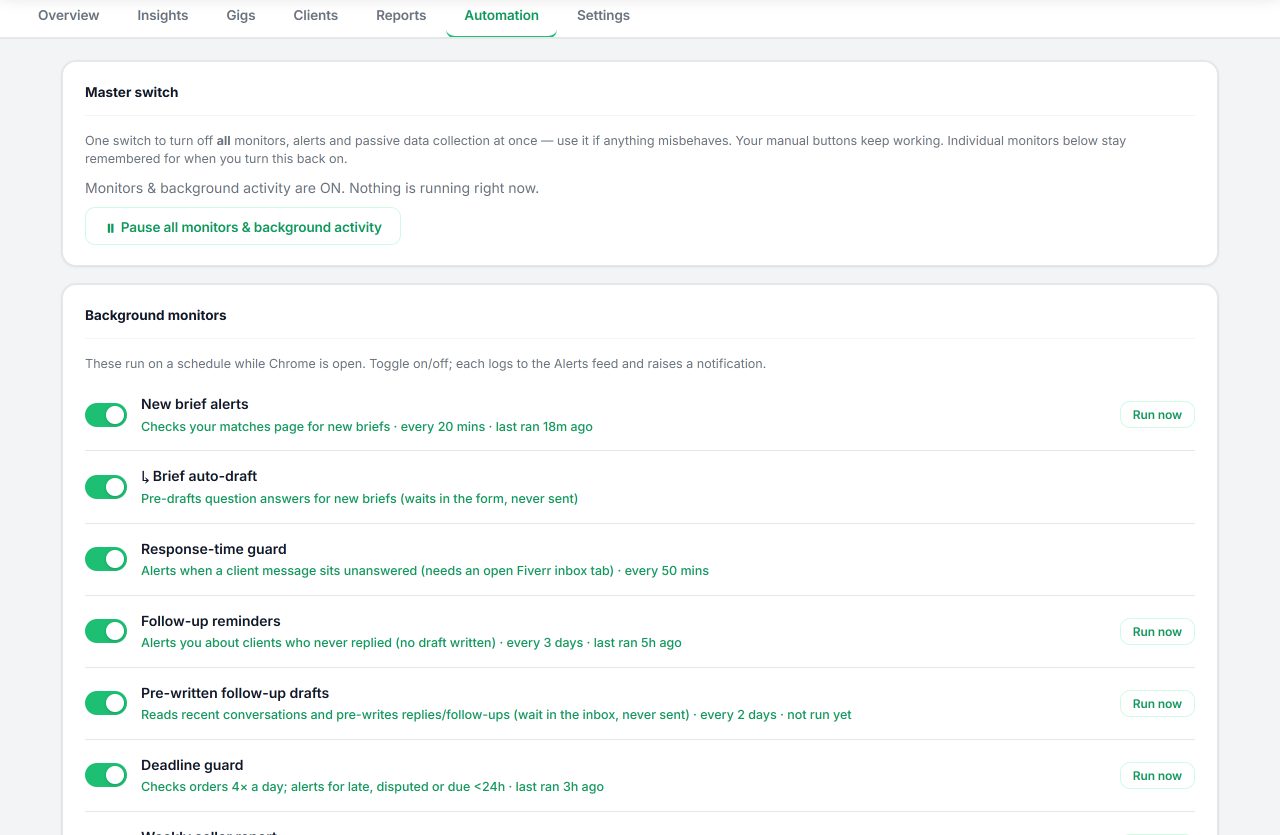
On Pro, monitors flag unread messages and approaching order deadlines while Chrome is open, which is when a reply window can quietly close. The extension never messages buyers on its own and never schedules sends, so every follow-up still leaves from your hand.
Follow-Up Timing Rules for Fiverr Buyers questions
How soon should I follow up with a Fiverr buyer?
It depends on the moment. Answer a buyer's question the same day. Wait two or three business days after sending a quote so the buyer has room to think. Confirm a delivery on day one, and send any review nudge once, near the close of the review window rather than the hour after delivery.
How many times should I follow up with a Fiverr buyer?
One follow-up per moment is the practical ceiling: one nudge after a quote, one message after delivery, one review nudge, and one re-engagement per quarter at most. Each message should carry something new. When your stop rule is reached, leave the thread open and move on to buyers who are answering.
Should I ask a Fiverr buyer for a review?
You can, once, and only as the review window closes. Frame it as a last touch rather than a request, and never tie it to a discount, a refund, or a future favor. Reviews are voluntary, and a repeat order from a happy buyer is worth more than a nudge that reads as pressure.
Why count follow-ups in business days?
Business days match how buyers experience a wait. Two calendar days that include a weekend feel like no time at all, while two business days give a real decision window. Line the send up with the buyer's working hours too, since a message that lands overnight simply waits until morning anyway.
Send on a clock, stop on a rule.
Pick the moment, add one new reason, and decide your stop rule before the first message goes out.